Posted in gnosticism, gnostics, neo-gnosticism

When our worship gets misdirected

By Elizabeth Prata

Paul spoke against the worship of angels in Colossians 2.

There are 6 main elements that Paul refutes in Colossians-
1. secret knowledge, (refuted in Col 1:27; 2:3)
2. asceticism, (Col 2:18)
3. depreciation of Christ (lowering Him in name and in glory), (Col 2:18b)
4. strict rule-keeping, ceremonies, or rituals (Col 2:23)
5. worship of angels, (Col 2:18)
6. and reliance on human wisdom and traditions (Col 2:20b-22)

One way to depreciate Jesus, the SOLE arbiter and dispenser of Truth, is to encourage people to shift their gaze to angels instead. (Like the Catholics want you to look at Mary, not Jesus). Anything to move Him to second place.

There is a reason that “voluntary humility” is followed by “worship of angels.” Here is a comment on Colossians 2:18 from Ellicott’s Commentary for English Readers:

Worshipping of angels.—This is closely connected with the “voluntary humility” above “that we must be brought near by angels and not by Christ, for that were too high a thing for us” (Chrysostom).

Everything old is new again, and elements of it are infiltrating everywhere today. It is a practice/philosophy that wants the adherent to look within herself for truth. “Follow your heart”, “The truth is in you”, “Be true to yourself” and something we hear a lot today, “MY truth”, and so on.

In refuting the false doctrines that had infiltrated the church at Colossae, Paul wrote:

Do not let anyone who delights in false humility and the worship of angels disqualify you for the prize.” (Colossians 2:18a).

At the core of Gnosticism is the belief that knowledge, typically secret knowledge – knowledge from angels, from the stars and planets, from the ancients – was the path to holiness and salvation,” David Grabbe wrote in Forerunner Commentary.

Paul warned about this again in Galatians 1:8, writing, “But though we, or an angel from heaven, preach any other gospel unto you than that which we have preached unto you, let him be accursed.

How many false religions were started by or are perpetuated by a fallen angel? Most. Mormonism, Islam, Seventh Day Adventists, and Jehovah’s Witnesses were started via “angels”, and Catholicism and New Age Mysticism make heavy use of angelic visits though angelic-seeming spirit guides, saint worship, and Marian apparitions. Many New Age sects began through the contact of “Spirit Guides”.

Why be so (falsely) humble? Because that way, neo-Gnostics can appear to be pious and make up their own rules at the same time. They say, “I’m too humble to know God’s word for sure, but THIS I know for sure, I was visited by an angel who showed me … And I know it’s true because it happened to me!” This aspect of neo-Gnosticism is re-emerging today in increasing amounts. Many are straying away from God’s word and substituting mystical experiences and intuition for truth.

Mike Ratliffe wrote, “These reactions are rooted in the “Hermeneutic of Humility,” which is a way of looking at our faith and interpreting the very Word of God through a filter that sees certainty as a product of pride and uncertainty as a virtue. … people contend that to be certain divides people while uncertainty creates an environment of unity. I contend that the “Hermeneutic of Humility” is that decaying point from which the godlessness in these days has become so manifest in the visible church in our time.”

Now, angels are not divine and worship of them is explicitly prohibited (as in Col. 2:18; Rev. 19:10; 22:9).

Heresy doesn’t always mean that a sect or a doctrine denies Jesus outright. The most successful sects and heretics preach Jesus, but they preach a different Jesus. They say that more must be done to attain salvation, that Jesus isn’t sufficient. They chip away at His sovereignty and slowly build man up as a partner on the sanctification process. Did you ever wonder why the verse in Acts 1:11 says, “Which also said, Ye men of Galilee, why stand ye gazing up into heaven? this same Jesus, which is taken up from you into heaven, shall so come in like manner as ye have seen him go into heaven.”

Paul referred to a Gnostic’s false humility. A false humility goes something like this: “‘so humble unworthy me can’t think of worshiping a Holy God. I’ll worship this angel instead.” But what is true humility? One can find a definition at Christian Research and Apologetics Ministry (CARM):

“Humility is the right understanding of who you are before God. Notice, I did not say it means that you have to hate yourself, or call yourself names, or say you aren’t worth anything, etc. Humility is that quality of a Christian that demonstrates a right relationship and position before God. This demonstration is manifested in attitude, words, and deeds.”

Paul referred to real humility in Colossians 3:12- “Put on then, as God’s chosen ones, holy and beloved, compassionate hearts, kindness, humility, meekness, and patience,” and the word for humility is translated “lowliness of mind.” Quite the opposite of the Gnostic’s puffed up sense of self and the high importance he places on his visions and experiences and knowledge!

——————

Gnostic buzzwords to watch out for,
–“received” as in ‘received a text’, ‘received a revelation’,
–ascend, higher, elevation
–spirit guide, spirit being, ascended masters (other terms for false angels and their worship),
–mystery, alchemy, altered states of consciousness,
–elementals (Paul refuted the necessity of seeking elemental forces in Col 2:8)
–new, as in new revelation, new light, new approach, new interpretation. Also, ‘fresh’.

Always look to Jesus. He is the sole source of Truth, Goodness, and Beauty. It all begins and ends with Him. Angels are His servants. Angels are not bringing any further revelation to anyone these days, because the canon is closed. If you think you have been visited by an angel who told you secret things, new things, fresh things, things outside of the Bible, you were visited by a demon.

Posted in gnosticism, gnostics, neo-gnosticism, religious tradition

Gnosticism Part 6, Reliance on Human Wisdom and Traditions

What is the meaning of life? Why am I here? Is there more to life than this? Is there life after death?

These are the eternal questions that man has asked almost from the beginning. That’s because God set eternity in our hearts.

“He has made everything beautiful in its time. Also, he has put eternity into man’s heart, yet so that he cannot find out what God has done from the beginning to the end.” (Ecclesiastes 3:11).

Barnes Notes explains, “God has placed in the inborn constitution of man the capability of conceiving of eternity, the struggle to apprehend the everlasting, the longing after an eternal life.”

This is part 6 looking at the origins of Gnosticism and its impact on today’s church, I will examine the sixth element that Zondervan’s NIV bible lists as the main components of the philosophy/religion: reliance on man’s wisdom and traditions. Though Gnosticism encompasses a wide range of beliefs, there are 6 main elements that Paul refutes in Colossians-

1. secret knowledge, (refuted in Col 1:27; 2:3)
2. asceticism, (Col 2:18)
3. depreciation of Christ (lowering Him in name and in glory), (Col 2:18b)
4. strict rule-keeping, ceremonies, or rituals (Col 2:23)
5. worship of angels, (Col 2:18)
6. and reliance on human wisdom and traditions (Col 2:20b-22)

Paul wrote in Colossians 2:20b-22:
“If with Christ you died to the elemental spirits of the world, why, as if you were still alive in the world, do you submit to regulations— 21“Do not handle, Do not taste, Do not touch” 22 (referring to things that all perish as they are used)—according to human precepts and teachings?”

It is the fact that we ask the eternal questions that unites us as humans. We all feel the need to ask, to find out, to search for meaning above and beyond ourselves. Every human on earth lives in a creation that God made. That He made it is evident. (Romans 1:20). It is the individual’s response to His creation that makes the difference in our eternity.

Romans 1:18-19 discusses the wrath of God against those who see what He has plainly made evident in creation but have suppressed it. However, those who suppress the fact that God revealed Himself plainly, still seek the answers to the eternal questions. So they make up philosophies to satisfy the longing. This is aptly demonstrated in the modern Gnostic’s own words. From Gnosis.org:

“All religious traditions acknowledge that the world is imperfect. Where they differ is in the explanations which they offer to account for this imperfection and in what they suggest might be done about it. Gnostics have their own — perhaps quite startling — view of these matters: they hold that the world is flawed because it was created in a flawed manner.”

The truth is, the world is imperfect because man is imperfect, sinful, as a matter of fact. It was made perfectly and God declared it very good. (Genesis 1:31). Man brought imperfection and thus introduced sin into God’s perfect creation. (Genesis 3:14-19.) But when a religion or a philosophy suppresses that fact, people seek that answer elsewhere as to why things are so messed up. Since they do not understand that they themselves are imperfect, they decide the world must be the problem.

That is why the Gnostics’ philosophies are so appealing to man. It is why Gnostic human wisdom and traditions are so readily absorbed by those who suppress the truth of God. It releases them from responsibility. Or they think it does. Yet all humans sin (Romans 3:23) and all will stand before God to give an account. (2 Cor 5:10, Job 34:11, Matthew 16:27…)

Reliance on human wisdom and philosophy is a tremendously appealing method to attempt to find answers to life’s problems. Buddha certainly thought so.

A gnostic belief system with its reliance on human traditions is like trying not to drown by hanging onto a rock.

Mark Fairley is part of the Fuel Project. He finished the “Know Your Enemy” series recently and has begun a second series called “Stay Free”. In the Enemy series, he explored the coming New World Order from a Christian perspective. He looked at the rise of false religions from the Fall to the current time. In his sequel Stay Free series he looks at morality and how society cannot survive without Christ.

In this 13-minute part, the series looks at the rise of Phariseeism. These were the worst of the worst as far as applying rules and traditions to human wisdom, which are no substitute for God. Indeed, even if one does not substitute tradition for God, man-made rules are not even helpful alongside true faith, as Paul wrote in Colossians 2 and as the narrator demonstrates. Reliance on human tradition and rules will only ever get you tangled up:

Stay Free (Part 18 – The Rise of the Pharisees)

John MacArthur preached on this verse in a sermon titled Philosophy or Christ?

Paul said there were two inadequate sources for wisdom, philosophy and vain deceit. (Col 2:8)

“Two inadequate sources: ‑ tradition. It’s always been the case. People have always believed it. You know what that does? That just perpetuates inadequate, depraved human thinking patterns. Tradition doesn’t mean anything. Just because it’s handed down doesn’t mean it’s true. If you’ve got error to start with and hand it down, it doesn’t make it any better than what you started with. Here he’s saying, “Philosophy comes after the tradition of men.” One of the things that’s so interesting and we don’t really have time to develop this … when you study philosophy, almost all philosophers, build on other philosophers.”

“There’s an incredible sequence that flows through the history of philosophy. And one guy goes this far, the next guy chops off a little bit of his philosophy and develops it, and the next guy…so what you have today in philosophy can go all the way back and almost all philosophy finds its roots in Aristotle and Plato. It’s all just a changing and a variation in the flow of the tradition of man. The errors are perpetuated, perpetuated, perpetuated, perpetuated. Look at Judaism. By the time Jesus arrived on the earth, the Jews had built up such a monstrosity of philosophy, such a mess of human wisdom, that they were unable any longer to tell what the traditions of men were and what the Word of God was. … There’s nothing sacred about tradition. It’s just perpetuated human ignorance.” (source)

God warns us against seeking after human wisdom in our own vain deceit: “For it is written, “I will destroy the wisdom of the wise, and the discernment of the discerning I will thwart.” (1 Corinthians 1:19)

Solomon had something to say about that search for wisdom-

“I said in my heart, “I have acquired great wisdom, surpassing all who were over Jerusalem before me, and my heart has had great experience of wisdom and knowledge.” 17And I applied my heart to know wisdom and to know madness and folly. I perceived that this also is but a striving after wind.” (Ecclesiastes 1:16-17).

Matthew Henry says of Solomon’s search for wisdom- “Solomon tried all things, and found them vanity. He found his searches after knowledge weariness, not only to the flesh, but to the mind. The more he saw of the works done under the sun, the more he saw their vanity; and the sight often vexed his spirit. He could neither gain that satisfaction to himself, nor do that good to others, which he expected. Even the pursuit of knowledge and wisdom discovered man’s wickedness and misery; so that the more he knew, the more he saw cause to lament and mourn. Let us learn to hate and fear sin, the cause of all this vanity and misery; to value Christ; to seek rest in the knowledge, love, and service of the Saviour.’

The only hope is Jesus and the only wisdom is His. He has generously made that wisdom available to us in the bible. His death on the cross and gift of grace through salvation makes His wisdom understandable to us. Once we are a born-again believer, we can rely on the Holy Spirit to help us understand it!

Why would we want to rely on our on wisdom when we have perfect truth upon which to lean on? The message doesn’t take 800 Pharisaical rules to apply. There is only this:

Trust in the LORD with all your heart, and do not lean on your own understanding. (Proverbs 3:5)
————–
Gnosticism series:

Introduction
Part 1: Secret Knowledge
Part 2: Asceticism
Part 3: Depreciation of Jesus
Part 4: Ceremonies & Rituals
Part 5: Worship of Angels
Conclusion 

Posted in gnosticism, gnostics, neo-gnosticism

Gnosticism Part 5: Worship of Angels

This is part 5 looking at the origins of Gnosticism and its impact on today’s church, I will examine the fifth element that Zondervan’s NIV bible lists as the main components of the philosophy/religion: Worship of Angels.

Though Gnosticism encompasses a wide range of beliefs, there are 6 main elements that Paul refutes in Colossians-
1. secret knowledge, (refuted in Col 1:27; 2:3)
2. asceticism, (Col 2:18)
3. depreciation of Christ (lowering Him in name and in glory), (Col 2:18b)
4. strict rule-keeping, ceremonies, or rituals (Col 2:23)
5. worship of angels, (Col 2:18)
6. and reliance on human wisdom and traditions (Col 2:20b-22)

“Gnosticism was the predominant source of heresy when the New Testament was written. The books of John, I Corinthians, Galatians, Colossians, I and II Timothy, Jude, and I John all combat various elements of Gnosticism. Even the book of Revelation cites a couple of Gnostic beliefs and practices, referring to “know[ing] the depths of Satan” and “the Nicolaitans” (Revelation 2:6, 15, 24).” (source)

Everything old is new again, and elements of it are infiltrating even the most conservative evangelical, fundamentalist churches today. That’s why I call it “neo-Gnosticism” when referring to the modern version of it.

“Neo-Gnosticism is the philosophy that invites you to search deep inside yourself and discover some exciting things by which you must then live. It is the philosophy which declares that the only real moral imperative is that you should then be true to what you find when you engage in that deep inward search.” source.

In refuting the false doctrines that had infiltrated the church at Colossae, Paul wrote:

“Do not let anyone who delights in false humility and the worship of angels disqualify you for the prize.” (Colossians 2:18a).

Why would Paul combine false humility and worship of angels in the same sentence? It seems like those two warnings are completely disparate. But they aren’t. “Because of the belief that the spirit of a person was trying to get back to heaven, worship of angels and astrology was a common tenet of Gnosticism, since angels and the patterns of stars and planets were believed to hold keys to this spiritual journey. At the core of Gnosticism is the belief that knowledge, typically secret knowledge – knowledge from angels, from the stars and planets, from the ancients – was the path to holiness and salvation,” David Grabbe wrote in Forerunner Commentary.

Paul warned about this again in Galatians 1:8, writing, “But though we, or an angel from heaven, preach any other gospel unto you than that which we have preached unto you, let him be accursed.”

How many false religions were started by or are perpetuated by a fallen angel? Most. Mormonism, Islam, Seventh Day Adventists, and Jehovah’s Witnesses were started via “angels”, and Catholicism and New Age Mysticism make heavy use of angelic visits though angelic-seeming spirit guides and Marian apparitions. Many New Age sects began through the contact of “Spirit Guides”.

Why be so (falsely) humble? Because that way, neo-Gnostics can appear to be pious and make up their own rules at the same time. They say, “I’m too humble to know God’s word for sure, but THIS I know for sure, I was visited by an angel who showed me … And I know it’s true because it happened to me!” This aspect of neo-Gnosticism is re-emerging today in increasing amounts. Many are straying away from God’s word and substituting mystical experiences and intuition for truth.

Mike Ratliffe wrote, “These reactions are rooted in the “Hermeneutic of Humility,” which is a way of looking at our faith and interpreting the very Word of God through a filter that sees certainty as a product of pride and uncertainty as a virtue. … people contend that to be certain divides people while uncertainty creates an environment of unity. I contend that the “Hermeneutic of Humility” is that decaying point from which the godlessness in these days has become so manifest in the visible church in our time. Carefully read the passage (2 Timothy 3:1-5). This is a warning of what happens in the Church when the Christian leaders forsake their true duty, which is to minister according the very clear commandments from God’s Word. When Christian liberalism in any form is embraced by those in control in our churches, the Gospel will be neglected. It will be watered down.”

Now, angels are not divine and worship of them is explicitly prohibited (as in Col. 2:18; Rev. 19:10; 22:9).

Mr Grabbe wrote, “In Genesis 3:1, in this first message to mankind, Satan sows seeds of doubt as to whether God can be trusted. Satan’s very first words were, “Has God indeed said. . . ?” Spoken or not, this sentiment that God is untrustworthy, and that His Word is suspect, has been a regular feature in mankind’s relationship with God ever since. The Gnostics were no exception—in fact, they are a prime example. In its most basic sense, Gnosticism is knowing, but its knowledge, while sometimes including the Word of God, does not have it as its foundation. Instead, more than what was contained in Scripture, Gnostics valued what they experienced, what elders told them, or what they learned from “angels,” astrology, or chemistry (alchemy). Thus, we see elements of Gnosticism in Galatians: a mixture of “lucky days,” to which they ascribed spiritual significance (part of their worship prior to conversion) and a belief, brought in by Judaizers or perhaps even an “angel” (Galatians 1:8), that justification could come by works of the law.”

Heresy doesn’t always mean that a sect or a doctrine denies Jesus outright. The most successful sects and heretics preach Jesus, but they preach a different Jesus. They say that more must be done to attain salvation, that Jesus isn’t sufficient. They chip away at His sovereignty and slowly build man up as a partner on the sanctification process. Did you ever wonder why the verse in Acts 1:11 says, “Which also said, Ye men of Galilee, why stand ye gazing up into heaven? this same Jesus, which is taken up from you into heaven, shall so come in like manner as ye have seen him go into heaven.”

Because if an angel should come and preach a different Jesus, a different Gospel, let him be accursed! We look for, listen to, and worship this same Jesus who came and died and rose again! A Gnostic’s Jesus will be different from the same Jesus who incarnated into flesh, ministered on earth, and died on the cross as God’s sacrifice for sins, and was resurrected on the third day.

Paul referred to a Gnostic’s false humility. A false humility goes something like this: “‘so humble unworthy me can’t think of worshiping a Holy God. I’ll worship this angel instead.” But what is true humility? One can find a definition at Christian Research and Apologetics Ministry (CARM):

“Humility is the right understanding of who you are before God. Notice, I did not say it means that you have to hate yourself, or call yourself names, or say you aren’t worth anything, etc. Humility is that quality of a Christian that demonstrates a right relationship and position before God. This demonstration is manifested in attitude, words, and deeds.”

Paul referred to real humility in Colossians 3:12- “Put on then, as God’s chosen ones, holy and beloved, compassionate hearts, kindness, humility, meekness, and patience,” and the word for humility is translated “lowliness of mind.” Quite the opposite of the Gnostic’s puffed up sense of self and the high importance he places on his visions and experiences and knowledge!

CARM again, “We need to start with our relationship with Him that can only come through a proper relationship with Jesus. We need to be humble before God and dependent up Him, seeking His will. Therefore, prayer, the place of dependence upon God, is the practice of humility before God. When we let our souls bask in the presence of God, we find out who we really are: sinners, saved by grace, and kept by His love. And, as Moses’ face shined because of being in the presence of God, so too will your heart reflect the humility and love of Jesus as we spend time with Him in prayer. Seek Jesus and you will find perfect Humility.”
——————

Gnostic buzzwords to watch out for,
–“received” as in ‘received a text’, ‘received a revelation’,
–ascend,
–spirit guide, spirit being, ascended masters (other terms for false angels and their worship),
–fullness (that is why Paul used fullness in Col 2:9-10),
–mystery, alchemy, altered states of consciousness,
–elementals (Paul refuted the necessity of seeking elemental forces in Col 2:8)

“See to it that no one takes you captive by philosophy and empty deceit, according to human tradition, according to the elemental spirits of the world, and not according to Christ. (Col 2:8)

The Lord Jesus is GREAT! He is mighty to save. I pray for us all “That ye would walk worthy of God, who hath called you unto his kingdom and glory.” (1 Thessalonians 2:12)
———————
Gnosticism series:
Introduction
Part 1: Secret Knowledge
Part 2: Asceticism
Part 3: Depreciation of Jesus
Part 4: Ceremonies & Rituals
Part 5: Worship of Angels
Part 6: Reliance on Human Traditions
Conclusion

Posted in beth moore, bill hybels, gnosticism, gnostics, neo-gnosticism, prophecy, rick warren

Gnosticism Part 4: Ceremonies & Rituals

If you read Colossians, you quickly become aware that Paul was busy refuting some false teachings that had begun to affect the church at Colossae. Epahras had sent Paul a letter about this, and Colossians was Paul’s response. Though Paul never mentioned “Gnosticism” by name, it becomes obvious that’s what he was referring to, because of his use of certain words and phrases.

Gnosticism is less a religion than a loose patchwork of philosophies and doctrines from other religions and disciplines, blended into an amorphous set of beliefs that taint the true faith as delivered by Jesus. There never was a church of Gnostics, or a firm set of Gnostic tenets, just beliefs certain people promoted as a subtle blend of Christianity and good-sounding religious practices from elsewhere, mostly the Eastern mystical religions. But in general, we can list six elements contained in most Gnostic teachings, courtesy of the Zondervan NIV bible, which in turn is based on Paul’s mention of them in Colossians.

1. secret knowledge, (refuted in Col 1:27; 2:3)
2. asceticism, (Col 2:18)
3. depreciation of Christ (lowering Him in name and in glory), (Col 2:18b)
4. strict rule-keeping, ceremonies, or rituals ( Col 2:23)
5. worship of angels, ( Col 2:18)
6. and reliance on human wisdom and traditions (Col 2:20b-22)

When we come through the door of justification, and before we exit life through the door of glorification, we engage in a life-long process of sanctification. This is the work of the Holy Spirit upon us to make us more Christlike and to consecrate us for holy work on earth. “There are many false paradigms of sanctification, and there always have been. The problem is, there is only one method of sanctification and that is through the Spirit. The false paradigms of sanctification cannot restrain the flesh. Though some paradigms or strategies of sanctification purport to restrain the flesh and make one holy, they don’t do that, any more than a false Gospel could save. … [Gnostic/Mysticism] “is the notion that there is within a person a mystical, intuitive capability that causes, if manipulated correctly, a person to rise in spiritual formation”, said John MacArthur, in his new blog series addressing mysticism/gnosticism and spiritual formation, in his part 2 called “Spiritual Formation and Biblical Sanctification.”

BibleGateway summarizes Gnosticism, “The heresy taking root in Colossae was a form of gnosticism, which taught (among other things) that humans could transcend evil and the corruptions of the world through asceticism and their own strength of will. …”

The early church was much plagued by Gnostics throughout the first through third centuries. Colossians and 1 John are the most pointed refutations of this false doctrine, but several other New Testament books dealt with it too, including 1 Timothy 6, Titus, and other books as well.

Gnosticism is a self-centered, and not a Jesus centered doctrine, meaning, they attempt to attain sanctification themselves. They also believe in a progressive sanctification. It was through completion of rituals and participation in ceremonies that Gnostics believed progressed one’s sanctification ever upward. Mormonism, Scientology, and many of the ‘secret societies’ like Odd Fellows, Red Men and Freemasonry have steps for the devotee to attain. Sometimes these steps are called “degrees”, as in Freemasonry. In Scientology they are called “levels”.

Gnostics brought a teaching, but their rituals varied widely, that is, until Aleister Crowley wrote one. Crowley was a British mystic and occultist who, when in Egypt in 1904, “received” a text known as The Book of the Law from what he believed was a divine source. From this basis Crowley built a theology of Gnosticism called Thelema. In 1913, he wrote a Gnostic Mass. The mass contained Crowley’s scripted rituals. Crowley was also a pansexual and a recreational drug user, which may explain his crazy eyes.

Left, Aleister Crowley in ceremonial garb. Wiki source

Crowley explained why he undertook to codify Gnostic teachings into spiritual practices expressed through a ‘mass’. He said in his Confessions, “Human nature demands (in the case of most people) the satisfaction of the religious instinct, and, to very many, this may best be done by ceremonial means. I wished therefore to construct a ritual through which people might enter into ecstasy as they have always done under the influence of appropriate ritual.”

But Paul said, “Therefore do not let anyone judge you by what you eat or drink, or with regard to a religious festival, a New Moon celebration or a Sabbath day.” (Colossians 2:16).

As for ecstasies, “Some charismatic Christians practice ecstatic states (called e.g. “being slain in the Spirit”) and interpret these as given by the Holy Spirit.” 

Since Gnostics deny the sufficiency of Christ’s work on the cross in His flesh, and they deny the Spirit’s work in sanctification, they need these rituals to make themselves thing they are accomplishing their own sanctification. All false religions, including Gnostics, focus on what the individual can do to attain heaven, or a higher consciousness, or transcendence, or any other phrase they claim will be the result of performing a certain ritual. In other words, I can do it, no God needed, thanks.

In Colossians 2:20, Paul exhorted, “If with Christ you died to the elemental spirits of the world, why, as if you were still alive in the world, do you submit to regulations—”

The above verse is explained, “‘Your union with Christ in his death has caused you to die to the rudiments of the world’, meaning, your union with Christ in his death has caused you to be separated from human religion, and human reli­gion is based in legalism and mysticism and self denial and all those works kind of things. But he says the redeemed are set free from self-styled, man made rules designed to make you holy.” (source)

For a pagan, including Gnostics, “salvation is not brought from above to below by divine visitations, but rather occurs through the Gnostic’s contemplative ascent through ever higher levels of the divine realm.”

“One version of a Gnostic ritual or ceremony was marking the various stages of a visionary ascent with certain baptisms, sealings, washings in various “waters.” Another ritual was utilizing a self-performable technique of successive stages of mental detachment from the world of multiplicity, and a corresponding assimilation of the self to the evermore refined levels of being.” You’ll find this is in Roman Catholic asceticism and Buddhism.”

“Other rituals and ceremonies included sexual sacramentalism, verbal performances through ritual speech, which can include glossalalia, traditional verbal formulae, spells, oaths, conjuration, invocations, evocations, voces mysticae, and prayers of various sorts addressed to transcendent powers, good and evil alike, and/or symbolic actions such as a ritual handshake. (source, University Nebraska-Lincoln)

You will note the incipient Gnosticism inherent in the Pentecostal ‘language of tongues’ (glossolalia) and levels of spiritual maturity through having had a “baptism of the Spirit.”

As you read the examples above, perhaps the modern re-emergence of these old Gnostic practices will have already been brought to your mind. The current evangelical craze for contemplative prayer, Lectio Divina, meditation, “Christian yoga“, expressive praise dance & mime performance, labyrinth walking, and becoming detached from the world to await a small voice in which conversations are held with the ‘Divine,’ are now apparent to you in the Gnostic teachings of Beth Moore, Ann Voskamp, Sarah Young, Bill Hybels, Rick Warren, Mark Driscoll, and many others.

The devilish influence of these practices are collectively known as “spiritual formation” and I mentioned them in part 2 four days ago. Since then, John MacArthur has also begun a blog series on spiritual formation and he is defining these false practices, blog by blog, so that the believer can be aware of their evil influence.

In 1932 the Polish cracked the Germans’ war codes. Just weeks before WWII broke out in 1939, they gave the information to the Allies. We called it “The Enigma Machine“. “The intelligence gleaned from this source, codenamed “Ultra” by the British, was a substantial aid to the Allied war effort. The exact influence of Ultra on the course of the war is debated; an oft-repeated assessment is that decryption of German ciphers hastened the end of the European war by two years. Winston Churchill told the United Kingdom’s King George VI after World War II: “It was thanks to Ultra that we won the war.”

You know, Solomon said that there is nothing new under the sun. (Ecclesiastes 1:9). Every false religion can be traced back to the Garden of Eden. Satan’s first words in the bible are recorded as ones which question the sufficiency and accuracy of the information God delivered to humans. He went on to imply that God was holding out on Adam and Eve, (God is a liar) that if Eve performed an action (eat the fruit) she would know as much as God, and that we can be like God. Gnosticism can be traced to those very words. There is no new false doctrine. They are all recycled bits from old satanic lies.

We do not need an enigma machine! We do not need to decipher our enemy’s plans! Why? Because we are not unaware of his schemes! (2 Cor 2:11). God has generously given us His word, inside of which is everything profitable for us (2 Timothy 3:16) to live and work out our salvation in fear and trembling. (Philippians 2:12). He laid out for us that satan is a liar and the father of lies. Under inspiration of the Holy Spirit, the bible is replete with examples of the lies of satan, warnings that he seeks someone to devour, (Luke 22:31; 1 Peter 5:8). He shows us what kind of lies he perpetrates (Genesis 3:1-5, Colossians 1-2; and many other NT books).

If we read the bible diligently we will be solidly infused with His word. Saturate yourself in Truth! When you come across falsity, for example if your church wants to institute contemplative prayer, build a labyrinth,  send you to a yoga workshop, or start a praise dance ministry…you will be able to detect it.

“When the Spirit of truth comes, he will guide you into all the truth, for he will not speak on his own authority, but whatever he hears he will speak, and he will declare to you the things that are to come.” (John 16:13). “He shall not speak of himself means He shall teach nothing contrary to what I have taught you:” we read in Clarke’s Commentary.

Just to reinforce for a moment that there is no new doctrine under the sun, here is the culminating prayer from the 1913 Liber XV Mass that Crowley wrote, which adheres to a position that Gnostics of earlier centuries believed, right down to Paul’s time:

“Lord most secret, bless this spiritual food unto our bodies, bestowing upon us health and wealth and strength and joy and peace, and that fulfilment of will and of love under will that is perpetual happiness.”

It is the Prosperity Gospel!

I am against Expressive, Choreographed Dance in Worship. I do not believe it to be an acceptable form of worship in a service. With that in mind, here is Stephen Colbert in “Just Say No to Liturgical Dance”. He provided his own liturgical dance version of the hymn “King of Glory” on the show Strangers with Candy. I think this shows the ridiculousness of praise dancing. I do not doubt the sincerity of many who perform this kind of dance in church, and I applaud them for wanting to serve Him, but I think it detracts from the fact that we must always keep Jesus as the focus, especially in these Gnostic days.

Gnosticism series:
Introduction
Part 1: Secret Knowledge
Part 2: Asceticism
Part 3: Depreciation of Jesus
Part 4: Ceremonies & Rituals
Part 5: Worship of Angels

Part 6: Human Traditions 
Conclusion 

Posted in gnosticism, gnostics, neo-gnosticism

Gnosticism Part 3: Depreciation of Jesus

In this part of the series on Gnosticism then and now, we’ll look at the third element of this philosophy-slash-religion: a depreciation of Jesus. Though Gnosticism contains many elements, and many other elements from different philosophies and religions overlap with Gnosticism, Zondervan’s NIV Bible lists 6, which are the ones I am looking at:

1. secret knowledge,
2. asceticism,
3. depreciation of Christ (lowering Him in name and in glory),
4. strict rule-keeping, ceremonies, or rituals
5. worship of angels,
6. and reliance on human wisdom and tradition.

The best summary of Gnosticism I’ve found is from Gene Edward Veith. He wrote in World Magazine in this 2006 article The Return of the Cainites, “The Gnostics were eastern mystics who taught that the physical realm is intrinsically evil and that the spirit can be freed from its bondage to physicality through the attainment of secret knowledge (or “gnosis”). They rejected the Christian doctrine of creation (saying that the material world is evil). They denied the incarnation (saying that Christ was a spiritual being who brought the secret knowledge and denying that He became “flesh”). And they denied the redemption (saying that sin is not a moral failure – since what we do in the flesh does not affect our spirits – but simply a lack of spiritual knowledge).”

There is nothing more blasphemous than taking away one iota of praise for the work Jesus did on earth, the cross, and the resurrection, and the reasons for it: our sin. The very things Gnostics deny are the very elements of the Gospel that Paul laid out for us in 1 Corinthians 15:1-4.

“Now, brothers and sisters, I want to remind you of the gospel I preached to you, which you received and on which you have taken your stand. By this gospel you are saved, if you hold firmly to the word I preached to you. Otherwise, you have believed in vain. For what I received I passed on to you as of first importance: that Christ died for our sins according to the Scriptures, that he was buried, that he was raised on the third day according to the Scriptures”.

Jesus died for sins. Gnostics claim He died to release us from an evil creation. Yet God called creation “Good”.

Gary Zeolla wrote, “The first to deny the Christian doctrine of a bodily resurrection were the Gnostics of the first through third centuries. Many involved in the New Age Movement today hold views similar to the early Gnostics. And the modern-day group know as Jehovah’s Witnesses deny the bodily resurrection of Christ.”

“Kurt Rudolph explains the concept of resurrection in gnosticism, “For the Gnostic any resurrection of the dead was excluded from the outset; the flesh or the substance is destined to perish. ‘There is no resurrection of the flesh, but only of the soul’, say the so-called Archonites, a late Gnostic group in Palestine.” [Kurt Rudolph, Gnosis (San Francisco: Harper & Row, 1985)]

Marcion was an early Gnostic philosopher and a Christian bishop. Born in c.80AD, he lived until c.AD 160. Marcion believed Jesus Christ was the savior sent by God, and Paul of Tarsus was his chief apostle, but he rejected the Hebrew Bible and the God of Israel. Marcionists believed that the wrathful Hebrew God was a separate and lower entity than the all-forgiving God of the New Testament. This belief was in some ways similar to Gnostic Christian theology; notably, both are dualistic, that is, they posit opposing gods, forces, or principles: one higher, spiritual, and “good”, and the other lower, material, and “evil”. (Wikipedia).

Marcion was eventually excommunicated for his heretical beliefs. Yet to this day his assertion that there is an ‘Old Testament God of wrath’ and a ‘New Testament God of love’ lives on.

Any philosophy, religion, or discipline that fails to adhere to the three elements of the Gospel as Paul has written to us is false. Period.

Any philosophy, religion, or discipline that fails to adhere to the three elements of the Gospel is an automatic lowering of Christ, a depreciation.

In biblical financial metaphors, Jesus is the ultimate asset, of precious and eternal value.

Investor Words describes the definition of depreciation as: “A noncash expense that reduces the value of an asset as a result of wear and tear, age, or obsolescence. Most assets lose their value over time (in other words, they depreciate), and must be replaced once the end of their useful life is reached.”

You note that modern Gnostics (neo-Gnostics) depreciate God by saying the OT God is obsolete, dry, or out of date. Or that OT God is of lesser quality or value.

There are many assets and as Investor Words claimed, most depreciate. Jesus said,

“Do not lay up for yourselves treasures on earth, where moth and rust destroy and where thieves break in and steal, but lay up for yourselves treasures in heaven, where neither moth nor rust destroys and where thieves do not break in and steal. For where your treasure is, there your heart will be also.” (Matthew 6:19-21).

James wrote in James 5:2, “Your wealth has rotted, and moths have eaten your clothes.”

There is only one treasure which does not depreciate, and that is Jesus. In financial terms, we have been given a deposit which will be redeemed on the Day of bodily resurrection:

“Guard, through the Holy Spirit who dwells in us, the treasure which has been entrusted to you.” (2 Timothy 1:14 NASB). That treasure is the Kingdom of God (Matthew 13:46) and the King of that Kingdom is the greatest treasure of all, Jesus, to whom has been given all authority. Paul wrote in Philippians 3:7-8 that all he has in this world is trash, but gaining Jesus is the treasure eternal. Compared to Him, there is no other treasure.

So that is why the Gnostics (via satan’s evil whispers) try to depreciate Christ. They do this by any means possible: by insinuating things which lowers Christ from His lofty position as satan did in the Garden to Eve (Did God really say?), by impugning His value (OT God is lower), His work (He never really came in the body), or His people (by drawing them away from Jesus as Paul warned in Col 2:8.). There are two ways to gain the top position, either raise yours higher than your competitor or lower his to below yours. Satan tries both.

‘I will ascend to heaven; above the stars of God I will set my throne on high; I will sit on the mount of assembly in the far reaches of the north; I will ascend above the heights of the clouds; I will make myself like the Most High.’” (Isaiah 14:13-14).

Satan said to Jesus on the Temple roof, “And he said to him, “All these I will give you, if you will fall down and worship me.”(Matthew 4:9)

How does modern Gnosticism depreciate Christ? If a teacher or pastor were to show up and say “satan is higher than God” we would of course know he was a false teacher or pastor. Satan is more subtle than that. Yet many people refuse to entertain a contention for the faith unless the situation is as blatant as the verses in Isaiah or Matthew, where satan is directly saying I am higher and Jesus is lower.

Today’s neo-Gnostics’ attacks are subtle! They depreciate God by using three methods. Maybe there are more but I’ll address these three which I believe are the most prevalent.

They lower Jesus by:
–what they say God/Jesus is saying, (therefore implying the bible is not sufficient);
how they say it, (irreverently, and their conversations never seem to focus on the same things the God of the bible does: obedience, holiness, sin, or suffering)
–and by diluting His word through sheer volume and numbers. More people today than ever claim to have received authoritative statements from God as exemplified in utterances, visions, and ‘word of knowledge’ or by direct revelation; by the numerous “visits” to heaven or hell, guided tours conducted by Jesus; and by numerous “new” translations of the bible. More of something always depreciates the original.

Satan was the first to do this in the Garden. He intimated to Eve that God was holding out on her by saying that if she ate the fruit, she will know good and evil, subtly insinuating by reverse psychology that she doesn’t know good and evil now, which is bad. Secondly, by offering Eve secret knowledge he alone possesses, which depreciates God’s word.

I’d mentioned in the last part about the neo-Gnostic secret knowledge, the example of Jentezen Franklin. Mr Franklin subtly scares the brethren by intimating that unless believers fast, heaven is a locked door to them. He said, “fasting is the secret key that unlocks heaven’s door and slams shut the gates of hell.” That one statement contains all the elements of the original Gnostic attack on a believer as seen in the Garden, Genesis 3: Franklin has secret knowledge, the door to heaven is locked to you (but not to him), and by doing what Franklin says, you gain power (locking hell and unlocking heaven). Then you will ‘know.’

Beth Moore says that she also has secret knowledge from God, which she claims he tells her audibly. The two even have a deal, as if they were equal partners in the relationship, which of course, lowers God. She wrote in Praying God’s Word, “Before God tells me a secret, He knows up front I’m going to tell it! By and large, that’s our “deal.” There’s that word secret again, used to intimate the person has a higher or better knowledge than the treasured word in the bible and not coincidentally, intimidates others into believing their relationship is lesser, their Jesus is lesser.

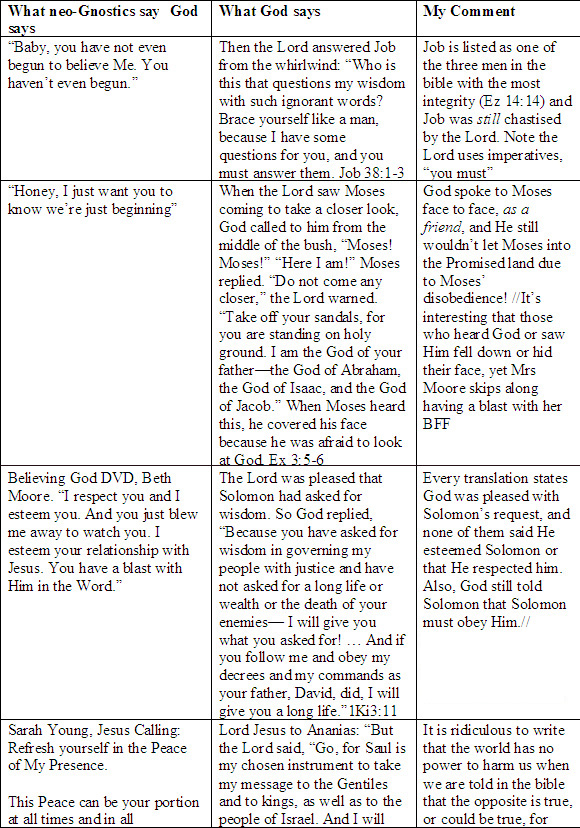
So let’s compare what and how God spoke in the bible and what and how God speaks to neo-Gnostics. I made a comparison chart. On the left are statements several people have said they heard God say to them, and on the right are God’s words as recorded in the bible. I used the New Living Translation so that no one can say that because the KJV or the ESV used more formal language it isn’t a fair comparison.It is everyday speech to everyday speech.

In this exercise, you see that even in the NLT’s ‘friendlier’ more everyday language, the times when God spoke to bible people He was still formal, using imperatives, referencing death, obedience, and what they ‘must do’. As an aside, just once I’d like to read a neo-Gnostic saying God spoke to them about their sin. [Sorry about the slightly overlarge formatting but this was the 7th attempt and the best one…]

A lowering of God naturally means an elevation of ourselves. A gnostic will seek to equalize the teeter-totter. In the Beth Moore Living Proof conference I attended, she spoke of “reciprocal relationship.” Though we are co-heirs, and Jesus is both our Father and our Friend, we do not have an equal relationship, a reciprocal partnership, or a “deal”. He is God, ruling with a rod of iron! (Rev 19:15)

My hope is that through these essays you will have your spiritual antenna raised and when you hear the buzzwords and listen to sermons, you will be able to track if there is any infiltration of Gnostic influences. I pray that you are in a sound, doctrinally solid, bible believing church and you never have to contend with such pollution. I am looking forward to the day when we will be with Jesus and worship him perfectly, with no error or twisted interpretation. What a day that will be!

Meanwhile, let us do all we can to maintain our high view of the only one who deserves it: Jesus. He is the Holy God of Israel, the Groom to His Bride, and our safety in the storm. We owe all to Him. May our prayers and our lives reflect His high position.

Gnosticism Series:
Introduction
Part 1: Secret Knowledge
Part 2: Asceticism
Part 3: Depreciation of Jesus
Part 4: Ceremonies & Rituals
Part 5: Worship of Angels
Part 6: Human Traditions
Conclusion

Posted in gnosticism, gnostics, neo-gnosticism

Gnosticism part 1: secret knowledge

Yesterday I introduced a new series on Gnosticism. I’m reading Colossians, which was a prison letter from Paul to the church at Colossae. Paul was responding to Epaphras’ news that the new Colossian believers were being quickly turned away from the faith by people who believed a different Gospel. What was that different Gospel? It was from the Gnostics, a group of cultish believers plaguing the church throughout the First Century, (and the second and third) and popping up here and there throughout the centuries since. Today, there is a resurgence of Gnostic belief encroaching and polluting even our fundamentalist churches among the Southern Baptist Convention. In other words, Gnosticism is a continual problem that never really went away.

The Tribulation is a time when all sins will be released for their fullest iniquity. The Holy Spirit’s ministry of restraint will be taken out of the way, and all sins, spiritual and carnal, will explode onto the earth. We see the setting for this coming explosion now. All false doctrines that have ever plagued the church are rising to the fore, all at once. We are battling Gnosticism, Mysticism, Liberalism, Post-Modernism, Legalism, Ecumenism, Prosperity Gospel, and much more. Jesus’s Seven Letters to the Seven Churches contained in Revelation 2-3 are a listing of some of the false doctrines and behavioral failings the early believers were falling prey to. Those false doctrines and behaviors hinder us now.

Zondervan’s NIV bible lists 6 elements that comprise Gnosticism. They are not exclusive, as Gnosticism has several branches and many different elements can be said to comprise the philosophy. In addition, several other false doctrines overlap Gnosticism, such as Mysticism and Legalism, for example. But for the sake of brevity (sort of) we will stick with the Zondervan 6. They are:

1. secret knowledge,
2. asceticism,
3. depreciation of Christ (lowering Him in name and in glory),
4. strict rule-keeping, ceremonies, or rituals
5. worship of angels,
6. and reliance on human wisdom and traditions

Today we will take a look at the element of “secret knowledge”.

David Grabbe wrote in “Whatever Happened to Gnosticism?” that “Gnosticism was the predominant source of heresy when the New Testament was written. The books of John, I Corinthians, Galatians, Colossians, I and II Timothy, Jude, and I John all combat various elements of Gnosticism. Even the book of Revelation cites a couple of Gnostic beliefs and practices, referring to “know[ing] the depths of Satan” and “the Nicolaitans” (Revelation 2:6, 15, 24).”

Gene Edward Veith wrote in World Magazine in this 2006 article “The Return of the Cainites,” “The Gnostics were eastern mystics who taught that the physical realm is intrinsically evil and that the spirit can be freed from its bondage to physicality through the attainment of secret knowledge (or “gnosis”). They rejected the Christian doctrine of creation (saying that the material world is evil). They denied the incarnation (saying that Christ was a spiritual being who brought the secret knowledge and denying that He became “flesh”). And they denied the redemption (saying that sin is not a moral failure – since what we do in the flesh does not affect our spirits – but simply a lack of spiritual knowledge).”

Jennifer Trafton and Rebecca Colossanov wrote in “Gnostics: Did you Know?” that “The Gnostics sometimes claimed that secret truth had been handed down by one apostle to a select group of insiders. But Christian opponents like Irenaeus argued that the true church represented the teaching of all of the apostles passed on in many locations.”

The word “Gnosticism” comes from the Greek word gnosis, which means “knowledge.” Gnosticism rejects the doctrines of original sin, human depravity and salvation through the substitutionary death of Christ. It emphasizes transcendence through inward, intuitive knowledge, i.e., “gnosis,” of the “divine spark in each individual.” (source)

Just to show how quickly satan sought to hinder Christ’s work, Simon Magus, the sorcerer from Acts 8:9-24 is said through tradition via Irenaeus to be the originator of Gnosticism.

As a kid, I used to be fascinated with the secret decoder rings you got in Cracker Jacks (back when they had good prizes!). And who could forget Ralphie’s excitement at getting closer to decoding the secret message from the Little Orphan Annie Radio radio show in the movie A Christmas Story. Ovaltine and other companies marketed early decoders to children which often included “secret messages” on their radio shows. These could be decoded for a preview of the next episode of the show.

This was creatively immortalized in the movie where the show’s announcer transmitted a secret message each week. Ralphie’s message deciphered to: “Be sure to drink your Ovaltine,” a message from the show’s sponsor. He muttered angrily, “a crummy Ovaltine commercial”.

Secret codes have a popular attraction for us, because we all want to know. We all want to be on the inside, no one wants to be left out.

The world is confusing and tumultuous, and in our fleshly pride we all want to make sense of it, and sometimes, even use that knowledge to get a leg up on the competition. Otherwise, why would Insider Trading of stock secrets be a Federal Crime, Corporate Spying be such a problem, and stealing plays and codes from football organizations be such a problem? We all want insider information the other guy has and we all want to protect our own information we already possess from the other guy.

Jesus said we have no power apart from Him, Gnostics say we have a Divine Spark that if we access and activate through secret knowledge, we will have as much power as Jesus. Jesus said to deny the flesh, and follow Him, Gnostics say the flesh (material world) is evil but we must be true to ourselves and follow our desires. Jesus said that all knowledge is from Jesus and has been delivered once for all to the saints, Gnostics say that accessing secret knowledge is the mechanism of salvation. The Gnostics claim that the early church “suppressed” the real knowledge, particularly the role of and contributions of women.

Additionally, people do not want to believe the reality and simplicity of the Gospel message, because people want to believe they have power and ability to save themselves. Nor do they hold the final truths to be in the bible, but instead should be explored from within, via mantras, rituals, and paths. In this way, Gnostics comfortably create their own truths rather than submit to One Truth. That is why, when yet another paper/book/doctrine comes along, people flock to it, triumphantly crowing, the real information is now out.

The bible says these people will be “having the appearance of godliness, but denying its power. Avoid such people.” Further, they are “always learning and never able to arrive at a knowledge of the truth.” (2 Timothy 3:5, 7). They know about God. But they do not know God.

In 1945, Egyptian farmers near Luxor found earthenware jars buried in the sand containing papyrus codices of ancient writings. When these papers at Nag Hammadi were discovered, many people thought that at last, the real information is now here. The codices included Acts of Peter and the Twelve Apostles, The Apocalypse of Adam, The (First) Apocalypse of James, The (Second) Apocalypse of James, The Apocalypse of Paul, The Apocalypse of Peter, The Apocryphon of James, The Apocryphon of John, The Book of Thomas the Contender, The Gospel of Philip, The Gospel of Thomas. Other Gnostic writings were discovered at other times, such as the Gospel of Judas, and The Gospel of Mary Magdalene.

Nag Hammadi codices, Source Wikipedia

The “Gospel” of Judas opens with one of Gnosticism’s famous buzzwords, secret. Specifically, it states “the secret account of the revelation that Jesus spoke in conversation with Judas Iscariot.”

God does not speak secrets. If He speaks, it is for all to hear. “Draw near to me, hear this: from the beginning I have not spoken in secret, from the time it came to be I have been there.” And now the Lord GOD has sent me, and his Spirit.” (Isaiah 48:16).

“For there is nothing hidden, except that it should be made known; neither was anything made secret, but that it should come to light.” (Mark 4:22)

“Beloved, although I was very eager to write to you about our common salvation, I found it necessary to write appealing to you to contend for the faith that was once for all delivered to the saints.” (Jude 1:3)

“Jesus answered him, “I have spoken openly to the world. I have always taught in synagogues and in the temple, where all Jews come together. I have said nothing in secret.” (John 18:20).

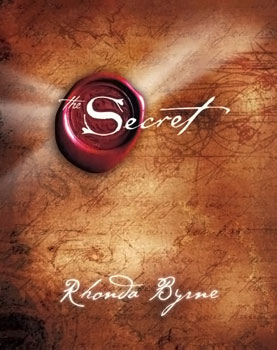
Despite clear teachings of the bible that Jesus said His teaching is not a secret, Gnosticism is alive and well in Christianity. It is also alive and well in popular culture. The 2007 book The Secret by Rhonda Byrne exploded across the Western world as ‘the answer’ to life’s problems. It was featured in Oprah’s book club. If you think Gnosticism is dead, that people are satisfied with the sufficient and inerrant bible and its answers, just look at the numbers clamoring for the ‘secret’ knowledge Ms Byrne would impart. Challies wrote in his review of the book, “The week after Oprah’s endorsement sales of The Secret jumped from 18,000 to 101,000. The week after a second endorsement sales rose to 190,000.”

Ms Byrne isn’t done. This is the promo for her new book, The Magic: “For more than twenty centuries, words within a sacred text have mystified, confused, and been misunderstood by almost all who read them. Only a very few people through history have realized that the words are a riddle, and that once you solve the riddle – once you uncover the mystery – a new world will appear before your eyes.  In The Magic, Rhonda Byrne reveals this life-changing knowledge to the world. “

The Da Vinci Code is another book and movie with Gnostic origins. Pretty much any “Christian” insight or doctrine that emphasizes codes is Gnostic in origin. Carl Jung was much taken with Gnosticism and therefore Jungian psychology contains many elements of it. Sarah Young’s Jesus Calling is Gnostic, (Tim Challies reviewed it here).

Much these days from Beth Moore is Gnostic. She repeatedly claims insider knowledge delivered directly to her and that she is to teach it. Moore recently said Jesus lifted her into another dimension to see the global church as He sees it and told her to return with this information and teach it, essentially saying she has been given special, secret knowledge which she now shares with others. Moore also promotes Lectio Divina, a mystical spiritual discipline which emphasizes gaining special knowledge of God through personal experience by emptying the mind and repeating babbling mantras. 1 Timothy 6:20 has something to say about irreverent babbling.

Gnosticism emphasizes meditation, mantras, and extreme mysticism because salvation to the Gnostics came via intuitive, personal knowledge and direct experience. Salvation is derived internally by knowledge and works, not externally from God. Those who did not attain knowledge were associated with ignorance, a particular evil to Gnostics. To a Gnostic, direct revelation from the Spirit is always more important than the word.

Buzzwords to listen for: The divine spark, lost books/lost knowledge, secret teachings, new insight, duality, seed, ascend, the Divine Feminine or the Feminine Divine, oneness.

Seen in: Scientology, New Age, Freemasonry, Henry Blackaby’s Experiencing God curriculum, Emergent Church, Benny Hinn…

This blogger wrote, “Gnosticism is Satan’s classic tool for combating the (difficult) truths of Christianity.”

Brethren, do not seek after books that purport to reveal new insights, deliver new knowledge, or have uncovered lost secrets. Jesus came to us visibly, preached, prophesied and taught, so that we would repent of our sins, have His Light of salvation through His grace. He delivered His word to us in the bible and nothing in there is a secret. It is open and available to all believers, and contains all one needs to know that is good and profitable. (2 Timothy 3:16).

My son, do not forget my teaching,
but let your heart keep my commandments,
for length of days and years of life
and peace they will add to you.
(Proverbs 3:1-2)

Trust in the Lord with all your heart,
and do not lean on your own understanding.
In all your ways acknowledge him,
and he will make straight your paths.
Be not wise in your own eyes;
fear the Lord, and turn away from evil.
It will be healing to your flesh
and refreshmentc to your bones
(Proverbs 3:5-8) [emphasis mine].
———————-
Gnosticism series:

Introduction
Part 1: Secret Knowledge
Part 2: Asceticism
Part 3: Depreciation of Jesus
Part 4: Ceremonies & Rituals
Part 5: Worship of Angels
Part 6: Human Traditions 
Conclusion