Posted in foxe's book of martyrs, martyr

Sunday Martyr Moment: "Into the kiln!" and the end of Emperor Valerian

Foxe’s Book of Martyrs. According to this summary from Christian Book Summaries,

Writing in the mid-1500s, John Foxe was living in the midst of intense religious persecution at the hands of the dominant Roman Catholic Church. In graphic detail, he offers accounts of Christians being martyred for their belief in Jesus Christ, describing how God gave them extraordinary courage and stamina to endure unthinkable torture.

From the same link, the book’s purpose was fourfold:

  • Showcase the courage of true believers who have willingly taken a stand for Jesus Christ throughout the ages, even if it meant death,
  • Demonstrate the grace of God in the lives of those martyred for their faith,
  • Expose the ruthlessness of religious and political leaders as they sought to suppress those with differing beliefs,
  • Celebrate the courage of those who risked their lives to translate the Bible into the common language of the people.

Text from Foxe’s Book of Martyrs

We left off with the martyrdom of Cyprian. Here we conclude the eighth persecution under Emperor Valerian:

~~~~~~~~~~~~~~~~~~

At Utica, a most terrible tragedy was exhibited: three hundred Christians were, by the orders of the proconsul, placed round a burning limekiln. A pan of coals and incense being prepared, they were commanded either to sacrifice to Jupiter, or to be thrown into the kiln. Unanimously refusing, they bravely jumped into the pit, and were immediately suffocated.

Fructuosus, bishop of Tarragon, in Spain, and his two deacons, Augurius and Eulogius, were burnt for being Christians.

Alexander, Malchus, and Priscus, three Christians of Palestine, with a woman of the same place, voluntarily accused themselves of being Christians; on which account they were sentenced to be devoured by tigers, which sentence was executed accordingly.

Maxima, Donatilla, and Secunda, three virgins of Tuburga, had gall and vinegar given them to drink, were then severely scourged, tormented on a gibbet, rubbed with lime, scorched on a gridiron, worried by wild beasts, and at length beheaded.

It is here proper to take notice of the singular but miserable fate of the emperor Valerian, who had so long and so terribly persecuted the Christians. This tyrant, by a stratagem, was taken prisoner by Sapor, emperor of Persia, who carried him into his own country, and there treated him with the most unexampled indignity, making him kneel down as the meanest slave, and treading upon him as a footstool when he mounted his horse. After having kept him for the space of seven years in this abject state of slavery, he caused his eyes to be put out, though he was then eighty-three years of age. This not satiating his desire of revenge, he soon after ordered his body to be flayed alive, and rubbed with salt, under which torments he expired; and thus fell one of the most tyrannical emperors of Rome, and one of the greatest persecutors of the Christians.

A.D. 260, Gallienus, the son of Valerian, succeeded him, and during his reign (a few martyrs excepted) the Church enjoyed peace for some years.

~~~~~~~~~~~~~~~~~~~~~

Just as I honor the Christian martyrs for exalting Jesus with their lives, it gives me no pleasure to see the fate of those who persecuted them. I am gripped with a heavy despair for all those who die while in their sins, forever destined to a hell of fire and torment. The torments they inflicted upon the martyrs were but a moment of trouble compared to an eternity in glory. (2 Corinthians 4:17). The torments that will be inflicted upon the tormentors will be a forever punishment for dishonoring the Holy Lord by rejecting His Gospel. (2 Thess. 1:9).

I wish that they had repented. I wish that they had been affected with the truth of the Gospel and the commitment of the martyrs to the name of Jesus Christ. Yet their stubbornness and their suppression of the truth went deep, and many, many tormenters themselves rejected the truth that was being proclaimed in front of them with lives and lips. They themselves unknowingly sealed their own fate even as they were inflicting those passing torments onto the martyrs.

The Lord is holy and just. Believe on His name and be saved.

Posted in faith, foxe's book of martyrs, martyr, suffering

Sunday Martyr Moment: Martyrs vs. Mark Driscoll – What is real suffering?

Foxe’s Book of Martyrs. According to this summary from Christian Book Summaries,

Writing in the mid-1500s, John Foxe was living in the midst of intense religious persecution at the hands of the dominant Roman Catholic Church. In graphic detail, he offers accounts of Christians being martyred for their belief in Jesus Christ, describing how God gave them extraordinary courage and stamina to endure unthinkable torture.

From the same link, the book’s purpose was fourfold:

  • Showcase the courage of true believers who have willingly taken a stand for Jesus Christ throughout the ages, even if it meant death,
  • Demonstrate the grace of God in the lives of those martyred for their faith,
  • Expose the ruthlessness of religious and political leaders as they sought to suppress those with differing beliefs,
  • Celebrate the courage of those who risked their lives to translate the Bible into the common language of the people.

Text from Foxe’s Book of Martyrs

~~~~~~~~~~~~~~~~~~~~~~~

The Eighth Persecution, Under Valerian, A.D. 257

Began under Valerian, in the month of April, 257, and continued for three years and six months. The martyrs that fell in this persecution were innumerable, and their tortures and deaths as various and painful. The most eminent martyrs were the following, though neither rank, sex, nor age were regarded.

Rufina and Secunda were two beautiful and accomplished ladies, daughters of Asterius, a gentleman of
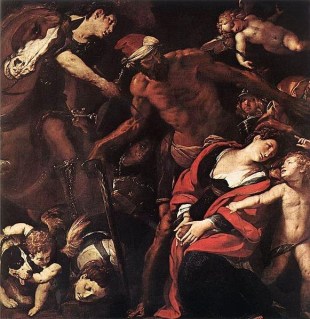
The Martyrdom of Secunda and Rufina
Collaborative painting by Il Morazzone,
Giulio Procaccini, Giovanni Battista Crespi (1620-1625)

eminence in Rome. Rufina, the elder, was designed in marriage for Armentarius, a young nobleman; Secunda, the younger, for Verinus, a person of rank and opulence. The suitors, at the time of the persecution’s commencing, were both Christians; but when danger appeared, to save their fortunes, they renounced their faith. They took great pains to persuade the ladies to do the same, but, disappointed in their purpose, the lovers were base enough to inform against the ladies, who, being apprehended as Christians, were brought before Junius Donatus, governor of Rome, where, A.D. 257, they sealed their martyrdom with their blood.

Stephen, bishop of Rome, was beheaded in the same year, and about that time Saturninus, the pious orthodox bishop of Toulouse, refusing to sacrifice to idols, was treated with all the barbarous indignities imaginable, and fastened by the feet to the tail of a bull. Upon a signal given, the enraged animal was driven down the steps of the temple, by which the worthy martyr’s brains were dashed out.

Sextus succeeded Stephen as bishop of Rome. He is supposed to have been a Greek by birth or by extraction, and had for some time served in the capacity of a deacon under Stephen. His great fidelity, singular wisdom, and uncommon courage distinguished him upon many occasions; and the happy conclusion of a controversy with some heretics is generally ascribed to his piety and prudence. In the year 258, Marcianus, who had the management of the Roman government, procured an order from the emperor Valerian, to put to death all the Christian clergy in Rome, and hence the bishop with six of his deacons, suffered martyrdom in 258.

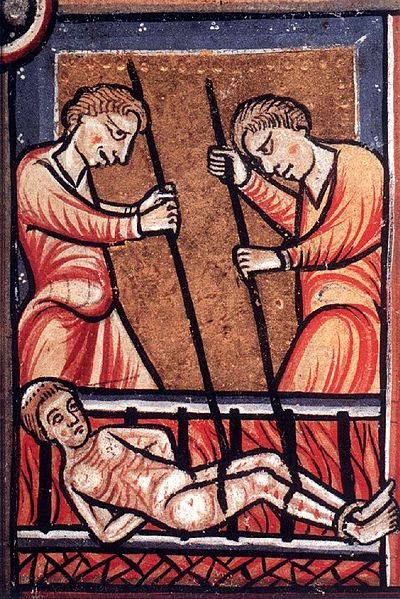
Let us draw near to the fire of martyred Lawrence, that our cold hearts may be warmed thereby. The merciless tyrant, understanding him to be not only a minister of the sacraments, but a distributor also of the Church riches, promised to himself a double prey, by the apprehension of one soul. First, with the rake of avarice to scrape to himself the treasure of poor Christians; then with the fiery fork of tyranny, so to toss and turmoil them, that they should wax weary of their profession.

With furious face and cruel countenance, the greedy wolf demanded where this Lawrence had bestowed the substance of the Church: who, craving three days’ respite, promised to declare where the treasure might be had. In the meantime, he caused a good number of poor Christians to be congregated. So, when the day of his answer was come, the persecutor strictly charged him to stand to his promise. Then valiant Lawrence, stretching out his arms over the poor, said: “These are the precious treasure of the Church; these are the treasure indeed, in whom the faith of Christ reigneth, in whom Jesus Christ hath His mansion-place.

What more precious jewels can Christ have, than those in whom He hath promised to dwell? For so it is written, ‘I was an hungered, and ye gave me meat: I was thirsty, and ye gave me drink: I was a stranger, and ye took me in.’ And again, ‘Inasmuch as ye have done it unto one of the least of these my brethren, ye have done it unto me.’ What greater riches can Christ our Master possess, than the poor people in whom He loveth to be seen?”

O, what tongue is able to express the fury and madness of the tyrant’s heart! Now he stamped, he stared, he ramped, he fared as one out of his wits: his eyes like fire glowed, his mouth like a boar formed, his teeth like a hellhound grinned. Now, not a reasonable man, but a roaring lion, he might be called.

Wikimedia Commons,
Martyrdom of Lawrence

“Kindle the fire (he cried)–of wood make no spare. Hath this villain deluded the emperor? Away with him, away with him: whip him with scourges, jerk him with rods, buffet him with fists, brain him with clubs. Jesteth the traitor with the emperor? Pinch him with fiery tongs, gird him with burning plates, bring out the strongest chains, and the fire-forks, and the grated bed of iron: on the fire with it; bind the rebel hand and foot; and when the bed is fire-hot, on with him: roast him, broil him, toss him, turn him: on pain of our high displeasure do every man his office, O ye tormentors.”

The word was no sooner spoken, but all was done. After many cruel handlings, this meek lamb was laid, I will not say on his fiery bed of iron, but on his soft bed of down. So mightily God wrought with his martyr Lawrence, so miraculously God tempered His element the fire; that it became not a bed of consuming pain, but a pallet of nourishing rest.

 ~~~~~~~~~~~~~~~~~~~~~~~

Consider what the ladies went through. They were young, engaged to be married to handsome, rich suitors. However, when the chips were down, their suitors showed eternally that their brides’ worth was less than their fortunes, and the suitors snitched to the government and gave them over. The ladies were killed. I wonder how the sisters felt in prison. They did not renounce, so we know that they were comforted by the Spirit. (Hebrews 13:5). It can’t have been easy though, in the dank, dark, rat and maggot infested, slimy prison, awaiting their fate. Were the sisters together? Did they sing? Pray? I’m sure they did. Through it all, they remained faithful to the one true Groom and their eternal reward in heaven will last forever. Moths and rust have already destroyed the two rich suitors and their fortunes. (Luke 17:33; Matthew 6:19).

The bishops of Rome had it hard, too. One after another were killed. When Sextus succeeded Stephen, he knew he was going to be killed at some point, I’m sure. What a job description. “Needed: Leader of church, the people you will lead are skittish and likely will be hunted and persecuted. You will be hunted and likely killed too. Probably tortured. Accepting inquiries from 2-5 PM, in person.”

And they lined up, serving Christ with full passion and love. Killed with Sextus were deacons Januarius, Vincentius, Magnus, Stephanus, Felicissimus and Agapitus. (Matthew 10:16).

And dear Lawrence, tortured mercilessly and roasted on a gridiron because he wouldn’t give over the church money! His declaration of the Church’s treasure being His sheep, priceless!

I think about today’s men who call themselves leaders and whine about difficulties of service in ministry. (Jude 1:16). Mark Driscoll of Mars Hill Church claims to have “faced danger” a few times. He wrote a long list of perceived persecutions and troubles he said he’s endured, in an essay titled “The hardest part of ministry” with the tag, ‘suffering.’ It’s a lengthy essay about his personal suffering, listing many woes he has faced. Here are a few.

Mark Driscoll, Wiki photo

Once, a man tried to enter his house. Another time a man with a “large knife” walked up the aisle and tried to stab him. Once, a sex offender tried to talk to his family. One time, someone sent Mark a letter telling him to stop preaching. Other times, people would post directions to Mark’s house on social media and encourage his critics to come to his home. He even has had to endure gossip! Once, someone even pooped on his porch!!

Yep, in his own humblebragging words, Mr Driscoll has surely been through it. Mr Driscoll wrote, “In general, going out in public has gotten tough. People feel free to interrupt family dinners out to sit at the table…” That’s just terrible! It’s not like his time is not his own but Jesus’s and his service is to Jesus or anything.

Like the two young ladies who lost their family, their fiancé, and their lives in A.D. 257 had been through it, sealing their martyrdom with their blood, some of today’s pastors are surely enduring a terrible persecution. Dealing with poop on your porch must surely equate with betrayal, imprisonment, and beheading as a terrible price for your service.

I love reading about the martyrs and writing about them so I can honor them as my forbears in faith. I love to ponder the faithfulness of our Savior who gives a faith so strong these precious martyrs endured torture and death with songs and prayers. I love to praise the Holy Spirit for empowering them with the things to say, like Lawrence bringing the sheep as the treasure, knowing it would mean his fleshly doom. Jesus is worth living for.  Jesus is worth dying for.

I also write about these martyrs so as to give us all a sense of perspective. Mr Driscoll has definitely lost his. When he preaches on suffering, do you truly think he understands biblical suffering for the name of Jesus? I don’t.

Driscoll at dinner with family, source: FB

Jesus is hated in this world and that hatred will only grow worse. (John 15:18; Matthew 10:22). Hatred for Him will express itself in physical harm, injustice and death. It already is, in many nations of the world. Complaining because you can’t eat supper in a restaurant without interruption from people is not ‘suffering.’ They are the people whom Lawrence called the most precious treasure of the church. Yet Mr Driscoll considers them a bother and just wants to eat his steak in peace. Perspective-

Being grilled on a gridiron is real suffering. Interruptions at dinner and gossip about you is not.

I think of two evangelists who rode a boat up a river deep into a jungle and trekked three more hours to reach a village of lost people in Laos. They shared about Christ and 178 people were converted and 8 were baptized. Yet the local witch doctor accused several Christians of causing the accidental deaths of three local men, and the Christians were rounded up, tried, told to renounce their faith, threatened with exile, and forced to pay restitution.

This incident was not in some long ago time. It was a news story posted on Voice of the Martyrs on November 18, 2013.

And rich pastors in the US complain that their woes are “cruel and unusual.”

Perspective. Keep in your heart what real suffering for the faith and the name of Jesus is so that we can praise His holy name for being so faithful to those who truly suffer. And let us rejoice in our own circumstances that He hasn’t ordained us to the same events as yet. Rejoice either way, that we suffer for Him or we live for him. And remember the martyrs.

Posted in martyr, origen

Sunday Martyr Moment: Origen

Foxe’s Book of Martyrs. According to this summary from Christian Book Summaries,

Writing in the mid-1500s, John Foxe was living in the midst of intense religious persecution at the hands of the dominant Roman Catholic Church. In graphic detail, he offers accounts of Christians being martyred for their belief in Jesus Christ, describing how God gave them extraordinary courage and stamina to endure unthinkable torture.

From the same link, the book’s purpose was fourfold:

  • Showcase the courage of true believers who have willingly taken a stand for Jesus Christ throughout the ages, even if it meant death,
  • Demonstrate the grace of God in the lives of those martyred for their faith,
  • Expose the ruthlessness of religious and political leaders as they sought to suppress those with differing beliefs,
  • Celebrate the courage of those who risked their lives to translate the Bible into the common language of the people.

Text from Foxe’s Book of Martyrs

The end of the Seventh Persecution, Under Decius, A.D. 249

Origen, the celebrated presbyter and catechist of Alexandria, at the age of sixty-four, was seized, thrown into a loathsome prison, laden with fetters, his feet placed in the stocks, and his legs extended to the utmost for several successive days. He was threatened with fire, and tormented by every lingering means the most infernal imaginations could suggest. During this cruel temporizing, the emperor Decius died, and Gallus, who succeeded him, engaging in a war with the Goths, the Christians met with a respite. In this interim, Origen obtained his enlargement, and, retiring to Tyre, he there remained until his death, which happened when he was in the sixty-ninth year of his age.
————————-
Who Was Origen?

A brilliant bible scholar and a man extremely well-versed in Greek philosophies, Origen nonetheless held to a stance of ultimate reconciliation. Seen most recently in Rob Bell’s book “Love Wins”, this stance is actually one of the first aberrant teachings of the early church. Origen was the most notable proponent of it. GotQuestions explains:

Although the doctrine of ultimate reconciliation has been championed by a variety of individuals down through history, there are two that stand out. The first is Origen of Alexandria (185-254 A.D.). The African theologian, who took an allegorical approach to Scripture and was heavily influenced by Greek philosophy, did not believe in the eternal suffering of sinners in hell. For Origen, all created beings, even demons and the devil, would eventually achieve salvation, no matter how long it took in the current life or in the life to come. He reasoned that because God’s love is so powerful, it will eventually soften even the hardest heart. This thought is echoed by Bell who says, “No one can resist God’s pursuit forever because God’s love will eventually melt even the hardest hearts” (p. 108).

Origen saw the church as the great “school of souls” in which erring pupils are instructed and disciplined, but for those who do not choose God in this life, they would continue their ‘tutelage’ in the next through an atoning and sanctifying process of purging fire. Origen believed that hell cannot be permanent for any soul because God could not abandon any creature. Since God respects human freedom, the process of winning over His created beings may take a long time in some cases, but God’s love, Origen believed, will ultimately triumph. Or as Rob Bell puts it, love wins.

Origen’s restoration of all beings, known as apokatastasis, is the Greek word used in Acts 3:21 for ‘restoration, and can be traced back to the Greek philosopher Heraclitus, who stated that “the beginning and end are common.” Origen’s belief in ultimate reconciliation was eventually refuted by Augustine and condemned in 543 A.D. in a council at Constantinople.

There truly is nothing new under the sun, and this ‘new’ thought that Rob Bell promotes is actually almost two thousand years old and held profound sway over the Christians at the time of Origen.

There is no second chance, no matter how much Origen or Rob Bell wish it were otherwise. The writer of Hebrews plainly states, “It is appointed for men to die once and after this comes judgment” (Hebrews 9:27).

Posted in foxe's book of martyrs, martyr, persecution, prayer

Sunday Martyr Moment: Seven soldiers in a cave

Foxe’s Book of Martyrs. According to this summary from Christian Book Summaries,

Writing in the mid-1500s, John Foxe was living in the midst of intense religious persecution at the hands of the dominant Roman Catholic Church. In graphic detail, he offers accounts of Christians being martyred for their belief in Jesus Christ, describing how God gave them extraordinary courage and stamina to endure unthinkable torture.

From the same link, the book’s purpose was fourfold:

  • Showcase the courage of true believers who have willingly taken a stand for Jesus Christ throughout the ages, even if it meant death,
  • Demonstrate the grace of God in the lives of those martyred for their faith,
  • Expose the ruthlessness of religious and political leaders as they sought to suppress those with differing beliefs,
  • Celebrate the courage of those who risked their lives to translate the Bible into the common language of the people.

Text from Foxe’s Book of Martyrs

The Seventh Persecution, Under Decius, A.D. 249, continued

In the year of our Lord 251, the emperor Decius having erected a pagan temple at Ephesus, he commanded all who were in that city to sacrifice to the idols. This order was nobly refused by seven of his own soldiers, viz. Maximianus, Martianus, Joannes, Malchus, Dionysius, Seraion, and Constantinus. The emperor wishing to win these soldiers to renounce their faith by his entreaties, gave them leniency and said that they would be allowed a considerable respite until he returned from an expedition. During the emperor’s absence, they escaped, and hid themselves in a cavern. The soldiers’ hiding place was discovered, and it was ordered sealed up, so that they would die of hunger and thirst.

~~~~~~~~~~~~~~~~~~~~~~~

The Voice of the Martyrs blog posted a story recently about how difficult it is for Chinese missionaries who obey God to enter the Tibetan mission field. One of those difficulties is the deep spiritual darkness of the region. It is Buddhist, and idols are everywhere. Here is an excerpt of a wonderful short essay about those difficulties, and the grace of God which strengthens and enables the missionaries to persevere.

The biggest obstacle faced by Chinese missionaries, however, is the intense spiritual warfare being waged in the region. Tibet is a Buddhist stronghold. The vast majority of the Tibetan people adhere to this religion. “The streets are full of idols,” says the Chinese missionary. “All of these people worship these idols.”

“A quick walk through the old part of Lhasa confirms this statement. Everywhere you walk and at all hours of the day, people are ceaselessly mumbling chants, rubbing their prayer beads in calloused fingers and spinning prayer wheels. According to the missionary, penetrating this spiritual darkness is extremely difficult – many of the Chinese Christians in the area, he says, are lazy and weak of faith as a result. Many more go home, disillusioned and discouraged.”

“As if these challenges weren’t enough, Chinese missionaries are often persecuted by the Chinese government, which maintains very strict control on religion in Tibet. Chinese missionaries have been thrown in prison and even kicked out of the province as a result of their efforts to evangelize the Tibetan. Evangelism in Tibet must be conducted very covertly and on a small scale level in order to avoid the wrath of the authorities.

In Lhasa, everywhere Buddhists are ceaselessly mumbling chants,
rubbing prayer beads in calloused fingers and spinning prayer wheels.(source)

The fingers of the Buddhist are calloused because they pray and pray but no one is listening.

But your iniquities have separated you from your God; And your sins have hidden His face from you, So that He will not hear (Isaiah 59:2).

Now we know that God does not hear sinners; but if anyone is a worshiper of God and does His will, He hears him (John 9:31).

The seven soldiers that the Emperor sealed up in the cave died a horrible death. Though not as painful as some of the Christians who were being actively tortured, the soldiers took a long time to die, in agonizing thirst, alone in the dark. Except … they were not alone.

I am sure that they prayed to our Holy God for comfort and to supplicate to Him. They laid down their lives for His glory. Being a faithful God, would not leave them alone in their moment of truth but accept the sacrifice of their lives and their dying prayers as the glory He deserves and demands. I wonder if the LORD sent an angel to minister to them as they lay dying. I wonder if they heard His voice whisper comfort to them. I wonder if they gained supernatural strength to pray and sing even as their wasted bodies lay shriveled and dying.

Even in death, the loss of the breath in the body is nothing, as long as there exists a blessed supernatural highway of communication between ourselves and our precious Savior. For the Buddhist, spinning wheels and counting beads, there is only blackness, emptiness, and darkness. They have the high altitude sunlight but have hearts of stone and dwell in the dark, while the 7 soldiers had the darkness of a cave, but the Light of glory at the end. No matter your situation today, whether you are in a real cave-like dark prison for the faith, or you are in a metaphorical dark cave of bad circumstances, you always know that you can pray. We are confident in Him.

And this is the confidence that we have toward him, that if we ask anything according to his will he hears us. And if we know that he hears us in whatever we ask, we know that we have the requests that we have asked of him.” (1 John 5:14-15)

Posted in felicitas, martyr, perpetua

Sunday Martyr moment: Perpetua and Felicitas

Foxe’s Book of Martyrs. According to this summary from Christian Book Summaries,

Writing in the mid-1500s, John Foxe was living in the midst of intense religious persecution at the hands of the dominant Roman Catholic Church. In graphic detail, he offers accounts of Christians being martyred for their belief in Jesus Christ, describing how God gave them extraordinary courage and stamina to endure unthinkable torture.

From the same link, the book’s purpose was fourfold:

  • Showcase the courage of true believers who have willingly taken a stand for Jesus Christ throughout the ages, even if it meant death,
  • Demonstrate the grace of God in the lives of those martyred for their faith,
  • Expose the ruthlessness of religious and political leaders as they sought to suppress those with differing beliefs,
  • Celebrate the courage of those who risked their lives to translate the Bible into the common language of the people.

Text from Foxe’s Book of Martyrs

The persecutions now extending to Northern Africa, which was a Roman province. Many were martyred in that quarter of the globe; here are but a few.

Perpetua, a married lady, of about twenty-two years who was still nursing a child. Those who suffered with her were, Felicitas, her slave, big with child at the time of her being apprehended, and Revocatus, a slave who was being taught the principles of Christianity. The names of the other prisoners, destined to suffer upon this occasion, were Saturninus, Secundulus, and Satur.

On the day appointed for their execution, they were led to the amphitheater. Satur, Saturninus, and Revocatus were ordered to run the gauntlet between the hunters, or such as had the care of the wild beasts. The hunters being drawn up in two ranks, they ran between, and were severely lashed as they passed.

Perpetua 

After an appearance before the proconsul Minutius in which she was offered freedom if she sacrificed to the idols, Perpetua had her still-nursing baby taken from her and was thrown into prison. Describing her faith and life in prison, she told her father, “The dungeon is to me a palace.” Later she and the other prisoners appeared before Hilarianus, the judge. He, also, offered to set her free if she sacrificed. Her father was there with her baby and he begged her to do so. She replied “I will not sacrifice.”

“Are you a Christian?” asked Hilarianus.
“I am a Christian,” Perpetua answered.

All of the Christians with her stood fast for Christ, and they were ordered to be killed by wild beasts for the enjoyment of the crowd on the next pagan holiday. The men were to be torn apart by lions and the women set upon by bulls.

“It will all happen in the prisoner’s dock as God wills, for you may be sure that we are not left to ourselves but are all in his power.”
On the day of their execution, Perpetua and Felicitas were first stripped naked and hung in nets, but were removed and clothed when the crowd objected. Upon returning to the arena Perpetua was tossed about by a mad bull and was stunned but not seriously hurt. Felicitas, however, was badly gored. Perpetua hurried to her side and held her while they waited for the bull to charge them again, but it refused to do so.They were dragged from the arena much to the crowd’s disappointment.

After a short time, they were brought back to be killed by gladiators. Felicitas was killed quickly, but the young, inexperienced gladiator assigned to kill Perpetua trembled violently and could only stab her weakly several times. Perpetua held his sword blade and guided it to a vital part of her body.

The fate of the men were similar. Satur and Revocatus were killed by the wild beasts, Saturninus was beheaded, and Secundulus died of his wounds in prison.

These executions were in 205, on the eighth day of March.

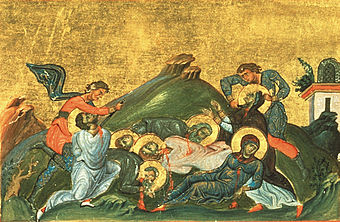
Painting showing the martyrdom of Perpetua,
Felicitas, Revocatus, Saturninus and Secundulus,
from the Menologion of Basil II (c. 1000 AD)
~~~~~~~~~~~~~~~~~~~

Perpetua kept a diary of the time she was arrested and imprisoned. It ends prior to her being led to the arena. Thanks to her diary, and that of another prisoner’s we have a picture of the persecuted life of early Christians. Perpetua was a disciple, new to the faith and un-baptized. However, her faith remained so strong during trial and persecution, and her eventual martyrdom so impressed Augustine that he preached four sermons about her.

From Perpetua’s diary, we read

“Her father immediately came to her in prison. He was a pagan, and he saw an easy way for Perpetua to save herself. He entreated her simply to deny she was a Christian.

“Father do you see this vase here?” she replied. “Could it be called by any other name than what it is?”
“No,” he replied.
“Well, neither can I be called anything other than what I am, a Christian.”

~~~~~~~~~~~~~~~~~~

Are you a Christian? The name means something very powerful and important. It means we are ambassadors of His message, receptacles of His Spirit, children of the Most High.

In school we tell the fifth graders, “Act like somebody.” Christians have an even higher calling- act like a Christian. We are “God’s workmanship, created in Christ Jesus to do good works’ (Ephesians 2:10). Let us always declare His praises, (1 Peter 2:9) and live lives that are “holy and pleasing to God.” (Romans 12:1). When or if we are called upon to death by martydom, let us die a death that is pleasing to God also.

Posted in comfort, martyr, strength in the Lord

Sunday Martyr Moment: Sanctus, Blandina, and Ponticus

Foxe’s Book of Martyrs. According to this summary from Christian Book Summaries,

Writing in the mid-1500s, John Foxe was living in the midst of intense religious persecution at the hands of the dominant Roman Catholic Church. In graphic detail, he offers accounts of Christians being martyred for their belief in Jesus Christ, describing how God gave them extraordinary courage and stamina to endure unthinkable torture.

From the same link, the book’s purpose was fourfold:

  • Showcase the courage of true believers who have willingly taken a stand for Jesus Christ throughout the ages, even if it meant death,
  • Demonstrate the grace of God in the lives of those martyred for their faith,
  • Expose the ruthlessness of religious and political leaders as they sought to suppress those with differing beliefs,
  • Celebrate the courage of those who risked their lives to translate the Bible into the common language of the people.

Text from Foxe’s Book of Martyrs:

Continuing the Fourth Persecution under Marcus Aurelius, 162AD

Some of the restless northern nations having risen in arms against Rome, the emperor marched to encounter them. He was, however, drawn into an ambuscade, and dreaded the loss of his whole army. Enveloped with mountains, surrounded by enemies, and perishing with thirst, the pagan deities were invoked in vain; when the men belonging to the militine, or thundering legion, who were all Christians, were commanded to call upon their God for succor. A miraculous deliverance immediately ensued; a prodigious quantity of rain fell, which, being caught by the men, and filling their dykes, afforded a sudden and astonishing relief. It appears that the storm which miraculously flashed in the face of the enemy so intimidated them, that part deserted to the Roman army; the rest were defeated, and the revolted provinces entirely recovered.

This affair occasioned the persecution to subside for some time, at least in those parts immediately under the inspection of the emperor; but we find that it soon after raged in France, particularly at Lyons, where the tortures to which many of the Christians were put, almost exceed the powers of description.

Sanctus, a deacon of Vienna; red hot plates of brass were placed upon the tenderest parts of his body; and kept there till they burned through to his bones.

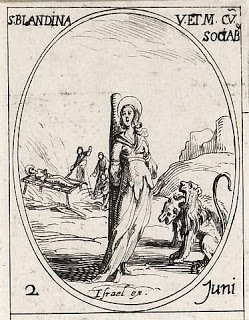
Blandina, a Christian lady, of a weak constitution; who was not thought to be able to resist torture, but whose fortitude was so great that her tormentors became exhausted with their devilish work, and was afterward taken into an amphitheater with three others, suspended on a piece of wood stuck in the ground, and exposed as food for wild lions. While awaiting her suffering, she prayed earnestly for her companions and encouraged them. But none of the lions would touch her, so she was put back into prison. This happened twice.

When she was again produced for the third and last time, she was accompanied by Ponticus, a youth of fifteen, and the constancy of their faith so enraged the multitude that neither the sex of the one nor the youth of the other were respected, being exposed to all manner of punishments and tortures. Being strengthened by Blandina, he persevered unto death; and she, after enduring all the torments heretofore mentioned, was at length slain with the sword.

~~~~~~~~~~~~~~~~~~~~

Lord, I am weak of fortitude, but I can be strengthened supernaturally, like Blandina, to endure all things. Would I be strong enough to pray for and encourage compatriots whilst impaled on a stick, suspended above milling and hungry lions? No. But I can do all things through You who strengthens me. You did not desert Blandina in her trial, and no matter what comes for me and my faithful brethren now or in the future, you will not desert us. You are Lord, and You are faithful.

Posted in justin, martyr, Sunday martyr moment

Sunday Martyr Moment: Justin Martyr, Felicitatis, others

Foxe’s Book of Martyrs. According to this summary from Christian Book Summaries,

Writing in the mid-1500s, John Foxe was living in the midst of intense religious persecution at the hands of the dominant Roman Catholic Church. In graphic detail, he offers accounts of Christians being martyred for their belief in Jesus Christ, describing how God gave them extraordinary courage and stamina to endure unthinkable torture.

From the same link, the book’s purpose was fourfold:

  • Showcase the courage of true believers who have willingly taken a stand for Jesus Christ throughout the ages, even if it meant death,
  • Demonstrate the grace of God in the lives of those martyred for their faith,
  • Expose the ruthlessness of religious and political leaders as they sought to suppress those with differing beliefs,
  • Celebrate the courage of those who risked their lives to translate the Bible into the common language of the people.

Text from Foxe’s Book of Martyrs:

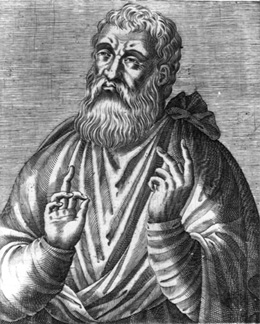
Justin Martyr. Wikipedia

The cruelties against Christians under Marcus Aurelius were so inhuman that many of those who watched them shuddered with horror, and were astonished at the courage of the sufferers. Some of the martyrs had their feet crushed in presses, and were then forced to walk over thorns, nails, sharp shells, and other pointed objects. Others were whipped until their sinews and veins were exposed. Then after suffering the most excruciating tortures that could be devised they were killed in terrible ways. Yet few turned from Christ or begged their torturer to lessen their pain.

Metrodorus, a minister, who preached boldly, and Pionius, who made some excellent apologies for the Christian faith, were likewise burnt. Carpus and Papilus, two worthy Christians, and Agatonica, a pious woman, suffered martyrdom at Pergamopolis, in Asia.

Felicitatis, an illustrious Roman lady, of a considerable family, and the most shining virtues, was a devout Christian. She had seven sons, whom she had educated with the most exemplary piety. All of them were martyred.

Januarius, the eldest son of Felicitatus, was scourged, and pressed to death with weights; Felix and Philip, the two next had their brains dashed out with clubs; Silvanus, the fourth, was murdered by being thrown from a precipice; and the three younger sons, Alexander, Vitalis, and Martial, were beheaded. The mother was beheaded with the same sword as the three latter.

Justin, the celebrated philosopher, fell a martyr in this persecution. He was a native of Neapolis, in Samaria, and was born A.D. 103. Justin was a great lover of truth, and a universal scholar; he investigated the Stoic and Peripatetic philosophy, and attempted the Pythagorean; but the behavior of our of its professors disgusting him, he applied himself to the Platonic, in which he took great delight. About the year 133, when he was thirty years of age, he became a convert to Christianity, and then, for the first time, perceived the real nature of truth.

He wrote an elegant epistle to the Gentiles, and employed his talents in convincing the Jews of the truth of the Christian rites; spending a great deal of time in travelling, until he took up his abode in Rome, and fixed his habitation upon the Viminal mount.

He kept a public school, taught many who afterward became great men, and wrote a treatise to confuse heresies of all kinds. As the pagans began to treat the Christians with great severity, Justin wrote his first apology in their favor. Justin’s’ arguments overpowered Crescens and so disturbed him that he resolved to destroy Justin. This piece displays great learning and genius, and occasioned the emperor to publish a decree in favor of the Christians.

I fell in love with the prophets and these men who had loved Christ; I reflected on all their words and found that this philosophy alone was true and profitable. ~Justin Martyr
Soon after, he entered into frequent contests with Crescens, a person of a vicious life and conversation, but a celebrated cynic philosopher. Justin’s’ arguments overpowered Crescens and so disturbed him that he resolved to destroy Justin. The second defense that Justin write on behalf of the Christians gave Crescens the opportunity he needed. He convinced the emperor that Justin was dangerous to him whereupon Justin and six followers were arrested and ordered to sacrifice to pagan idols. When they refused, they were scourged and beheaded.

~~~~~~~~~~~~~~~~~~~~~~~~

Lord, we know that the unregenerate heart and unsanctified mind can devise horror after horror. The Holocaust showed us the depths of man’s inhumanity to man and the future Tribulation will exceed even those horrors. It’s unimaginable what the Christians who preceded us went through, but thank You for your grace and comfort to them while they were under trial. I know that many hearts were converted upon seeing their courage, which was the strength of the Holy Spirit in them. As this time at the end of the Age of Grace draws to a close, I pray You deliver the same strength and courage to today’s martyrs. So that once more, many hearts are converted as they see dark evil of hate and torture against Your light of holy eternity in pure hearts proclaiming Your name even as they die under the sword.

——————————-
Further Reading:

CS Lewis Institute: Profiles in Faith Justin Martyr (a .pdf)

Christian History: Justin Martyr

Posted in foxe's book of martyrs, martyr

Sunday Martyr Moment: Alexander of Rome, Zenon, Faustines & Jovita

Foxe’s Book of Martyrs. According to this summary from Christian Book Summaries,

Writing in the mid-1500s, John Foxe was living in the midst of intense religious persecution at the hands of the dominant Roman Catholic Church. In graphic detail, he offers accounts of Christians being martyred for their belief in Jesus Christ, describing how God gave them extraordinary courage and stamina to endure unthinkable torture.

From the same link, the book’s purpose was fourfold:

  • Showcase the courage of true believers who have willingly taken a stand for Jesus Christ throughout the ages, even if it meant death,
  • Demonstrate the grace of God in the lives of those martyred for their faith,
  • Expose the ruthlessness of religious and political leaders as they sought to suppress those with differing beliefs,
  • Celebrate the courage of those who risked their lives to translate the Bible into the common language of the people.

Text from Foxe’s Book of Martyrs:

Trajan being succeeded by Adrian, the latter continued this third persecution with as much severity as his predecessor. About this time Alexander, bishop of Rome, with his two deacons, were martyred; as were Quirinus and Hernes, with their families;

Zenon, a Roman nobleman, and about ten thousand other Christians.

In Mount Ararat many were crucified, crowned with thorns, and spears run into their sides, in imitation of Christ’s passion. Eustachius, a brave and successful Roman commander, was by the emperor ordered to join in an idolatrous sacrifice to celebrate some of his own victories; but his faith (being a Christian in his heart) was so much greater than his vanity, that he nobly refused it. Enraged at the denial, the ungrateful emperor forgot the service of this skillful commander, and ordered him and his whole family to be martyred.

Today: Deadly attacks force Christians
to flee villages in Nigeria’s Middle Belt (source)

At the martyrdom of Faustines and Jovita, brothers and citizens of Brescia, their torments were so many, and their patience so great, that Calocerius, a pagan, beholding them, was struck with admiration, and exclaimed in a kind of ecstasy, “Great is the God of the Christians!” for which he was apprehended, and suffered a similar fate.

Many other similar cruelties and rigors were exercised against the Christians, until Quadratus, bishop of Athens, made a learned apology in their favor before the emperor, who happened to be there and Aristides, a philosopher of the same city, wrote an elegant epistle, which caused Adrian to relax in his severities, and relent in their favor. Adrian died in 138 AD and was succeeded by Antoninus Pius. Emperor Pius was one of the most amiable monarchs that ever reigned, and stopped all persecutions against the Christians.

~~~~~~~~~~~~~~~~~~~~~~~~~~~
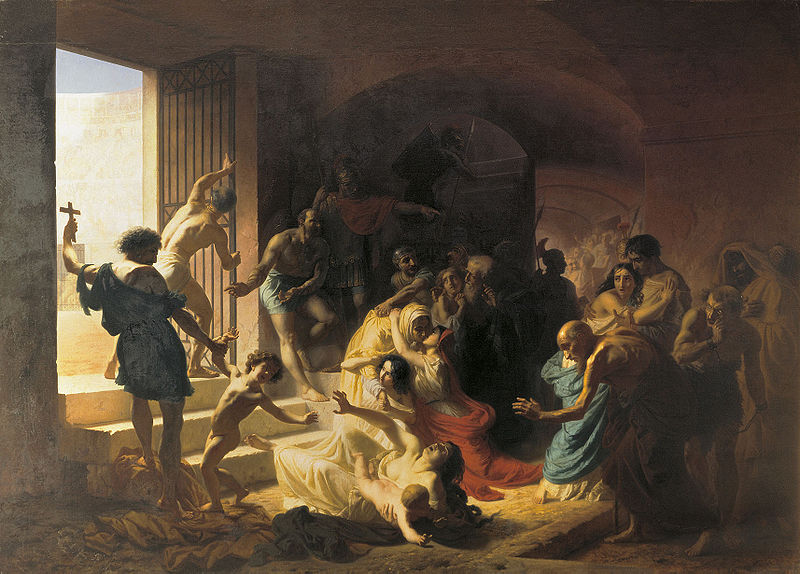
Christian Martyrs in the Colosseum by Konstantin Flavitsky

Faustines and Jovita were patient under persecution, glorifying God. The Gentiles watch us and they notice. The observer Quadratus was struck with the faith of the two brothers under torture, and thus he knew that the brothers were men of God and their faith came from God. How hollow faith in Zeus must have seemed in comparison!

No matter what kind of trial we are under, we should always be kind and patient. Many of our brethren are undergoing persecution in parts of the world. 45 Christians were killed in bombings at churches in Kano city, Nigeria. In Egypt, the Muslim Brotherhood is taking their anger out on Christians.

A Pakistani teen who provoked an international outcry when she was falsely accused of burning Islam’s holy book is finally out of danger and settling into a new life in Canada. But while Rimsha Masih and her family have been granted asylum and were quietly relocated to southern Ontario, life for much of the Christian community they left behind in Islamabad remains bleak.”

The Name Of Jesus Has Become A Dirty Word In Politically Correct America
“In the United States today, there are very few words that provoke as much outrage as the name of Jesus.  It is being banned from graduation ceremonies, chaplains all over America are being forbidden from using His name in their prayers, and many school officials all over the nation have become absolutely fanatical about eliminating every trace of Christian expression from their schools. One elementary school in North Carolina even ordered a little six-year-old girl to remove the word “God” from a poem that she had written to honor her grandfathers.”

O, Lord, please give strength and supernatural faith to those who are living in such deadly situations. Let the glory of the Lord shine out from them in the face of their persecutors. For those of us in places where we are not hunted to death (yet) such as Canada or the US, let us who are maligned or mocked also show grace to those who spit on the name of Jesus. Give us supernatural kindness so that like Calocerius, a pagan, beholding us, would be struck with admiration, and exclaim, “Great is the God of the Christians!”

Posted in foxe's book of martyrs, goose, john huss, martin luther, martyr

Sunday Martyr Moment: John Huss, "The goose is cooked"

A day early with this because today is the anniversary of the burning of martyr John Huss. July 6, 1415. Excerpted from Foxe’s Book of Martyrs. John Huss was killed by the Roman Catholic Church for the ‘heresy’ of proclaiming that Christ is the Head of the church and that salvation is in Christ alone. The martyrs died proclaiming Jesus is the head of the church and so many foolish people today have wantonly substituted idols for Him instead.

The day will come in His millennium Kingdom when
They shall not hurt or destroy
in all my holy mountain;
for the earth shall be full of the knowledge of the Lord
as the waters cover the sea.
~Isaiah 11:9

The earth will be FULL of the knowledge of the Lord! Full…all will know and all will bow.

As he was taken to his death, Huss refused to recant and was heard to say, ‘You are now going to burn a goose, but in a century you will have a swan which you can neither roast nor boil.’ A hundred years later Martin Luther arose, challenged the church, and was known as The Swan.

~~~~~~~~~~~Foxe’s Book: John Huss~~~~~~~~~~~

When he was brought before the Council, the articles exhibited against him were read: they were upwards of forty in number, and chiefly extracted from his writings. John Huss’s answer was this:

“I did appeal unto the pope; who being dead, and the cause of my matter remaining undetermined, I appealed likewise unto his successor John XXIII: before whom when, by the space of two years, I could not be admitted by my advocates to defend my cause, I appealed unto the high judge Christ.”

When John Huss had spoken these words, it was demanded of him whether he had received absolution of the pope or no? He answered, “No.” Then again, whether it was lawful for him to appeal unto Christ or no? Whereunto John Huss answered: “Verily I do affirm here before you all, that there is no more just or effectual appeal, than that appeal which is made unto Christ, forasmuch as the law doth determine, that to appeal is no other thing than in a cause of grief or wrong done by an inferior judge, to implore and require aid at a higher Judge’s hand. Who is then a higher Judge than Christ? Who, I say, can know or judge the matter more justly, or with more equity? when in Him there is found no deceit, neither can He be deceived; or, who can better help the miserable and oppressed than He?” While John Huss, with a devout and sober countenance, was speaking and pronouncing those words, he was derided and mocked by all the whole Council.

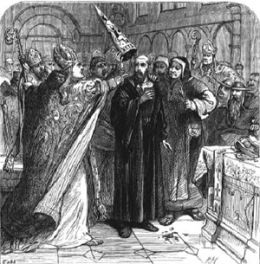
“His vestments were removed from him, one by one, and each bishop present pronouncing a curse on him as part of the ceremony. They put a cap on his head; on which were painted frightful pictures of demons, and on the front of it the words “Archheretic.” Jan Hus said, “Most joyfully will I wear this crown of shame for Thy sake, O Jesus, who for me didst wear a crown of thorns.” ‘ (source) .

These excellent sentences were esteemed as so many expressions of treason, and tended to inflame his adversaries. Accordingly, the bishops appointed by the Council stripped him of his priestly garments, degraded him, put a paper miter on his head, on which was painted devils, with this inscription, “A ringleader of heretics.” Which when he saw, he said: “My Lord Jesus Christ, for my sake, did wear a crown of thorns; why should not I then, for His sake, again wear this light crown, be it ever so ignominious? Truly I will do it, and that willingly.” When it was set upon his head, the bishop said: “Now we commit thy soul unto the devil.” “But I,” said John Huss, lifting his eyes towards the heaven, “do commend into Thy hands, O Lord Jesus Christ! my spirit which Thou has redeemed.”

When the chain was put about him at the stake, he said, with a smiling countenance, “My Lord Jesus Christ was bound with a harder chain than this for my sake, and why then should I be ashamed of this rusty one?”

When the wood was piled up to his very neck, the duke of Bavaria was so officious as to desire him to abjure. “No, (said Huss;) I never preached any doctrine of an evil tendency; and what I taught with my lips I now seal with my blood.” He then said to the executioner, “You are now going to burn a goose, (Huss signifying goose in the Bohemian language:) but in a century you will have a swan which you can neither roast nor boil.” If he were prophetic, he must have meant Martin Luther, who shone about a hundred years after, and who had a swan for his arms.

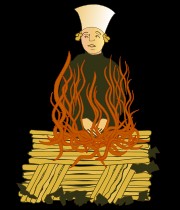
Jan Hus burning.
Drawing after Ulrich von Richental’s illustrated
chronicle of the Council of Constance

The flames were now applied to the wood when our martyr sung a hymn with so loud and cheerful a voice that he was heard through all the cracklings of the combustibles, and the noise of the multitude. At length his voice was interrupted by the severity of the flames, which soon closed his existence.

Then, with great diligence, gathering the ashes together, they cast them into the river Rhine, that the least remnant of that man should not be left upon the earth, whose memory, notwithstanding, cannot be abolished out of the minds of the godly, neither by fire, neither by water, neither by any kind of torment.

~~~~~~~~~~~~~~~~~~~~~~~~~~~~~~~~

John MacArthur has a tremendous sermon about John Huss and Martin Luther, and their resistance to the RCC’s popery. It’s called Undermining the Headship of Christ. It is well worth a listen.

Posted in foxe's, macarthur, martyr, persecution

Sunday Martyr Moment: The coming persecution to the west

Foxe’s Book of Martyrs. According to this summary from Christian Book Summaries,

Writing in the mid-1500s, John Foxe was living in the midst of intense religious persecution at the hands of the dominant Roman Catholic Church. In graphic detail, he offers accounts of Christians being martyred for their belief in Jesus Christ, describing how God gave them extraordinary courage and stamina to endure unthinkable torture.

From the same link, the book’s purpose was fourfold:

  • Showcase the courage of true believers who have willingly taken a stand for Jesus Christ throughout the ages, even if it meant death,
  • Demonstrate the grace of God in the lives of those martyred for their faith,
  • Expose the ruthlessness of religious and political leaders as they sought to suppress those with differing beliefs,
  • Celebrate the courage of those who risked their lives to translate the Bible into the common language of the people.

Last Sunday I’d ended the first phase of the persecutions with the death of Apostle John. He was the last of the first generation martyrs. In Foxe’s Book it is described thus: “Chapter One: History of Christian Martyrs to the First General Persecutions Under Nero”.

In the course of that first wave, Paul and Peter were martyred. In summary, Foxe wrote, “To their names may be added, Erastus, chamberlain of Corinth; Aristarchus, the Macedonian, and Trophimus, an Ephesians, converted by St. Paul, and fellow-laborer with him, Joseph, commonly called Barsabas, and Ananias, bishop of Damascus; each of the Seventy.”

Under Nero’s persecution after the Great Fire at Rome of 67AD, the church at Rome was scattered, and this blew the seeds of the Gospel outward toward Asia. (1 Peter 1:1). The 7 Churches of Asia Minor were founded at that time. However, it wasn’t long before persecution followed the Christians at the cities far from Rome, and this is what Peter meant when he wrote, ‘you are being tested in various trials’ in 1 Peter 1:6.

This first wave of the original generation continued under Domitian. Foxe’s summary again, “Nicodemus, a benevolent Christian of some distinction, suffered at Rome during the rage of Domitian’s persecution. Protasius and Gervasius were martyred at Milan. Timothy was the celebrated disciple of Paul, and bishop of Ephesus, where he zealously governed the Church until A.D. 97. At this period, as the pagans were about to celebrate a feast called Catagogion, Timothy, meeting the procession, severely reproved them for their ridiculous idolatry, which so exasperated the people that they fell upon him with their clubs, and beat him in so dreadful a manner that he expired of the bruises two days later.”

After Apostle John died in around 98AD, The Third Persecution, Under Trajan, A.D. 108, began.

“Pliny was a governor of a Roman province at the beginning of the Second Century.  He was monitoring those who identified themselves as Christians in order to make report to the Emperor Trajan.  He wrote to Trajan around 100 AD.” Foxe wrote of Pliny’s letter to Trajan,

“In the third persecution Pliny the Second, a man learned and famous, seeing the lamentable slaughter of Christians, and moved therewith to pity, wrote to Trajan, certifying him that there were many thousands of them daily put to death, of which none did any thing contrary to the Roman laws worthy of persecution. “The whole account they gave of their crime or error (whichever it is to be called) amounted only to this-viz. that they were accustomed on a stated day to meet before daylight, and to repeat together a set form of prayer to Christ as a God, and to bind themselves by an obligation-not indeed to commit wickedness; but, on the contrary-never to commit theft, robbery, or adultery, never to falsify their word, never to defraud any man: after which it was their custom to separate, and reassemble to partake in common of a harmless meal.”

~~~~~~~~~~~~~~~~~~~~~~~~~~~~

Hatred of Christians is coming to America. Persecution is coming. Christians have always suffered horribly in all the world throughout all ages. Christians in America have not. We are the cushiest, most comfortable generation, and as a result have grown casual to the Gospel and irreverent toward Christ. The charge of Jesus to the church at Laodicea could well be taken as a charge against us today:

“‘I know your works: you are neither cold nor hot. Would that you were either cold or hot! So, because you are lukewarm, and neither hot nor cold, I will spit you out of my mouth. For you say, I am rich, I have prospered, and I need nothing, not realizing that you are wretched, pitiable, poor, blind, and naked.” (Revelation 3:15-17).

It is the church at Laodicea which Jesus asks to open the door and let Him in when He knocks. It is the church at Laodicea that has left Jesus off the list of ingredients when they play at church.

Of the true church, Dr. John MacArthur wrote this week to his subscribers, “It’s no surprise that true Christians are feeling pressures we’ve never before experienced. Believers today face open hostility simply for what we believe.”

 [Ed Note: Brings to mind Pliny’s perplexity of the hatred leveled against Christians who were simply praying, vowing to do good and having harmless meals together…]. Continuing MacArthur-

“Our gospel, our values, our priorities, our doctrine, what we love and what we hate what we live for and what we die for- our lives are more permanently and comprehensively at odds with the world. What’s more, the situation can and will still get worse. I’ve commented several times recently that I believe that hostility toward Christians in the West will eventually give way to full-blown persecution, just as it already has in other parts of the world.”

“As the pressure on Christianity has increased, it has been interesting to see so many supposed Christian institutions caving in and surrendering. We’re now finding out what people really believe and who is willing to stand for truth. Christian organizations are having to ask themselves, What are we going to say about immorality, premarital sex, drunkenness, and homosexuality? Sadly, many are waffling.”

Taking a break for a moment from Dr. MacArthur’s letter, here is an exact example of a waffling pastor. Mark Driscoll, who seems so outspoken on everything else, declined to comment on the DOMA ruling. Christian Post reports,

“Outspoken megachurch pastor Mark Driscoll, who has more than 389,000 followers on Twitter, stuck to tweeting paraphrases from the Bible and promoting current Mars Hill Church sermons on Wednesday morning and afternoon. When contacted by CP, spokesperson Justin Dean said that the Seattle-based Mars Hill Church lead pastor would not be commenting on the Supreme Court decisions.” (source)

Dr. MacArthur continued in his letter,

“Our view is that the more heated the battle becomes the clearer we need to become on our biblical convictions. The true church will always embrace persecution when it comes, rather than run from it. Suffering for Christ is a blessing from God with purifying effects for true believers. When suffering comes, the church actually thrives. Of course that doesn’t mean that facing hostility and persecution is easy, or that it doesn’t raise practical questions about the present and the future- no Christians cherish the thought of their children or grandchildren suffering…”

The call for today is to remember the martyrs even as hostility and persecution comes to us in the West. Align yourself with the stance that Dr MacArthur outlined:

“As other organizations seek to evolve with the times, insulate themselves from hostility, and accommodate the culture, our plan is to actively stake out the biblical positions everywhere we can. We are going to articulate biblical truth more clearly and assertively than ever. In fact, as the culture continues to degenerate and biblical standards are challenged, every new attempt to undermine Scripture is going to elicit from us a loving- but clear-confrontation.”

“Dear friends, do not be surprised at the fiery ordeal that has come on you to test you, as though something strange were happening to you.” (1 Peter 4:12)

One of the reason above that Foxe stated he wrote his book of martyrs is to “Demonstrate the grace of God in the lives of those martyred for their faith.” I plea for you to become solid in your stance and firm in your conviction to demonstrate that very grace. The Age of Grace is coming to an end, and the people who are not living in Grace need to see it more than ever. They won’t see it if we hide, waffle, or are unclear. Get clear on your convictions and the biblical worldview we need to have. Stand on the rock.

I started these Sunday Martyr Moments on April 14, 2013, several months ago, because I could see the need coming to re-connect with what real persecution is and to take inspiration from those who died for the faith without reneging on their convictions. It is doubtless coming to us in America.

Let us continue in the faith, a long, unbroken line of glory from the first martyr to the last, praising Jesus under all circumstances. Let us gird our loins and stand firm on the Gospel.

Ignatius was a beloved father in the faith in the time of Trajan’s persecution. He said, “Now I begin to be a disciple. I care for nothing, of visible or invisible things, so that I may but win Christ. Let fire and the cross, let the companies of wild beasts, let breaking of bones and tearing of limbs, let the grinding of the whole body, and all the malice of the devil, come upon me; be it so, only may I win Christ Jesus!”

He was eventually convicted and thrown to the lions. Ignatius “heard the lions roaring, saying: “I am the wheat of Christ: I am going to be ground with the teeth of wild beasts, that I may be found pure bread.”

May you be found to be pure bread, with no leaven, for the name of Jesus and His eternal glory.