Posted in creation, grace, moon

Creation Grace: The Moon

“And God said, “Let there be lights in the expanse of the heavens to separate the day from the night. And let them be for signs and for seasons,f and for days and years, and let them be lights in the expanse of the heavens to give light upon the earth.” And it was so. And God made the two great lights—the greater light to rule the day and the lesser light to rule the night—and the stars. And God set them in the expanse of the heavens to give light on the earth, to rule over the day and over the night, and to separate the light from the darkness. And God saw that it was good. And there was evening and there was morning, the fourth day.” (Genesis 1:14-19)

Remember Your Creator in Your Youth

“Remember also your Creator in the days of your youth, before the evil days come and the years draw near of which you will say, “I have no pleasure in them”; before the sun and the light and the moon and the stars are darkened and the clouds return after the rain,” (Ecclesiastes 12:1-2)

Posted in grace, mercy

We are living stones

“As you come to him, a living stone rejected by men but in the sight of God chosen and precious, you yourselves like living stones are being built up as a spiritual house, to be a holy priesthood, to offer spiritual sacrifices acceptable to God through Jesus Christ.” (1 Peter 2:4-5)

We’re living stones, being built up into a spiritual house…

I grew up in New England. When the farmers cleared the field, they dug up a lot of rocks. Rocks, rocks, everywhere. What to do with the rocks? Make a border wall out of them.

Our house was a small Cape Cod, a 100 year old cottage. The front of our house had a very long rock wall of old rocks that had been unearthed from the fields. By the 1960s the wall was falling down and it needed to be rebuilt

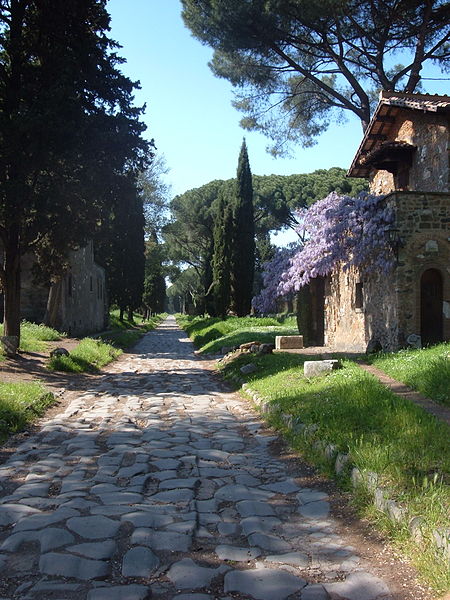
My father hired two old Italian guys to rebuild the wall. Italians have been masons and laying rock for thousands of years. The Appian Way is one of the world’s oldest paved roads, and it is still there, and works. Though the Italians invented cement, in our case, the wall wasn’t set with mortar or cement. It is the nestling of just the right rock next to each other, the pressure exerted of the whole structure, and gravity that keeps them all in place. (Photo, Appian Way, Wikimedia Commons)

The old guys had the rocks strewn all around. One of them would pick up a rock and test it, and look at it closely, turning it over and over. Feeling it all around with his hands, brushing off the sand and dirt, he’d put it next to the rock on the wall, and see if it fit. Nope. He’d pull it out and talk to the other Italian guy for a while, and after some talk, and laughter, taking their time, he would pick up another rock, and test it all over again.

Gradually, slowly, the wall took shape. Long and straight, it stands to this day.

In reading that verse last night at church, the picture of the old Italian guys came to my mind. I envisioned Jesus and the Holy Spirit, calmly and precisely talking, working together in perfect unity, laughing and admiring the work each was doing. Jesus saying to the Spirit, “draw that one over there to Me, I’m ready for Him… put that one here and this one next to it, ah, perfect fit…” The spiritual house is being built, in His timing, constructed to last forever, with us as the living stones. His precision is straight and true. As well as Potter and carpenter, I guess we can add Stone Mason to His construction skills, couldn’t we.

He is the Rock, the Chief Cornerstone…

“As you looked, a stone was cut out by no human hand, and it struck the image on its feet of iron and clay, and broke them in pieces.” (Daniel 2:35)

“For it stands in Scripture: “Behold, I am laying in Zion a stone, a cornerstone chosen and precious, and whoever believes in him will not be put to shame.”” (1 Peter 2:6).

He is the chief cornerstone, but having the Spirit in us, our souls are so intimately tied with Him that we also are stones. Little stones from the Rock. And here comes the pun: we are chips off the old block.

Bishop of Lincoln Robert Sanderson is said to have said it first in a 1637 sermon:
“Am not I a child of the same Adam … a chip of the same block, with him?”

We are of Adam, but our precious Lord didn’t leave us on the stone quarry floor. He picked us up, adopted us, polished us, built us up “to be a holy priesthood,” and set us in His spiritual House. Praise His merciful name, His grace is so generous!

Posted in catholicism, catholics, francis, grace, pope

Pope Francis denies Jesus

I’ve stated several times on this blog that any person who adheres to the Catholic faith, its creeds, or submits to the Pope as spiritual authority, isn’t saved. The Catholic religion is a false religion. Espousing, believing, or failure to renounce Catholic dogma means you will go to hell when you die. Mother Teresa is in hell. Every pope that ever lived in in hell. Catholicism denies the saving work of Jesus as the SOLE means of redemption. The Pope is a heretic. I hope I have been clear.

Today Pope Francis followed in his papist forbears’ footsteps by explicitly denying Jesus. I am going to post what he is quoted as saying, and then lead you through how it denies Jesus. Pope Francis exhibits the exact nature of the characteristic 2 Timothy 3:5 states we will see in the last days, an appearance of Godliness, but denying its power. Watch and read:

Pope says everyone can do good, regardless of belief

Every human person despite his or her beliefs can do good, and a sharing in good works is the prime place for encounter among those who disagree, Pope Francis said at his Mass today. “The Lord created us in his image and likeness, and we are the image of the Lord, and he does good and all of us have this commandment at heart: do good and avoid evil. All of us,” the Pope taught in his homily May 22 at St. Martha’s residence in the Vatican.

He went on to explain that all human persons are created in the image of God, who is goodness himself and the source of goodness. He emphasized the universality of Christ’s saving act on the cross as a compliment [sic] to the universal call to holiness, regardless of religious belief.

“The Lord has redeemed all of us, all of us, with the Blood of Christ: all of us, not just Catholics. Everyone.” “Even the atheists. Everyone,” Pope Francis stressed. He said that the saving blood of Christ “makes us children of God of the first class. We are created children in the likeness of God and the blood of Christ has redeemed us all. And we all have a duty to do good.”

In reading this, it becomes obvious that the Pope denied Jesus in three ways.

1. Doing good. Psalm 14:1 says there is none who does good. The Pope is talking about a human moral standard of doing good, relativistic and with no absolute benchmark. To men, doing good may mean giving back a lost wallet, or helping an old lady across the street. In God’s view, there is not one person who does good. We cannot achieve any standard of holiness on our own. Yet as the Pope is speaking in his religious capacity at Mass, he is saying we possess within us the standard of goodness that God accepts simply for having been born, because our “likeness” is like God’s.

The bible says none do good. Romans 3:10-12, “as it is written: “None is righteous, no, not one; no one understands; no one seeks for God. All have turned aside; together they have become worthless; no one does good, not even one.”

2. Universal salvation. The Pope said that even atheists are saved because Jesus died on the cross and shed His blood. ““The Lord has redeemed all of us, all of us, with the Blood of Christ: all of us, not just Catholics. Everyone. “Even the atheists. Everyone,” Pope Francis stressed.”” However, only those who repent and believe are saved. Romans 10:9 says “because, if you confess with your mouth that Jesus is Lord and believe in your heart that God raised him from the dead, you will be saved.” Also see Acts 126:31, 1 John 4:15, Mark 1:15).

What the Pope is really promoting is universal salvation. Rev. Matt Slick explains what universal salvation is. “Universalism is the teaching that all people will be saved. Some say that it is through the atonement of Jesus that all will ultimately be reconciled to God. Others just say that all will go to heaven sooner or later, whether or not they have trusted in or rejected Jesus as savior during their lifetime.”  The Pope’s statement is shocking to Catholics because previously, Catholic dogma stated that only Catholics are saved. They believe that the blood of Jesus atoned for only those who are in the Catholic denomination, excluding Baptists, Lutherans, etc. So the Pope claiming that the blood of Jesus saves all, and that all are saved, is astounding to Catholics. Catholics have pronounced anathema (curse) on all non-Catholics since 1545, but true believers know that the Pope’s words about salvation and redemption are false.

3. Jesus plus works. (Quote from the article: “He emphasized the universality of Christ’s saving act on the cross as a complement to the universal call to holiness, regardless of religious belief.”) According to the Pope, Jesus’s blood PLUS good works, AKA holiness, is the combination one needs for salvation. Worse, believing that the work of Jesus is a complement to anything else is heresy. This is in effect saying that our works is primary and Jesus’s work is a complement as complement is defined here: “Add to (something) in a way that enhances or improves it; make perfect.” His work on the cross is not a complement to anything. He IS the perfect! It is Jesus plus nothing which saves.

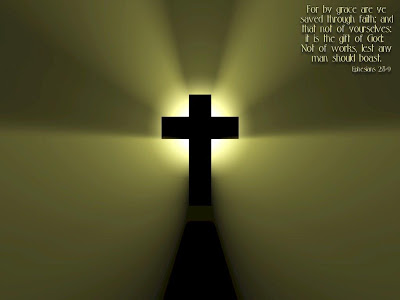
The bible says, “For by grace you have been saved through faith. And this is not your own doing; it is the gift of God, not a result of works, so that no one may boast.” Ephesians 2:8-9.

I hope this explanation has helped you see how influential and pervasive the false doctrines of the Catholic faith are and how much more dangerous they have become with this Mass today by the Pope. I had a terrible feeling when Pope Francis was elected, being a Jesuit. The march toward a prophesied universal faith, AKA one world religion seen in Revelation 13:15-17, just got a lot more real.

Posted in grace, martyr

Sunday Martyr Moment

I am reading Foxe’s Book of Martyrs. According to this summary from Christian Book Summaries,

Wiki photo of John Foxe, 1517-1587

Writing in the mid-1500s, John Foxe was living in the midst of intense religious persecution at the hands of the dominant Roman Catholic Church. In graphic detail, he offers accounts of Christians being martyred for their belief in Jesus Christ, describing how God gave them extraordinary courage and stamina to endure unthinkable torture.

From the same link, the book’s purpose was fourfold:

  • Showcase the courage of true believers who have willingly taken a stand for Jesus Christ throughout the ages, even if it meant death,
  • Demonstrate the grace of God in the lives of those martyred for their faith,
  • Expose the ruthlessness of religious and political leaders as they sought to suppress those with differing beliefs,
  • Celebrate the courage of those who risked their lives to translate the Bible into the common language of the people.

It is very affecting. I am so humbled by the descriptions of the martyrs since the earliest moments of our faith. As I go to worship on Sunday I think of them as Paul often depicted, running a race. It is a relay race and they hand the baton to the next generation, the baton being the word of the Lord as contained in the bible. The martyrs receive the Crown of Life! I can’t wait for the ceremony when they are called up front by Jesus to be acknowledged for their ultimate sacrifice, yet those who lay down their life will receive it. (Matthew 16:25)

“Blessed is the man who remains steadfast under trial, for when he has stood the test he will receive the crown of life, which God has promised to those who love him.” (James 1:12)

“Do not fear what you are about to suffer. Behold, the devil is about to throw some of you into prison, that you may be tested, and for ten days you will have tribulation. Be faithful unto death, and I will give you the crown of life.” (Revelation 2:10)

I can only read a bit at a time, because the stories of persecution are so powerfully evil, the demonstration of faith so humbling, and the grace bestowed upon martyrs so beautiful. But that’s good though, I hope it takes me a lifetime to read of the stories of my brethren.

Foxe starts with the first martyr, Stephen, and collects the martyrs’ stories into the ages. Foxe has a section on the Inquisition, and the updated book has modern martyrs also. Please stay with me on Sundays as I share stories of life and death, faith and evil, and the grace of Jesus. The book blurb says Foxe wanted us to remember the martyrs, ‘for he knew the blood of the martyrs is the seed of the church’. It is good to remember.

I’ll type out the passage from my book which is the updated version.

The second person to suffer and die for the church (after Jesus, who was not a martyr) was Stephen, whose name means ‘crown.’ (Acts 6-8).  He was martyred because of the faithful way in which he had proclaimed the Gospel to those who had killed Jesus. They became so enraged at what he sad to them that they drove him out of the city and stoned him to death. Stephen’s martyrdom came about 8 years after his Lord’s crucifixion, which would place his death in the year A.D. 35, since it was supposed that Jesus was actually born in about 6 B.C, two years before Herod the Great dies in 4 B.C. (See Matthew 2:16).

The same hate generated against Stephen apparently brought great persecution to all who professed faith in Christ as Messiah. Luke writes,

“And there arose on that day a great persecution against the church in Jerusalem, and they were all scattered throughout the regions of Judea and Samaria, except the apostles. ” (Acts 8:1b).

During that time about two thousand Christians were martyred, including Nicanor, who was one of the seven deacons appointed by the Church (Acts 6:5).

Thank you Stephen, thank you Nicanor. I will meet you, my brothers, in eternity’s New Jerusalem after the rapture.

Posted in faith, grace

Do a mighty work of God!

When we think of a mighty work of God, we often think of the Old Testament. Noah built the equivalent of the Queen Mary! Moses parted the Red Sea! David slew Goliath!

We often think of the New Testament. Peter pointed to Ananias and he dropped dead! Paul exorcised demons from a slave girl! John saw the future!

But did you know that you do mighty works as well? Yes, you do!

If you are raising a child to love the Lord, you are doing a mighty work of God.

If you are suffering in a dread disease with grace, you are doing a mighty work of God.

If you are attending church week in and week out, worshiping in spirit and truth, you are doing a mighty work of God.

If you witness to a stranger, you are doing a mighty work of God.

If you publicly repent of a sin, you are doing a mighty work of God.

The grace of our Risen Lord dwells within us and if we are enjoined in holy living for His sake and on His strength, it is a mighty work of God!

“In this the love of God was made manifest among us, that God sent his only Son into the world, so that we might live through him.” (1 John 4:9)

Posted in grace, jesus, prayer, spiritual armor

Put on your armor and cling to the Rock!

Here is some good scripture for you. I hope it motivates and comforts you, as it does me:

“10Finally, be strong in the Lord and in the strength of his might. 11Put on the whole armor of God, that you may be able to stand against the schemes of the devil. 12For we do not wrestle against flesh and blood, but against the rulers, against the authorities, against the cosmic powers over this present darkness, against the spiritual forces of evil in the heavenly places. 13Therefore take up the whole armor of God, that you may be able to withstand in the evil day, and having done all, to stand firm. 14Stand therefore, having fastened on the belt of truth, and having put on the breastplate of righteousness, 15and, as shoes for your feet, having put on the readiness given by the gospel of peace.”

“16In all circumstances take up the shield of faith, with which you can extinguish all the flaming darts of the evil one; 17and take the helmet of salvation, and the sword of the Spirit, which is the word of God, 18praying at all times in the Spirit, with all prayer and supplication. To that end keep alert with all perseverance, making supplication for all the saints, 19and also for me, that words may be given to me in opening my mouth boldly to proclaim the mystery of the gospel, 20for which I am an ambassador in chains, that I may declare it boldly, as I ought to speak.” (Ephesians 6:10-20).

Look back at the first verse, be strong, this is a command, but do it in HIS might. We know we are not strong, we are weak. Therefore the Spirit helps us in our weakness. (Romans 8:26). The Lord sends ministering angels. (Hebrews 1:14, Hebrews 13:2). He sends armor, as we read above. This support is sent to us because we must never forget we are in a battle. We are not warring against people. The ungodly act the way they do because they cannot help it. The Godly act the way they do because the flesh is weak and we stumble, but we are to love and restore because we stand on the same blood-soaked ground together that Christ died for us. Those are the only classes of people, unsaved and saved. Therefore, we do not war against people. Our battle is spiritual. (Photo- be strong and stand firm, you’re on the Rock! photo credit: Dru! via photopin cc)

In the case of the Spirit, He is in us and we follow His lead. We do nothing except follow. In the case of the angels, we are unaware of how or when they help us, but we trust His word that they do. We do nothing because we don’t know they are there. In the case of the armor, we must do something- put it on and wield it.

Whatever portion or part of the armor you need today, wield it. I am wielding the shield of faith so as to extinguish the darts of the evil one. Barnes Notes explains beautifully why this one is the most important of the suit of armor:

“Faith here is made to occupy a more important place than either of the other Christian graces. It bears, to the whole Christian character, the same relation which the shield does to the other parts of the armor of a soldier. It protects all, and is indispensable to the security of all, as is the case with the shield. The shield was an ingenious device by which blows and arrows might be parried off, and the whole body defended. It could be made to protect the head, or the heart, or thrown behind to meet all attack there. As long as the soldier had his shield, he felt secure; and as long as a Christian has faith, he is safe. It comes to his aid in every attack that is made on him, no matter from what quarter; it is the defense and guardian of every other Christian grace; and it secures the protection which the Christian needs in the whole of the spiritual war.”

Look at the part of the verse which states we are fighting against the “cosmic powers.” Does that make you feel like a superhero? It should, partly! It is Christ in us who overcame and overcomes the cosmic powers, He is THE Superhero. But it is completely amazing that He uses us in the battle! Life on earth is really a long training session in Gladiator School, lol.

When He sends us out as sheep among wolves, He does not leave us alone! (Matthew 10:16). He does not save us just to leave us alone in the middle of the pasture with a pack of wolves out to get us. We are not alone. Oh, the wolves are there, and will try hard to devour the sheep, but those who endure and hold fast will be shown in the end to be the righteous ones. (Matthew 10:26). Meanwhile, we have armor, and help.

The passage above goes on with even more tremendous ammunition- prayer! Verse 18 reminds us of the power of prayer as we do our acts for God. Never feel like you’re ‘bugging God’ with too many petitions. We are told to do so. ‘Make supplication at all times in the Spirit’. Oh, wait, that was another very present help that’s listed in the passage! The Spirit! He is so gracious to send all these helps!

When you have the whole armor on, stand firm. After all, He sent His Son to retrieve us from the clutches of the evil one. He overcame so that we would not be snatched out of His hand. He sends squads of angels. He gives armor. He sent the Spirit to dwell in us. He gave us each other to encourage each other. He encourages prayer, listens, and answers. He sent His word to strengthen us and equip us. Wow!

He sent His grace, which is sufficient. His grace alone is sufficient to win the battle. Yet how much more abundantly does He equip us to withstand these present evil days!

Stand firm. Have faith. Love God and Fear His name. You will be all right 🙂

Posted in grace, works

The proidigal son never got to say…

Did you ever notice this? I hadn’t. I was listening to Todd Friel’s lecture series “Drive By Discernment” and RW Glenn made the point.

When we read the parable of the Prodigal Son, (Luke 15:11-32) we know that the elder son represents works related salvation. However did you ever notice this subtlety which also speaks to the futility of works related salvation in the younger son?

The younger son had gone off with and lived large, and had run out of money. He’d turned to slopping pigs for pay. He decides that he can do that at his father’s house, so he heads home. Along the way, this younger son rehearses what he is going to say when he meets the father. Luke 15:18-24 (Geneva bible) has the scene within the scene:

I will rise and go to my father, and say unto him, Father, I have sinned against heaven, and before thee, And am no more worthy to be called thy son: make me as one of thine hired servants. So he arose and came to his father, and when he was yet a great way off, his father saw him, and had compassion, and ran and fell on his neck, and kissed him. And the son said unto him, Father, I have sinned against heaven, and before thee, and am no more worthy to be called thy son. Then the father said to his servants, Bring forth the best robe, and put it on him, and put a ring on his hand, and shoes on his feet, And bring the fat calf, and kill him, and let us eat, and be merry: For this my son was dead, and is alive again: and he was lost, but he is found. And they began to be merry.”

The Father interrupts the son! The son never actually says ‘Let me work for you as a hired hand’. Grace was given after the son said “I have sinned.”

I love the holy word, don’t you?! Worship the Father of all Grace today, this Lord’s Day.

Posted in grace, pope, rcc, works religion

Why works-based faiths like the Catholic religion will not save you

My posts on the resignation of the Pope and the resulting discussion that the Roman Catholic Church is a false church has received more views than any post I’ve ever done, by at least double. Not only is it huge news that the Pope resigned, but it is news to many when someone declares flatly that the RCC is a false church and it promotes doctrines of demons.

(Left, Pope Pius IX, was the longest-reigning elected Pope in the history of the Catholic Church, serving from 16 June 1846 until his death, nearly 32 years. During his pontificate, he convened the First Vatican Council in 1869, which decreed papal infallibility. He also defined the dogma of the Immaculate Conception of the Blessed Virgin Mary, meaning that Mary was conceived without original sin. Previously, those doctrines were not an official part of Catholic dogma.)

Here are the three posts I’ve written about the RCC Pope, and the Prophecy of the Popes:

1. December 2011, Pope Benedict’s health failing, St. Malachy’s prophecy comes up again
2. February 2013, Pope Benedict resigned- will the next pope validate Malachy’s prophecy?
3. February 2013, Catholicism is not a Christian religion

The comments have been respectful for the most part. I have only had to delete a few out of hand for profanity or for not adding anything to the discussion (i.e. ‘You’re all nuts!” kinds of comments get deleted. At least tell us WHY you think we’re nuts…lol). Thank you all for reading and commenting.

In the comment section yesterday, someone had asked about how to witness to Catholics. It was a good question, and I responded. I thought I’d make my response be a post by itself. This is that post.

Any religion besides Christianity, which is to say, every other religion, promotes some form of works toward a person’s salvation. I say again, all other religions in some form or fashion are a works-based religion. How do I know this? Because there is grace, and works. Christianity is a grace based religion. Salvation comes because of the grace bestowed on penitents who believe in the atoning sacrifice of Jesus and His resurrection. He is the only God who can and who does bestow grace, absolve sins, and resurrect the dead. No other religious figure can do that because no other figure has risen from the dead. Therefore in the false religions, lacking the one thing that can actually save a person, the proponents of these false religions add works to their schema to cover the deficit.

In attempting to attain heaven by his own efforts, man forgets how holy God is and how lowly and polluted with sin we are. Attempting offer works to Jesus as an entry validation is like offering Jesus a filthy rag as your best effort. Isaiah 64:6a says-

We have all become like one who is unclean, and all our righteous deeds are like a polluted garment.

Not to get too graphic, but the word for polluted garment is actually Hebrew for used menstrual rag. Believing we can get to heaven on our own works means when you stand before Holy God, and we all will, you will in effect hold out a used and crusty Tampax, and say “Here is a gift for you, Jesus, these are my works. Now I can go into heaven, right?”

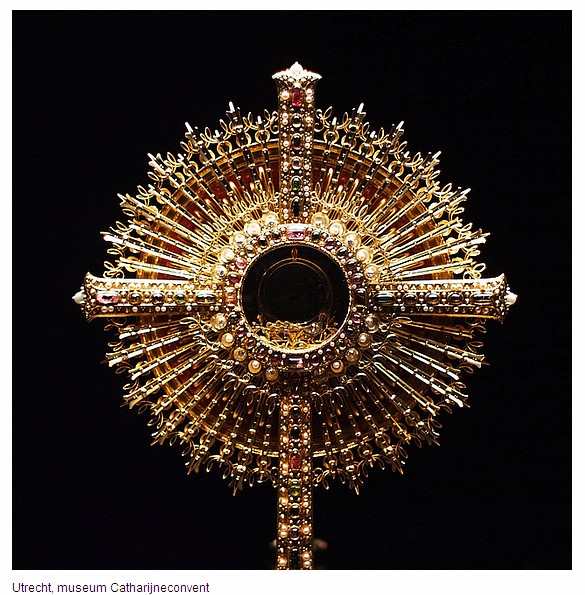
Unappealing, right? God hates sin and cannot even look at sin or the sinner. He is angry over sin. He is personally angry with you by name, over your sin. (Exodus 4:14; 15:7; Leviticus 26:27-33; Numbers 11:1; 12:9; 22:22; 25:3; Deuteronomy 3:17; 29:24-29; Joshua 7:1; Judges 2:14; 2 Samuel 24:1; 1 Kings 14:15; 15:30; 16:2; 25:53; 2 Kings 13:3; 17:11; 23:19; 1 Chronicles 13:10; 2 Chronicles 28:25; Psalm 7:11; 11:4-7; Hebrews 10:27). (Right, Monstrance, a vessel used to show the consecrated Eucharistic host; Utrecht Museum, by Johan)

Get the idea? There is only His grace, and our works. His grace is pure and holy, and our works are a used tampon.

Buddhism, though seemingly altruistic in their promotion of good deeds toward others, is really at root a works based religion because one must work on one’s self before one can attain a state of nirvana. A Buddhist must work on their attitude toward worldly attachments, and once releasing all attachment to any self-desires, can then turn around and help others. Buddhism is an inward works based religion. I know I’m generalizing here, but you get the idea in broad strokes. A Buddhist must work on himself before attaining happiness and being able to help others.

Islam is the same but different. Allah’s grace descends upon the believer but the person must perform good works toward others. The entry into paradise for the Muslim is dependent upon a combination of grace and works. If the Muslim has performed more good works than bad, he’s in. However, the believer never quite knows where he stands…so the tension inside their heart is very heavy. To make matters worse, the Koran states that both good and evil come from Allah, and he is capricious. When you get to Allah’s Paradise gate good deeds may indeed outweigh the bad, but Allah may say “begone with you” anyway. The only sure way to please Allah for sure and make it into an Islamic paradise is to be a suicide martyr. And now you know why they line up for the job…

In Catholicism, works also figures in. God’s grace is upon the believer, but that grace is only an enabling function. It enables one to do good works and it is that which they will be judged as worthy or not for heaven.

In Christianity, we receive a free gift when God says, ‘you believe on the Son, therefore I declare you innocent of your sins, justified in My eyes.” (Titus 3:7). In the RCC, justification is denied.

  • If any one saith, that by faith alone the impious is justified; in such wise as to mean, that nothing else is required to co-operate in order to the obtaining the grace of Justification, and that it is not in any way necessary, that he be prepared and disposed by the movement of his own will; let him be anathema” (Council of Trent, Canons on Justification, Canon 9)
  • “If any one saith, that man is truly absolved from his sins and justified, because he assuredly believed himself absolved and justified; or, that no one is truly justified but he who believes himself justified; and that, by this faith alone, absolution and justification are effected; let him be anathema.” (Canon 14).

Anathema means excommunicated from the body of believers or it means cursed, usually both. The RCC does not come right out and say ‘you must work for salvation’ but that is what they teach. You can read here an essay outlining the key differences between Catholic and Christian doctrines.

One of the biggest burdens in all works-related salvation schemes, Catholicism included, is a secret, nagging fear and burden in the person that they may not be ‘doing enough.’ Mormons are particularly burdened with these secret thoughts, which they rarely verbalize, but are there. Catholics have these interior fears as well, because they are taught that they must maintain their salvation. As any sinner knows, even those who are thoroughly saved and rest on Jesus’s grace alone, we stagger with our conscience in knowing how desperately wicked we are. So any person depending on works in any way for their salvation will always fear they are missing the mark. Catholics are always worried. They have to be, they have no assurance of their salvation!

“If you could lose your salvation, you would.”
As John MacArthur replied once when asked about salvation, “if you could lose your salvation, you would.” That simple truth cuts right to the heart of works-based religions. Imagine the fear and burden of a Catholic wondering if they have recovered from their last sin enough. If they said enough hail Marys. If they will go to purgatory or heaven…

In witnessing to a Catholic, I think that focusing on the simplicity and perfection of grace alone will go a long way toward penetrating a Catholic’s mind and heart, because that is where the anxiety is, in my opinion. Humans simply do not have the perseverance to live a sinless life. Humans are not capable of accumulating enough resources to reach heaven. Only Jesus did that. People in works-based religions are always wondering, “Have I done enough?”

photo credit: John Steven Fernandez via photopin cc

In the faith that Jesus delivered to the saints once for all, HE is the one who did enough! We can have assurance of the perfection and completion of His work because God accepted Jesus as the sacrifice, raising Him from the dead. His grace is sufficient for all believers, no more works are needed, because as Jesus said,

“It is finished.”

John 19:30 records the last words of Jesus in His earthly ministry. It is finished means “As if he had said: “I have executed the great designs of the Almighty – I have satisfied the demands of his justice – I have accomplished all that was written in the prophets, and suffered the utmost malice of my enemies; and now the way to the holy of holies is made manifest through my blood.” An awful, yet a glorious finish. Through this tragical death God is reconciled to man, and the kingdom of heaven opened to every believing soul.” (Clarke’s Commentary on the Bible)

It is awful, as Clarke said, but it is simple. We only need to believe on the work of Jesus through the cross to be saved. It sounds so uncomplicated, doesn’t it? It is. The layers of works and tradition that the RCC has overlaid on this simple and awful-beautiful truth is the monstrous thing. Laying our works on His work is grotesque. Believe on the Son and be saved, beloved. How can one be saved? I will say again, using the words of the Holy Spirit,

“Believe in the Lord Jesus, and you will be saved” (Acts 16:31).

cross photo credit: Christopher JL via photopin cc
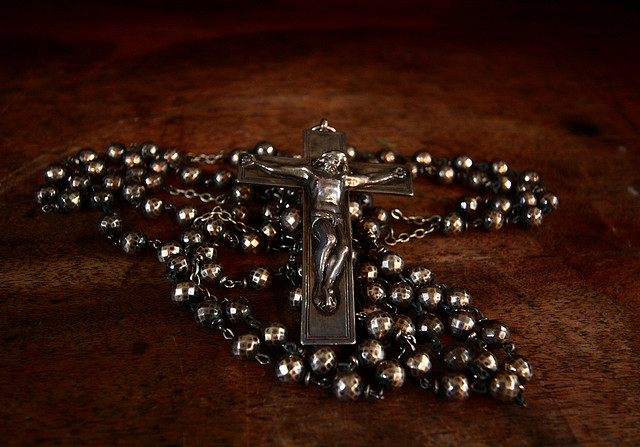
rosary photo credit: Lawrence OP via photopin cc

Posted in christmas, grace, Immanuel

On the joy of discovering I am a wretch

I used to enjoy visiting cathedrals, basilicas, abbeys, cloisters … anything that was old and resembled something artistic and architectural.

Milan, Italy. Duomo

I enjoyed the peace inside, the stillness and coolness. I liked to look at the art and the statues. Visiting a church as a tourist is different than belonging to one as a Christian. I was blind, I did not see.

Paris, Notre Dame

In Pisa, I enjoyed the acoustic perfection of the Baptistry. Really. It is acoustically perfect. And who doesn’t love the story of the Leaning Tower? I heard the sound of a tenor voice sweetly rumbling among the rafters in the Baptistry. I could hear the notes, but I was blind. I did not see.

Enjoying a church as an architectural wonder is great, but it got me no closer to Jesus.

Quito, Bell Tower

These churches are mausoleums to emptiness, odes to nothingness. And far be it for me to visit a working, bible believing church. Too new. Too uninteresting. It had nothing for me. Sigh… I was so blind. Far better to stick with large, tourist oriented churches. Safer that way.  I heard the bells and listened to the choirs and studied the history, but I was blind…

St. Paul’s Cathedral, London

Even in a simple clapboard church, if I happened to visit for a service, and if they happened to play the wonderful hymn, Amazing Grace, I’d sing, all right. But when it came to the part about ‘saved a wretch like me’, I clamped my mouth shut. I was not a wretch, I was not, I was not! That lyric was stupid, I thought. But I was blind. How could I see the most important thing?

Labrador

I sang of grace, but I didn’t know what grace was. (Unmerited favor from God). How could I possibly know how amazing it is? I didn’t. I sang pretty words that had no meaning for me. “I once was lost but now I’m found” is a comforting lyric. I could safely relate to that. Who doesn’t find comforting the notion of being lost but found and enveloped in arms of love? Yet I was blind, and did not know I was lost and I did not know love. I didn’t know the height from which the arms came down to envelop me nor the depths of sin in which I was living. (1 John 5:17)

Then I was saved. (Grace!) I came to know Jesus (Amazing!) But the most important thing of all is learning that He is not in a cathedral or abbey or cloister or basilica. He is now in my heart and He is now with me wherever I go. I had been looking for Him the whole time, but I was missing Him by a mile.

I praise God that He came down to us as a babe. Grace came down to live with us (Immanuel; Matthew 1:22-23). He lived a perfect life so that He would qualify as the Lamb of God to be slain as the sacrifice for sin. He sent me a spirit of repentance and of faith so that I could know Him and be reconciled to Him with no wrath between us. (Romans 8:7).

Now I have the best Christmas gift of all: I know I am a wretch! I sing that lyric with gusto. I know Jesus loves us and He came to put away sin. I know that in my wretchedness He came to save me. I once was lost but now I’m found. Christmas, (and Easter), made it all possible. Thank you Jesus. Happy Birthday!

Amazing Grace, how sweet the sound,
That saved a wretch like me.
I once was lost but now am found,
Was blind, but now I see.

The best photo of all —

Posted in grace, mourn, sin

George Carlin, sin, and Godly sorrow

This is a weird coincidence. I queued up the original episode of Saturday Night Live, which debuted in October 1975. As I began to watch, I listened to host George Carlin’s opening monologue. I was thinking I first watched it 38 years ago, and my how the time flies by. I was wondering how many of the cast are dead by now. Just then, Carlin asked,

“Do you ever look at the crowds in old movies and wonder if they’re dead yet?”

Either I should be spooked by the coincidence, or worried that I think like George Carlin. Anyway, here are the ones who are dead:

Dan Aykroyd
Chevy Chase
John Belushi
Jane Curtin
Garrett Morris
Laraine Newman
Gilda Radner

First head writer: Michael O’Donoghue
First musical performer: Billy Preston
First host: George Carlin

Did Carlin ever wonder if someone would wonder that about him?

During the program, Carlin joked about the vagaries of the English language, which was funny. He mocked corporate and government America, which was intellectually provoking. Then of course Carlin landed on Jesus as his main topic of satiric rebuke. He settled in to a riff of disdain for the Savior, so I turned it off.

My mind then went further on the “are they dead now” thought. George Carlin spent a lifetime mocking the only One who could save Him from hell, and hell is surely where Carlin is right now. Carlin is living the ultimate irony. I mourned.

Far from chortling over someone’s eternal destiny, I do cry, lament, become melancholy. The deeper I go into Christ, the deeper the grief over the world and over people who reject eternal life. When I look a them I see walking skeletons. They are dead in their trespasses.

It’s like when you pass an accident by the side of the road. All these lives, millions upon millions of lives are wrecks, and yet I can’t look away. For example, I watched a biopic of Sonny & Cher last night. Sonny Bono was killed in a ski accident in 1998 at the Heavenly Ski Resort. He was an avowed Roman Catholic who dabbled in Scientology. Chances are, though he died in a place called heavenly, he is not there now. While watching the biography movie, that was all I could think about. Except when my thoughts went to Cher, who is living out Jonathan Edwards’ famous sermon “Sinners in the hands of an Angry God,” and that her foot shall slide in due time. Then I thought of their child, sweet Chastity Bono, who had a sex change operation and is now a man called Chaz. Yet another grief to lament another lost soul.

The problem is, the whole world is an accident at the side of the road. There is no way to look away. Nowhere to avert one’s eyes so as not to see the carnage. It’s all a wreck.

Though this seems like a downer, and it is really, there is an upside. First, because I don’t think I’m the only one to feel this way. After Newtown School Massacre, I think many Christians were brokenhearted for the world. The act brought us to new levels of grief. One cannot help but think about the effects of the fallen world on unsaved individuals polluted by almost total corruption.

Additionally, as the chasm between sinner and saved grows wider prior to the rapture, and the world comes hurtling toward its prophesied end, many on the side of Jesus feel the weight of loss. John MacArthur spoke of it at a Q & A recently. He said the older he gets, the sadder he gets. This is because the deeper in Christ you go the more vivid sin becomes to us. In his sermon, Satan’s Plan for the Church, he said more,

“The older I get and I’m sure it’s true with you if you think about it, the older I get, the more I realize that the world has fallen. The older I get, I guess the more I realize that basically things are not going to get any better. They continue to get worse. Everything in the world has been touched or tainted, has been marred or scarred by the pervasive power and the presence of sin. And that our entire world and our entire universe and our very culture itself is winding down becomes imminently obvious to anyone who looks. No matter how good, no matter how successful, no matter how prosperous, no matter how happy people might be in any given moment, they’re always on the brink of disaster, always on the brink of destitution, always on the brink of evil, sorrow, failure and such is the nature of life in a fallen world.”

Yes, mourning over sin is a downer, but the upside is that Jesus is gracious. He has anticipated each and every feeling and circumstance humans have or ever will have. He said, in Matthew 5:4,

“Blessed are those who mourn, for they shall be comforted.”

I believe this means those who mourn over sin are blessed.

“For godly grief produces a repentance that leads to salvation without regret, whereas worldly grief produces death.” (2 Corinthians 7:10).

I believe this means the true source of every grief is sin, and so the only comfort in Godly grief is Jesus.

“Truly, truly, I say to you, you will weep and lament, but the world will rejoice. You will be sorrowful, but your sorrow will turn into joy.” (John 16:20).

In that verse, Jesus was foretelling His death and resurrection on the cross to His disciples, but I believe we can extrapolate that to a generalized feeling of hope of the future joy He will bring when He finally disposes of all sin and we lay eyes on His resurrected Self.

If you have been mourning over sin, for whatever reason and in whatever form, take heart. Psalm 56:8 says:

“You have kept count of my tossings; put my tears in your bottle. Are they not in your book?”

The ancient Greeks and Romans used to actually collect tears of grief and place them into small bottles baked of clay or fashioned out of onyx or agate, and either bury them with the loved one or keep them as a memorial of friendship or love over loss. These bottles were called lacrymatories. When David asks God ‘are they not in your book?’ he knows God has taken an exact account of all the tears shed in relation to His business.

Grief over sin, our own and the world’s, is a weighty thing, but Jesus has the scales in His hand and He knows exactly to the ounce how much we can carry.

Ultimately, each tear shed over sin is a connection to the grace of Jesus. Take comfort in that, my dear brethren. “For this light momentary affliction is preparing for us an eternal weight of glory beyond all comparison,” (2 Corinthians 4:17)