Posted in catacombs, early christian, foxe's book of martyrs, rome

Sunday Martyr Moment: Coliseum and Catacombs

Foxe’s Book of Martyrs. According to this summary from Christian Book Summaries,

Writing in the mid-1500s, John Foxe was living in the midst of intense religious persecution at the hands of the dominant Roman Catholic Church. In graphic detail, he offers accounts of Christians being martyred for their belief in Jesus Christ, describing how God gave them extraordinary courage and stamina to endure unthinkable torture.

From the same link, the book’s purpose was fourfold:

  • Showcase the courage of true believers who have willingly taken a stand for Jesus Christ throughout the ages, even if it meant death,
  • Demonstrate the grace of God in the lives of those martyred for their faith,
  • Expose the ruthlessness of religious and political leaders as they sought to suppress those with differing beliefs,
  • Celebrate the courage of those who risked their lives to translate the Bible into the common language of the people.

Text from Foxe’s Book of Martyrs

“It has been said that the lives of the early Christians consisted of “persecution above ground and prayer below ground.” Their lives are expressed by the Coliseum and the catacombs. Beneath Rome are the excavations which we call the catacombs, which were at once temples and tombs. The early Church of Rome might well be called the Church of the Catacombs. There are some sixty catacombs near Rome, in which some six hundred miles of galleries have been traced, and these are not all. These galleries are about eight feet high and from three to five feet wide, containing on either side several rows of long, low, horizontal recesses, one above another like berths in a ship. In these the dead bodies were placed and the front closed, either by a single marble slab or several great tiles laid in mortar. On these slabs or tiles, epitaphs or symbols are graved or painted. Both pagans and Christians buried their dead in these catacombs. When the Christian graves have been opened the skeletons tell their own terrible tale. Heads are found severed from the body, ribs and shoulder blades are broken, bones are often calcined from fire. But despite the awful story of persecution that we may read here, the inscriptions breathe forth peace and joy and triumph. Here are a few:

“Here lies Marcia, put to rest in a dream of peace.”
“Lawrence to his sweetest son, borne away of angels.”
“Victorious in peace and in Christ.”
“Being called away, he went in peace.”
Remember when reading these inscriptions the story the skeletons tell of persecution, of torture, and of fire.
But the full force of these epitaphs is seen when we contrast them with the pagan epitaphs, such as:
“Live for the present hour, since we are sure of nothing else.”
“I lift my hands against the gods who took me away at the age of twenty though I had done no harm.”
“Once I was not. Now I am not. I know nothing about it, and it is no concern of mine.”
“Traveler, curse me not as you pass, for I am in darkness and cannot answer.”

The most frequent Christian symbols on the walls of the catacombs, are, the good shepherd with the lamb on his shoulder, a ship under full sail, harps, anchors, crowns, vines, and above all the fish.”

~~~~~~~~~~~~~~~~~~~~~~~~~~~

Wikipedia explains the Catacombs: “The Catacombs of Rome (Italian: Catacombe di Roma) are ancient catacombs, underground burial places under Rome, Italy, of which there are at least forty, some discovered only in recent decades. Though most famous for Christian burials, either in separate catacombs or mixed together, they began in the 2nd century AD,[1] much as a response to overcrowding and shortage of land. Many scholars have written that catacombs came about to help persecuted Christians to bury their dead secretly. The soft volcanic tuff rock under Rome is highly suitable for tunnelling, as it is softer when first exposed to air, hardening afterwards. Many have kilometres of tunnels, in up to four storeys (or layers). The Christian catacombs are extremely important for the art history of early Christian art, as they contain the great majority of examples from before about 400 AD, in fresco and sculpture. The Jewish catacombs are similarly important for the study of Jewish art at this period.”

Below, Early Christian funerary art from the Roman catacombs depicting the good shepherd 3rd-5th century CE
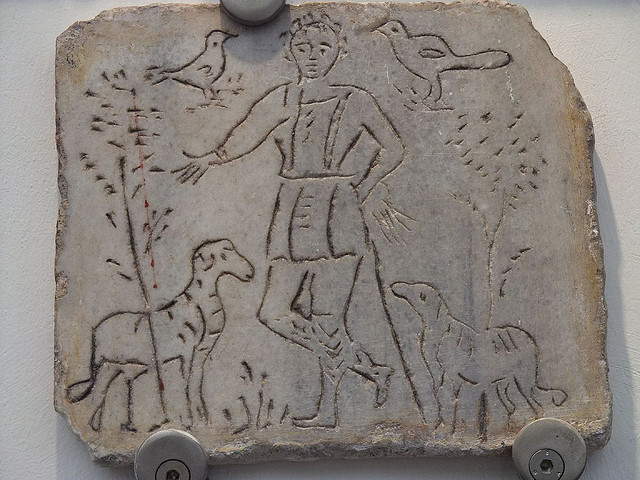
photo credit: mharrsch via photopin cc

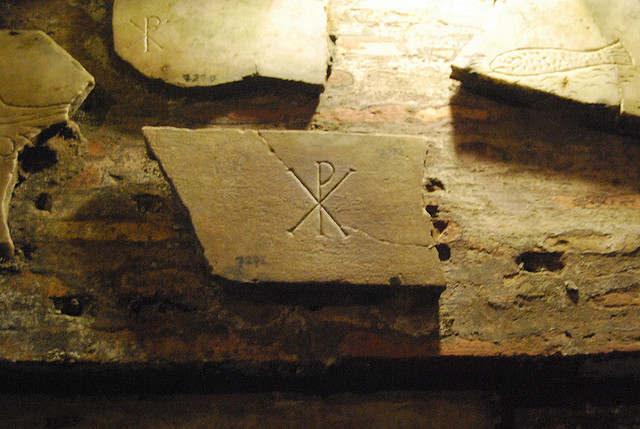
Catacombs of San Callisto; in the center, the Chi Rho — a commonly used Greek monogram for Christ. Also note the fish in the upper right hand corner, another Christian symbol — the letters in the Greek word for symbol were an an anagram for “Jesus Christ, Savior, Son of God.More at Jim Forest’s Photostream

photo credit: jimforest via photopin cc

~~~~~~~~~~~~~~~~~~~~~~~

I visited the Colosseum and the Catacombs when I was in Rome some years ago. The Colosseum was where many thousands of Christians were slaughtered for the name of Jesus. The Catacombs was the place where they were buried. They tunneled under ground secretly because no one was allowed to be buried within the walls of the city, and land was expensive anyway. Christians were usually poor and could not afford land. Wealthy Brethren donated land for the purpose, and the Catacombs were born.

Photo Jim Forest

 When I was there, I wasn’t saved yet. After visiting these two important places in the birth of Christianity, my only takeaway was of the Colosseum, that the Romans were geniuses at engineering, and from the Catacombs, how small the early Romans were. Their funeral holes in the walls of the tufa were a mere four or five feet.

How I wish I could go back there now that I am part of the great, eternal body of believers, connected through time by the blood of Jesus. Now I know of the plan of redemption God promised His Son from before the foundation of the world (1 Peter 1:20, Titus 1:1-2). I would give the places more respect, pray in praise for our Magnificent God for creating a people who, by the Spirit endured death for His holy name, and thank Him for my inclusion in this great Body.

As it is, I’ll do the same from my chair here in Georgia, because I know that though my body may perish, it will be resurrected and united with my eternal soul, in a timeless and boundary-less place called heaven.

~~~~~~~~~~~~~~~~~~~

Further reading from this blog,

Colosseum- “Take Heart Grieving Family Members!

External reading:

The Catacombs of San Callisto

The earliest surviving Christian art is from the Catacombs of Rome. Here is a five-minute Youtube video explaining the art of the catacombs. And here is a five-minute pictorial representation of the art, set to Latin chant, on Youtube.

Posted in foxe's book of martyrs, martyr

Sunday Martyr Moment: Alexander of Rome, Zenon, Faustines & Jovita

Foxe’s Book of Martyrs. According to this summary from Christian Book Summaries,

Writing in the mid-1500s, John Foxe was living in the midst of intense religious persecution at the hands of the dominant Roman Catholic Church. In graphic detail, he offers accounts of Christians being martyred for their belief in Jesus Christ, describing how God gave them extraordinary courage and stamina to endure unthinkable torture.

From the same link, the book’s purpose was fourfold:

  • Showcase the courage of true believers who have willingly taken a stand for Jesus Christ throughout the ages, even if it meant death,
  • Demonstrate the grace of God in the lives of those martyred for their faith,
  • Expose the ruthlessness of religious and political leaders as they sought to suppress those with differing beliefs,
  • Celebrate the courage of those who risked their lives to translate the Bible into the common language of the people.

Text from Foxe’s Book of Martyrs:

Trajan being succeeded by Adrian, the latter continued this third persecution with as much severity as his predecessor. About this time Alexander, bishop of Rome, with his two deacons, were martyred; as were Quirinus and Hernes, with their families;

Zenon, a Roman nobleman, and about ten thousand other Christians.

In Mount Ararat many were crucified, crowned with thorns, and spears run into their sides, in imitation of Christ’s passion. Eustachius, a brave and successful Roman commander, was by the emperor ordered to join in an idolatrous sacrifice to celebrate some of his own victories; but his faith (being a Christian in his heart) was so much greater than his vanity, that he nobly refused it. Enraged at the denial, the ungrateful emperor forgot the service of this skillful commander, and ordered him and his whole family to be martyred.

Today: Deadly attacks force Christians
to flee villages in Nigeria’s Middle Belt (source)

At the martyrdom of Faustines and Jovita, brothers and citizens of Brescia, their torments were so many, and their patience so great, that Calocerius, a pagan, beholding them, was struck with admiration, and exclaimed in a kind of ecstasy, “Great is the God of the Christians!” for which he was apprehended, and suffered a similar fate.

Many other similar cruelties and rigors were exercised against the Christians, until Quadratus, bishop of Athens, made a learned apology in their favor before the emperor, who happened to be there and Aristides, a philosopher of the same city, wrote an elegant epistle, which caused Adrian to relax in his severities, and relent in their favor. Adrian died in 138 AD and was succeeded by Antoninus Pius. Emperor Pius was one of the most amiable monarchs that ever reigned, and stopped all persecutions against the Christians.

~~~~~~~~~~~~~~~~~~~~~~~~~~~
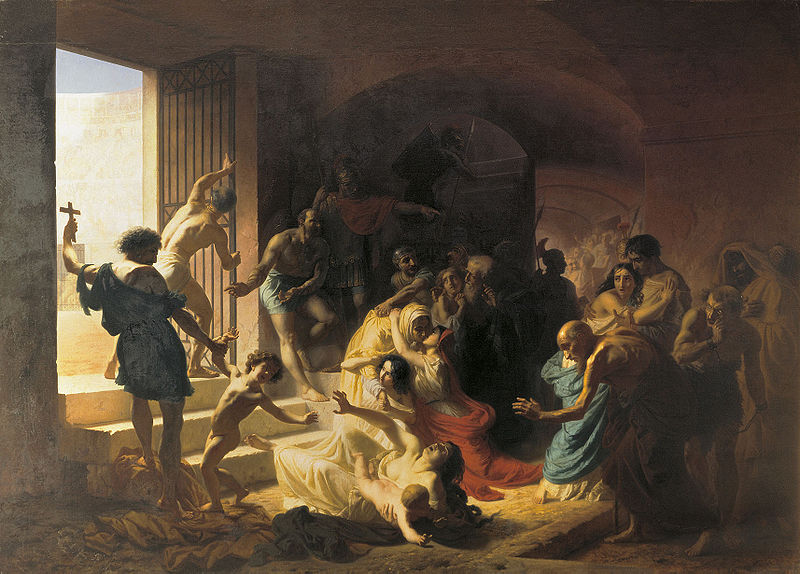
Christian Martyrs in the Colosseum by Konstantin Flavitsky

Faustines and Jovita were patient under persecution, glorifying God. The Gentiles watch us and they notice. The observer Quadratus was struck with the faith of the two brothers under torture, and thus he knew that the brothers were men of God and their faith came from God. How hollow faith in Zeus must have seemed in comparison!

No matter what kind of trial we are under, we should always be kind and patient. Many of our brethren are undergoing persecution in parts of the world. 45 Christians were killed in bombings at churches in Kano city, Nigeria. In Egypt, the Muslim Brotherhood is taking their anger out on Christians.

A Pakistani teen who provoked an international outcry when she was falsely accused of burning Islam’s holy book is finally out of danger and settling into a new life in Canada. But while Rimsha Masih and her family have been granted asylum and were quietly relocated to southern Ontario, life for much of the Christian community they left behind in Islamabad remains bleak.”

The Name Of Jesus Has Become A Dirty Word In Politically Correct America
“In the United States today, there are very few words that provoke as much outrage as the name of Jesus.  It is being banned from graduation ceremonies, chaplains all over America are being forbidden from using His name in their prayers, and many school officials all over the nation have become absolutely fanatical about eliminating every trace of Christian expression from their schools. One elementary school in North Carolina even ordered a little six-year-old girl to remove the word “God” from a poem that she had written to honor her grandfathers.”

O, Lord, please give strength and supernatural faith to those who are living in such deadly situations. Let the glory of the Lord shine out from them in the face of their persecutors. For those of us in places where we are not hunted to death (yet) such as Canada or the US, let us who are maligned or mocked also show grace to those who spit on the name of Jesus. Give us supernatural kindness so that like Calocerius, a pagan, beholding us, would be struck with admiration, and exclaim, “Great is the God of the Christians!”

Posted in foxe's book of martyrs

Sunday Martyr Moment: Ignatius

Foxe’s Book of Martyrs. According to this summary from Christian Book Summaries,

Writing in the mid-1500s, John Foxe was living in the midst of intense religious persecution at the hands of the dominant Roman Catholic Church. In graphic detail, he offers accounts of Christians being martyred for their belief in Jesus Christ, describing how God gave them extraordinary courage and stamina to endure unthinkable torture.

From the same link, the book’s purpose was fourfold:

  • Showcase the courage of true believers who have willingly taken a stand for Jesus Christ throughout the ages, even if it meant death,
  • Demonstrate the grace of God in the lives of those martyred for their faith,
  • Expose the ruthlessness of religious and political leaders as they sought to suppress those with differing beliefs,
  • Celebrate the courage of those who risked their lives to translate the Bible into the common language of the people.

The Third Persecution, Under Trajan, A.D. 108

In the third persecution Pliny the Second, a man learned and famous, seeing the lamentable slaughter of Christians, and moved therewith to pity, wrote to Trajan, certifying him that there were many thousands of them daily put to death, of which none did any thing contrary to the Roman laws worthy of persecution. “The whole account they gave of their crime or error (whichever it is to be called) amounted only to this-viz. that they were accustomed on a stated day to meet before daylight, and to repeat together a set form of prayer to Christ as a God, and to bind themselves by an obligation-not indeed to commit wickedness; but, on the contrary-never to commit theft, robbery, or adultery, never to falsify their word, never to defraud any man: after which it was their custom to separate, and reassemble to partake in common of a harmless meal.”

In this persecution suffered the blessed martyr, Ignatius, who is held in famous reverence among very many. This Ignatius was appointed to the bishopric of Antioch next after Peter in succession. Some do say, that he, being sent from Syria to Rome, because he professed Christ, was given to the wild beasts to be devoured. It is also said of him, that when he passed through Asia, being under the most strict custody of his keepers, he strengthened and confirmed the churches through all the cities as he went, both with his exhortations and preaching of the Word of God. Accordingly, having come to Smyrna, he wrote to the Church at Rome, exhorting them not to use means for his deliverance from martyrdom, lest they should deprive him of that which he most longed and hoped for. “Now I begin to be a disciple. I care for nothing, of visible or invisible things, so that I may but win Christ. Let fire and the cross, let the companies of wild beasts, let breaking of bones and tearing of limbs, let the grinding of the whole body, and all the malice of the devil, come upon me; be it so, only may I win Christ Jesus!” And even when he was sentenced to be thrown to the beasts, such as the burning desire that he had to suffer, that he spake, what time he heard the lions roaring, saying: “I am the wheat of Christ: I am going to be ground with the teeth of wild beasts, that I may be found pure bread.”

Trajan being succeeded by Adrian, the latter continued this third persecution with as much severity as his predecessor. About this time Alexander, bishop of Rome, with his two deacons, were martyred; as were Quirinus and Hernes, with their families;

Zenon, a Roman nobleman, and about ten thousand other Christians.

In Mount Ararat many were crucified, crowned with thorns, and spears run into their sides, in imitation of Christ’s passion. Eustachius, a brave and successful Roman commander, was by the emperor ordered to join in an idolatrous sacrifice to celebrate some of his own victories; but his faith (being a Christian in his heart) was so much greater than his vanity, that he nobly refused it. Enraged at the denial, the ungrateful emperor forgot the service of this skilful commander, and ordered him and his whole family to be martyred.

At the martyrdom of Faustines and Jovita, brothers and citizens of Brescia, their torments were so many, and their patience so great, that Calocerius, a pagan, beholding them, was struck with admiration, and exclaimed in a kind of ecstasy, “Great is the God of the Christians!” for which he was apprehended, and suffered a similar fate.

Many other similar cruelties and rigors were exercised against the Christians, until Quadratus, bishop of Athens, made a learned apology in their favor before the emperor, who happened to be there and Aristides, a philosopher of the same city, wrote an elegant epistle, which caused Adrian to relax in his severities, and relent in their favor.

Adrian dying A.D. 138, was succeeded by Antoninus Pius, one of the most amiable monarchs that ever reigned, and who stayed the persecutions against the Christians.

~~~~~~~~~~~~~~~~~~~~~~~~~~~~

What a fellow believer Ignatius was. Oh, Lord, may I be always reminded of Ignatius: strengthening others even as a death sentence lay over his head. May I learn to serve You better through edifying other believers, not thinking of myself, but only of Your glory.

Posted in foxe's book of martyrs, goose, john huss, martin luther, martyr

Sunday Martyr Moment: John Huss, "The goose is cooked"

A day early with this because today is the anniversary of the burning of martyr John Huss. July 6, 1415. Excerpted from Foxe’s Book of Martyrs. John Huss was killed by the Roman Catholic Church for the ‘heresy’ of proclaiming that Christ is the Head of the church and that salvation is in Christ alone. The martyrs died proclaiming Jesus is the head of the church and so many foolish people today have wantonly substituted idols for Him instead.

The day will come in His millennium Kingdom when
They shall not hurt or destroy
in all my holy mountain;
for the earth shall be full of the knowledge of the Lord
as the waters cover the sea.
~Isaiah 11:9

The earth will be FULL of the knowledge of the Lord! Full…all will know and all will bow.

As he was taken to his death, Huss refused to recant and was heard to say, ‘You are now going to burn a goose, but in a century you will have a swan which you can neither roast nor boil.’ A hundred years later Martin Luther arose, challenged the church, and was known as The Swan.

~~~~~~~~~~~Foxe’s Book: John Huss~~~~~~~~~~~

When he was brought before the Council, the articles exhibited against him were read: they were upwards of forty in number, and chiefly extracted from his writings. John Huss’s answer was this:

“I did appeal unto the pope; who being dead, and the cause of my matter remaining undetermined, I appealed likewise unto his successor John XXIII: before whom when, by the space of two years, I could not be admitted by my advocates to defend my cause, I appealed unto the high judge Christ.”

When John Huss had spoken these words, it was demanded of him whether he had received absolution of the pope or no? He answered, “No.” Then again, whether it was lawful for him to appeal unto Christ or no? Whereunto John Huss answered: “Verily I do affirm here before you all, that there is no more just or effectual appeal, than that appeal which is made unto Christ, forasmuch as the law doth determine, that to appeal is no other thing than in a cause of grief or wrong done by an inferior judge, to implore and require aid at a higher Judge’s hand. Who is then a higher Judge than Christ? Who, I say, can know or judge the matter more justly, or with more equity? when in Him there is found no deceit, neither can He be deceived; or, who can better help the miserable and oppressed than He?” While John Huss, with a devout and sober countenance, was speaking and pronouncing those words, he was derided and mocked by all the whole Council.

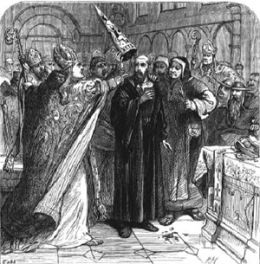
“His vestments were removed from him, one by one, and each bishop present pronouncing a curse on him as part of the ceremony. They put a cap on his head; on which were painted frightful pictures of demons, and on the front of it the words “Archheretic.” Jan Hus said, “Most joyfully will I wear this crown of shame for Thy sake, O Jesus, who for me didst wear a crown of thorns.” ‘ (source) .

These excellent sentences were esteemed as so many expressions of treason, and tended to inflame his adversaries. Accordingly, the bishops appointed by the Council stripped him of his priestly garments, degraded him, put a paper miter on his head, on which was painted devils, with this inscription, “A ringleader of heretics.” Which when he saw, he said: “My Lord Jesus Christ, for my sake, did wear a crown of thorns; why should not I then, for His sake, again wear this light crown, be it ever so ignominious? Truly I will do it, and that willingly.” When it was set upon his head, the bishop said: “Now we commit thy soul unto the devil.” “But I,” said John Huss, lifting his eyes towards the heaven, “do commend into Thy hands, O Lord Jesus Christ! my spirit which Thou has redeemed.”

When the chain was put about him at the stake, he said, with a smiling countenance, “My Lord Jesus Christ was bound with a harder chain than this for my sake, and why then should I be ashamed of this rusty one?”

When the wood was piled up to his very neck, the duke of Bavaria was so officious as to desire him to abjure. “No, (said Huss;) I never preached any doctrine of an evil tendency; and what I taught with my lips I now seal with my blood.” He then said to the executioner, “You are now going to burn a goose, (Huss signifying goose in the Bohemian language:) but in a century you will have a swan which you can neither roast nor boil.” If he were prophetic, he must have meant Martin Luther, who shone about a hundred years after, and who had a swan for his arms.

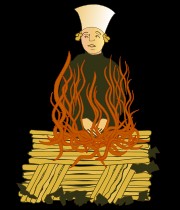
Jan Hus burning.
Drawing after Ulrich von Richental’s illustrated
chronicle of the Council of Constance

The flames were now applied to the wood when our martyr sung a hymn with so loud and cheerful a voice that he was heard through all the cracklings of the combustibles, and the noise of the multitude. At length his voice was interrupted by the severity of the flames, which soon closed his existence.

Then, with great diligence, gathering the ashes together, they cast them into the river Rhine, that the least remnant of that man should not be left upon the earth, whose memory, notwithstanding, cannot be abolished out of the minds of the godly, neither by fire, neither by water, neither by any kind of torment.

~~~~~~~~~~~~~~~~~~~~~~~~~~~~~~~~

John MacArthur has a tremendous sermon about John Huss and Martin Luther, and their resistance to the RCC’s popery. It’s called Undermining the Headship of Christ. It is well worth a listen.

Posted in apostle john, foxe's book of martyrs, martyr

Sunday Martyr Moment: Apostle John

Foxe’s Book of Martyrs. According to this summary from Christian Book Summaries,

Writing in the mid-1500s, John Foxe was living in the midst of intense religious persecution at the hands of the dominant Roman Catholic Church. In graphic detail, he offers accounts of Christians being martyred for their belief in Jesus Christ, describing how God gave them extraordinary courage and stamina to endure unthinkable torture.

From the same link, the book’s purpose was fourfold:

  • Showcase the courage of true believers who have willingly taken a stand for Jesus Christ throughout the ages, even if it meant death,
  • Demonstrate the grace of God in the lives of those martyred for their faith,
  • Expose the ruthlessness of religious and political leaders as they sought to suppress those with differing beliefs,
  • Celebrate the courage of those who risked their lives to translate the Bible into the common language of the people.

JOHN

The Apostle John, the brother of James, is credited with founding the seven churches of Revelation: Smyrna, Pergamos, Sardis, Philadelphia, Laodicea, Thyatira, and Ephesus. It was from Ephesus, it is said, that he was arrested and sent to Rome where he was cast into a large vessel filled with boiling oil that did not harm him. As a result, he was released and banished by the Emperor Domitian to the Isle of Patmos, where he wrote the book of Revelation. After being released from Patmos, he returned to Ephesus where he died about 98AD. He was the only apostle to escape a violent death.

Even with the continual persecutions and violent deaths, the Lord added to the church daily. The Church was now deeply rooted in the doctrine of the apostles and watered abundantly with the blood of the saints. She was prepared for the cruel persecutions to come.

—————–

I’ve often read that John was the only Apostle the Lord let live to a ripe old age, and the only one to escape martyrdom. Yet I often think that that in itself was a difficult end, also. John was one of the few who saw the Lord transfigured- standing atop the mountain in His glory. He was the only apostle to have seen the entire crucifixion, and was the first apostle to see the empty tomb. He saw, lived, breathed and tasted a small glimpse of glory .

Yet he lived so long…almost 70 more years after the crucifixion…he had seen his brother James die, the first apostle martyred (Acts 12:2). He had seen his family die. He had seen Mary the mother of Jesus whom he took care of, die. His friends died. He, alone, was left at the end. Having seen and tasted the glory that he knew was in front of him 70 long years prior, was made to wait the longest to come into it.

Thank you Lord for raising up such a patient and humble and long-serving servant- for your glory and our benefit. I’m so appreciative of the books he wrote: The Gospel of John, Revelation, and the epistles of John 1, 2, and 3. I know that in eternity the wait must not have seemed long, but while living so long and in such persecuting and difficult conditions, it must have felt like an eternity.

Posted in bartholomew, foxe's book of martyrs, jude, marturdom, thomas

Sunday Martyr Moment: Jude, Bartholomew, and Thomas

Foxe’s Book of Martyrs. According to this summary from Christian Book Summaries,

Writing in the mid-1500s, John Foxe was living in the midst of intense religious persecution at the hands of the dominant Roman Catholic Church. In graphic detail, he offers accounts of Christians being martyred for their belief in Jesus Christ, describing how God gave them extraordinary courage and stamina to endure unthinkable torture.

From the same link, the book’s purpose was fourfold:

  • Showcase the courage of true believers who have willingly taken a stand for Jesus Christ throughout the ages, even if it meant death,
  • Demonstrate the grace of God in the lives of those martyred for their faith,
  • Expose the ruthlessness of religious and political leaders as they sought to suppress those with differing beliefs,
  • Celebrate the courage of those who risked their lives to translate the Bible into the common language of the people.
Jude

Apostle Jude
by Anthonis van Dyck

The brother of James, was commonly called Thaddeus. He was crucified at Edessa, an ancient city of Mesopotamia, about A.D. 72.

Bartholomew

Tradition says he preached in several countries, and then translated the Gospel of Matthew into the language of East Indian, he taught it in that country. He was at length cruelly beaten and then crucified by the impatient idolaters.

Thomas

Called Didymus, preached the Gospel in Persia, Parthia and India.In Calamina, India, he was tortured by angry pagans, run through with spears, and thrown into the flames of an oven.

Posted in foxe's book of martyrs, martyr

Sunday Martyr Moment: Paul

Foxe’s Book of Martyrs. According to this summary from Christian Book Summaries,

Writing in the mid-1500s, John Foxe was living in the midst of intense religious persecution at the hands of the dominant Roman Catholic Church. In graphic detail, he offers accounts of Christians being martyred for their belief in Jesus Christ, describing how God gave them extraordinary courage and stamina to endure unthinkable torture.

From the same link, the book’s purpose was fourfold:

  • Showcase the courage of true believers who have willingly taken a stand for Jesus Christ throughout the ages, even if it meant death,
  • Demonstrate the grace of God in the lives of those martyred for their faith,
  • Expose the ruthlessness of religious and political leaders as they sought to suppress those with differing beliefs,
  • Celebrate the courage of those who risked their lives to translate the Bible into the common language of the people.
Paul

The Apostle Paul was imprisoned in Rome in AD 61. and there wrote his prison Epistles: Ephesians, Philippians, and Colossians. His imprisonment ended approximately three years later during the year that Rome burned, which was in May AD 64. (See Acts 28:30). During his brief freedom, Paul may have visited western and eastern Europe and Asia Minor- he also wrote the first Epistle to Timothy and his Epistle to Titus.

At first, Nero was blamed for setting fire to Rome, so to direct the blame away from himself, he blamed the Christians. As a result, a fierce persecution broke out against them. During it, Paul was arrested and put back into prison in Rome. While in prison this second time he wrote his second letter to Timothy. It was his last.

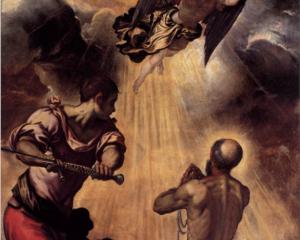
Not long after, he was judged guilty of crimes against the Emperor and condemned to death. He was taken to the execution block and beheaded. It was AD 66, just four years before Jerusalem fell.

The Martyrdom of Paul – Tintoretto, c.1556
Posted in foxe's book of martyrs, martyr

Sunday Martyr Moment: Mark and Peter

Foxe’s Book of Martyrs. According to this summary from Christian Book Summaries,

Writing in the mid-1500s, John Foxe was living in the midst of intense religious persecution at the hands of the dominant Roman Catholic Church. In graphic detail, he offers accounts of Christians being martyred for their belief in Jesus Christ, describing how God gave them extraordinary courage and stamina to endure unthinkable torture.

From the same link, the book’s purpose was fourfold:

  • Showcase the courage of true believers who have willingly taken a stand for Jesus Christ throughout the ages, even if it meant death,
  • Demonstrate the grace of God in the lives of those martyred for their faith,
  • Expose the ruthlessness of religious and political leaders as they sought to suppress those with differing beliefs,
  • Celebrate the courage of those who risked their lives to translate the Bible into the common language of the people.

Mark

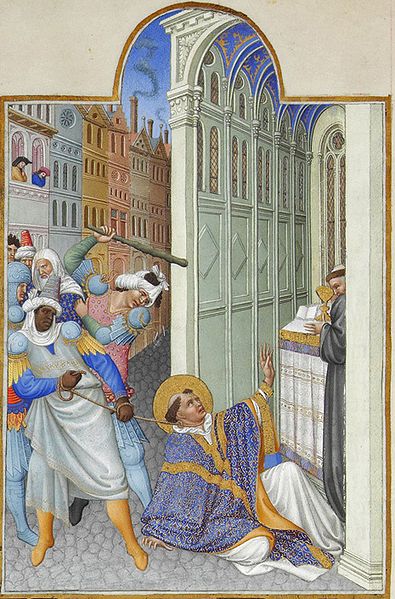
Little is known about Mark except what is written in the New Testament about him. After Paul’s mention of him in 2 Timothy 4:11, he disappears from view. Tradition says he was dragged to pieces when he spoke out against a solemn ceremony for their idol Serapis.

The martyrdom of Saint Mark.
(Musée Condé, Chantilly).

Peter

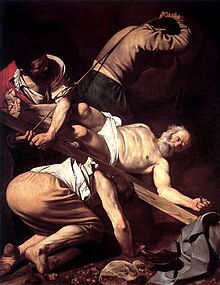
The only account we have of the martyrdom of Apostle Peter is from the early Christian writer Hegesippus. His account includes a miraculous appearance by Christ. When Peter was old (John 21:18), Nero planned to put him to death. When the disciples heard of this, they begged Peter to flee the city [said to be Rome], which he did. But when he got to the city gate, he saw Christ walking towards him. Peter fell to his knees and said “Lord, where are you going?” Christ answered, “I’ve come to be crucified again.” By this, Peer understood it was his time to suffer the death of Jesus which would glorify God. (John 21:19). So he went back to the city. After being captured and taken to his place of martyrdom, he requested that he be crucified in an upside-down position because he did not consider himself worthy to be crucified in the same position as his Lord.

 Caravaggio: painting of the 
crucifixion of Apostle Peter
 Michaelangelo: fresco of the
crucifixion of Apostle Peter
Posted in foxe's book of martyrs, martyr

Sunday Martyr Moment: Matthias and Andrew

Foxe’s Book of Martyrs. According to this summary from Christian Book Summaries,

Writing in the mid-1500s, John Foxe was living in the midst of intense religious persecution at the hands of the dominant Roman Catholic Church. In graphic detail, he offers accounts of Christians being martyred for their belief in Jesus Christ, describing how God gave them extraordinary courage and stamina to endure unthinkable torture.

From the same link, the book’s purpose was fourfold:

  • Showcase the courage of true believers who have willingly taken a stand for Jesus Christ throughout the ages, even if it meant death,
  • Demonstrate the grace of God in the lives of those martyred for their faith,
  • Expose the ruthlessness of religious and political leaders as they sought to suppress those with differing beliefs,
  • Celebrate the courage of those who risked their lives to translate the Bible into the common language of the people.
Matthias

Of whom less is known than of most of the other disciples, was elected to fill the vacant place of Judas. He was stoned at Jerusalem and then beheaded.

Andrew

Was the brother of Peter. He preached the gospel to many Asiatic nations; but on his arrival at Edessa he was taken and crucified on an X-shaped cross, which came to be known as St. Andrew’s Cross. Art: Mattia Preti – The crucifixion of St Andrew.

The flag of Scotland is an X-shaped cross. Wikipedia explains, “Use of the familiar iconography of his martyrdom, showing the apostle bound to an X-shaped cross, first appears in the Kingdom of Scotland in 1180 during the reign of William I. This image was again depicted on seals used during the late 13th century; including on one particular example used by the Guardians of Scotland, dated 1286.”

Posted in foxe's book of martyrs

Sunday Martyr Moment

Foxe’s Book of Martyrs. According to this summary from Christian Book Summaries,

Writing in the mid-1500s, John Foxe was living in the midst of intense religious persecution at the hands of the dominant Roman Catholic Church. In graphic detail, he offers accounts of Christians being martyred for their belief in Jesus Christ, describing how God gave them extraordinary courage and stamina to endure unthinkable torture.

From the same link, the book’s purpose was fourfold:

  • Showcase the courage of true believers who have willingly taken a stand for Jesus Christ throughout the ages, even if it meant death,
  • Demonstrate the grace of God in the lives of those martyred for their faith,
  • Expose the ruthlessness of religious and political leaders as they sought to suppress those with differing beliefs,
  • Celebrate the courage of those who risked their lives to translate the Bible into the common language of the people.
James (the Less)

This James was the brother of Jesus and the writer of the epistle. He seems to have been the leader of the church at Jerusalem (see Acts 12:17; 15:13-29; 1:18-24). the exact time and manner of his death is not certain, although it’s believed to be about AD 66. According to Flavius Josephus, the Jewish historian, the High Priest Ananus ordered James killed by stoning. But Hegesippus, an early Christian writer,  quoted by third-century Christian historian Eusebius, says James was cast down from the Temple Tower. This version of his death further states that James was not killed by the fall, and so his head was smashed by a fuller’s club, which may have been used to beat clothing, or a hammer used by blacksmiths.