Posted in big bang, creation, God, phil johnson, physics, pratchett

“In the beginning there was nothing, which exploded"

Scientists have announced another breakthrough. Breakthroughs seems to come fast and furious in some of the scientific disciplines. Some seem to stick and others seem to fade away immediately after the hoopla subsides. Think Missing Link in the field of evolution. And think Higgs Boson in the field of Physics. Or gluon. Or quark. Or dark matter. Or, even, the Big Bang.

The “breakthrough” physicists are excited about is that they say they have found another nugget of information about our universe immediately after it banged open. They believe that everything we see was once smaller than an electron, and something made it bang open. At the bang, there were massive gravitational waves that spread out, and this is what physicists have said they found evidence of. “Inflation” is the term they use to describe the run-up to the bang.The universe got bigger and bigger until it split open in a cataclysmic event. Gravitational waves billions of light years across or something, spread out across an instantly expanding universe. The gravitational waves make a distinctive curl or a swirl, and since the wave has already passed by, supposedly billions of years ago, the only remaining way to detect the wave is the way the light around where it used to be is polarized. A telescope in the Antarctic has discovered the swirly polarized signature of the gravitational Big Bang wave. I’ll let Discovery explain further.

Located in the arid atmospheric conditions of Antarctica, BICEP2 has a very clear view of the cosmos. The instrument has the ability of measuring the polarization of the weak signal from the CMB radiation. On Earth, sunlight can become polarized if it reflects off a mirror or when filtered by polarized sunglasses (thus reducing the glare). The radiation from the ancient CMB can also become polarized and gravitational waves have the ability to manipulate the polarization of the incoming radiation. The specific type of polarization, known as ‘B-mode polarization,’ is what BICEP2 has been looking for. And now, with a high degree of certainty, astronomers have found it.

“The swirly B-mode pattern of polarization is a unique signature of gravitational waves,” said Chao-Lin Kuo, of Stanford University and the SLAC National Accelerator Laboratory, co-leader of the project. “This is the first direct image of gravitational waves across the primordial sky.”

Today’s announcement is being touted as the “discovery of the century,” and although the two papers that were announced today have yet to go to print, the high certainty that backs these results is a huge hint that astronomers may have struck gold. Not only does this finding support the theory of cosmic inflation and the first strong observational evidence of gravitational waves, it could tie in to one of the most perplexing problems in modern quantum physics: What role does gravity play with the quantum world?

Physicists are having a hard time understanding how gravity relates to the Standard Model of physics, a situation that has forced theoretical physicists to pursue increasingly exotic ideas to find an answer.
—————-

The ‘increasingly exotic ideas in order to find an answer’ is where physicist Alexander Unziger comes in. He is a scientist who says that most of what physicists have come up with is bunk and inventions. But first, a review.

The way that most physicists describe the universe is in the Standard Model. Scientists know there are four major components of the universe, weak nuclear force, strong nuclear force, electromagnetic force, and gravitational force. They think have figured out the first three but for the life of them they can’t figure out gravity. Like where it comes from or how it works. So in the Standard Model they simply ignore it. The Standard Model does not address gravitational force at all. They focus on the first three. That is the first inkling that all is not well in astrophysics.

You might remember the Large Hadron Collider, which conducted an experiment to collide particles to recreate a mini-Big Bang, and see what resulted from the collision. Physicists were looking for the particle that is called Higgs Boson, which would explain the universe’s mass. Back along, they discovered neutrinos, which are particles that have no mass, but what gives the universe mass, the corresponding element to counterbalance the neutrino? They postulated there must exist such a particle, which they dubbed the theoretical Higgs Boson.

Yet that brought them further down the rabbit hole, because if there is a Higgs boson particle, counterbalancing the mass-less neutrino, there still isn’t enough matter in the universe to account for the universe. We’re only up to 4% of the universe. So they invented the theory of dark matter.

Our current understanding of the universe suggests that the matter we can observe only accounts for about 4 percent of all the matter that must exist. When we look at the movement of galaxies and other celestial bodies, we see that their motions suggest there’s much more matter in the universe than we can detect. Scientists named this undetectable material dark matter. Together, observable matter and dark matter could account for about 25 percent of the universe.” (source)

So they invented the theory of dark energy.

And so on and etcetera.

Back to Dr Unzicker.

Science on Sunday: The Higgs Fake
I’ve just read The Higgs Fake by Alexander Unzicker. He says physicists such as Einstein would have considered the “discovery” of the Higgs boson to be utterly ridiculous. And more. Unzicker really rips into particle physics. Not physics, particle physics, also known as high energy physics or HEP. But note that Unzicker isn’t some anti-science zealot. See the author section on Amazon along with his CV and his arXiv papers. He’s a whistleblower, which is why he’s written this book.

You know this when you’ve read A Zeptospace Odyssey by CERN physicist Gian Giudice, because then you know a few things. Like the Higgs mechanism is “frightfully ad hoc”. Like it’s responsible for only 1% of the mass of matter. Like the Higgs boson isn’t the central particle of the Standard Model. So you know there’s a big difference between the facts and the mystery-of-mass hype. And you know that there’s particle physicists out there who know the facts but keep quiet, whilst others hype the hype and tell fairy tales about cosmic treacle.

So you know Unzicker isn’t talking out of his hat. You know Unzicker is right when he says particle physicists haven’t reduced the number of parameters or incorporated gravity. You know they haven’t explained the fine structure constant. Or the mass of the electron and the proton. Or why the electron and proton and their antiparticles are the only stable massive particles. You know particle physicists haven’t explained spin, or charge, or Beta decay, or any of the other puzzles that bothered Einstein and Bohr and Pauli and Schrödinger and Dirac. You know instead that particle physicists have made things more complicated rather than more elegant, going against the grain of scientific progress. You know that instead of explaining things, particle physicists have invented things. Things like supersymmetry, which is now a dead man walking. Things like isospin and color and hypercharge and strangeness. Things that aren’t explained at all, and things that are swept under the carpet, like quark confinement.

So you smile wryly when Unzicker quotes from The End of Physics by David Lindley, a former editor at Nature: “In the end, the quark model succeeded by the ironical trick of proving that no quark would ever be directly seen by a physicist.

This Alexander Unzicker sounds like my kind of scientist.

So why this whole long science essay? To mention the following three items:

1. When scientists theorize one thing and it doesn’t fit, they have to invent another theory to cover the flaws in the first theory, and then invent another to bring along the first two, and so on. This is a perfect fulfillment of this verse:

always learning and never able to arrive at a knowledge of the truth. (2 Timothy 3:7)

Of course the verse mainly means they are always learning about God in some kind of fake religion but for these scientists, science is their God. They want to know about the creation, to them it’s called the universe, and they are always learning and dub their theories “The God Particle” and “Higgsogenesis”, but never actually acknowledge God or know God.

2. Forget muons and gluons and Standard Model and dark matter and dark energy and Higgs boson and Large Hadron Collider and gravitational waves. Here is the Standard Model of the Creation of the Universe:

In the beginning, God created the heavens and the earth. (Genesis 1:1)

That’s it. That is the answer. It is so simple that people think, ‘Oh No, It Cannot Be’. O, but it is. We overcomplicate the Gospel by adding words and law. (Galatians 3:12). We overcomplicate our prayers by adding words and repetitions. (Matthew 6:5, 6:7). And we overcomplicate science by deleting God, the First Cause of the Universe’s Existence and the Sustainer of the the Creation. (Hebrews 1:3)

3. It is all a shame, because though science is interesting, the God of creation has been made plain to them. Plain! It’s obvious! It’s not difficult, people!

For what can be known about God is plain to them, because God has shown it to them.” (Romans 1:19).

The word in Greek is from phaneros, and it means: apparent, disclosed, evident, light, obvious, outward, tell, well known. The verse doesn’t say that He just showed it to them but He has made it plain.

Yet they persist. Famous Physicist Niels Bohr said,

It is wrong to think that the task of physics is to find out how Nature is. Physics concerns what we say about Nature.

There we have it. man seeks not only to suppress their evident knowledge of God, nor glorify Him, nor give Him thanks, “They exchanged the truth about God for a lie, and worshiped and served created things rather than the Creator” (Romans 1:25). They make themselves gods by saying how the universe came to be.

They come up with theories like gravitational waves in the Big Bang, a theory novelist Terry Pratchett poked at in his book Lords and Ladies,

In the beginning there was nothing, which exploded.”

Genesis 1:1 is simple but profound. Please listen to Phil Johnson’s wonderful recent sermon called “What Creation Reveals.” Pastor Johnson said,

Of Genesis 1:1, “A. W. Tozer said that’s the single most important verse in all of Scripture, even surpassing John 3:16. Something in me recoils from the idea of trying to rank the relative importance of key Bible verses, because “All Scripture is breathed out by God and profitable” but (of course) Tozer believed that as well. So I think I understand what he meant when he ranked Genesis 1:1 as the Bible’s most important text. This is the necessary starting-point and foundation for everything else the Bible has to say.There is no text in the whole Bible that contains more or explains more than Genesis 1:1. Literally everything is in this verse. …  

If creation is the foundation of all truth, the gospel is the central truth to which all other truth leads, and Christ Himself is the very pinnacle and incarnation of all truth. If you have not yet embraced Him as “the way, and the truth, and the life,” my prayer for you is that God will open your eyes to see, and that your entire life and worldview will be transformed by the truth of Christ.

Posted in creation, God, sunset

What is it about sunsets?

Sunset, Comer, GA. EPrata photo

A friend of mine said that she loves sunsets. She and her gal friends, when they have an annual get-together at the beach, chase sunsets. They love the beauty and color and vibrancy and uniqueness of each one.

That got me thinking about sunsets. In October of this year I had put up a few of my favorite sunset photos. I used to travel quite a bit, and enjoyed sunsets in many places and in many climes. One place we used to enjoy sunsets was Naples Florida. Naples is on the west coast of FL and almost as far south as far as you can go on the peninsula. The city overlooks the Gulf of Mexico.

When you have a city on a west coast overlooking the water, it sets up a great view for seeing sunsets (and the green flash). People used to gather at the beach just before sunset. As the day waned and sunset drew near, the atmosphere at the beach changed from boisterous family fun, wheels of gulls, and screeches of children, to a quiet slapping of shutting folding chairs, towels snapping as they’re shook out, and slow footprints in the sand drifting away from the beach and back to the car.

Sunset, Danielsville, GA. EPrata photo

Then the sunset chasers arrived. Clusters of folks would stand around, or sometimes sit, and watch the changing colors in the sky. The place would become quiet. Eyes would gravitate to the shore, and voices would become whispers, almost reverential, so as not to break the spell. The sun bedecked itself in glorious colors as it neared the horizon, and the hues became almost otherworldly. Voices were all silent now with eyes full of wonder tracking the orb’s descent. As the sun sunk below the blue gulf, and the skies turned blue and purple itself, sunset watchers would sigh, and slowly fold their chairs and drift to their cars.

What is it about a sunset that evoked such reverence and attention from seekers, many of whom didn’t even believe in God? It wasn’t a movie or a show or a musical or a circus…it was a sunset. What is it about sunsets?

Sunrise, Comer, GA. EPrata photo

so that those who dwell at the ends of the earth are in awe at your signs. You make the going out of the morning and the evening to shout for joy. ~Psalm 65:8

An old-time pastor named Charles E. Jefferson pondered the meaning of the sunset in his sermon with that title.

How many sunsets have you seen during this last week, this last month, this last year? How many have you seen in the last ten years, the last twenty, the last thirty? I do not ask how many have you glanced at, but how many have you gazed upon, paid attention to, pondered? On how many have you held your mind long enough for it to become impressed, for an influence to be diffused through your heart, for a discipline to be exercised upon your spirit? How many sunsets stand out vivid and glorious on the walls of your memory? How many of you can say, that the glory of setting suns is an appreciable factor in the development of your emotional and spiritual life?

Charles E. Jefferson (1860-1937)
Sunset, Colbert, GA. EPrata photo

The purpose of my sermon is to awaken in you the sense of condemnation, the consciousness of sin because of your neglect of this great feast of the Lord. I would have you think of the sunset as a means of grace. Have you ever counted up the means of grace? How long is your list? What have you included? Public worship? Yes. Bible reading? Yes. Prayer? Yes. Is that all? Have you not put down the sunset? That is a means of grace. By all means, put that down. It is a sacrament. It is the visible sign of an invisible grace. It is a symbol for mediating God’s grace to your heart. Put it down in the list of the means of grace; include it, also, in your list of sacraments. Reckon it a page in -your Bible. It is certainly a word ‘of the Lord.’ It is not a word of man. Man cannot speak after that fashion. There are some things- which God allows man to assist Him in making. If God wants a potato or a turnip, a cucumber or a squash, He allows man to help Him in producing it. If God wants a flower-bed or a lawn He allows man to collaborate with Him. But there are some things in which man can have no part. When God makes a sunset He says to man: “Now, please step aside; I want to do all this by Myself. You cannot in any way assist Me. This work is completely beyond you. I, alone, can produce a work like this.

The bible says that all peoples from all nations, tribes, and tongues, have been made plainly aware of the attributes of our God the Holy Creator.

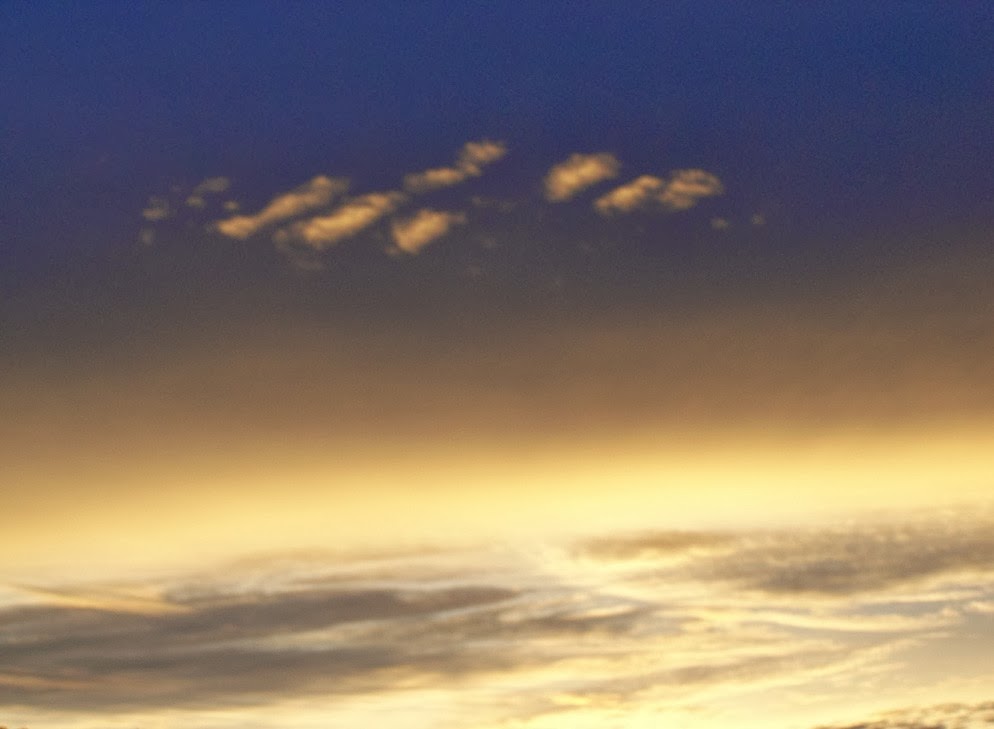
Nacreous clouds at Sunset, EPrata photo

For what can be known about God is plain to them, because God has shown it to them. For his invisible attributes, namely, his eternal power and divine nature, have been clearly perceived, ever since the creation of the world, in the things that have been made. So they are without excuse. (Romans 1:19-20).

The sunset is a miracle, a sign, and a wonder. Pastor Jefferson continues,

What a mystery it is that a thing so resplendently beautiful should be made of vibrations, and dust-particles and the movements of vapour. By reflection and refraction, and radiation and absorption, every dust particle obeying one law, and every vibration obeying another law, and every air-current obeying still another law, this stupendous miracle comes to pass.”

Consider the sunset. Consider the God who ordained it. Exult in the daily joy we have to worship His works and His creative power.

Posted in creation, genesis, God, revelation, solar maximum

God the creator and God the UNcreator

I mentioned before that any time there is a large earthquake, this blog sees an increase in views. People are somehow more unsettled after an earthquake than most other natural disasters, though any disaster sees people flocking to sites in search of the meaning of it all.

Personally I think quakes unsettle people because this is the very ground we walk on that is moving, splitting, and otherwise kicking up.  If solidity isn’t solid, than maybe invisible God is real…The subconscious thought or fear is likely, “If the earth isn’t solid, then what is?”

God of course.

But any natural disaster sends people searching for what, where, why. God is creator. He made the earth and the stars and the heavens and the stars and everything in between. He made it…and He can UNmake it.

Wikipedia photo, Linnaean taxonomy

Man assigns lists and categories to everything in the natural world, trying to organize it, in order to understand it. I remember being very interested in the biological taxonomy of mollusks in my 30s. Wikipedia explains taxonomy–

The establishment of universally accepted conventions for the naming of organisms was Linnaeus’ main contribution to taxonomy—his work marks the starting point of consistent use of binomial nomenclature.[129] During the 18th century expansion of natural history knowledge, Linnaeus also developed what became known as the Linnaean taxonomy; the system of scientific classification now widely used in the biological sciences.

The Linnaean system classified nature within a nested hierarchy, starting with three kingdoms. Kingdoms were divided into classes and they, in turn, into orders, and thence into genera (singular: genus), which were divided into Species (singular: species).[130] Below the rank of species he sometimes recognized taxa of a lower (unnamed) rank; these have since acquired standardised names such as variety in botany and subspecies in zoology. Modern taxonomy includes a rank of family between order and genus and a rank of phylum between kingdom and class that were not present in Linnaeus’ original system

I bought plastic divided tackle boxes at Wal-Mart and collected shells from all the oceans I sailed on and

Initiamenta conchologica, or, Elements of conchology
Printed and published by Reeve, Brothers,1846-1849.
biodiversitylibrary.org/item/54210

all the beaches I walked on, and labeled them and placed them within a taxonomy … and it felt so good to organize the world. I felt that if I could organize it, and then I could understand it, and then I could control it.

Of course that is a mistake, no matter how fun it is to study natural history. But I wasn’t saved then and I didn’t know God.

And in the end, man doesn’t really understand the world or the universe much at all. See the following articles:

The Sun That Did Not Roar
This is the height of the 11-year solar cycle, the so-called solar maximum. The face of the Sun should be pockmarked with sunspots, and cataclysmic explosions of X-rays and particles should be whizzing off every which way. Instead, the Sun has been tranquil, almost spotless. As W. Dean Pesnell, the project scientist for NASA’s Solar Dynamics Observatory, dryly noted, “We’re not having much of a solar maximum.” A week ago, a solitary sunspot blemished an otherwise blank yellow disk. In the ensuing days, a few more specks appeared, but even a small explosion, or coronal mass ejection, last Thursday seemed like the halfhearted effort of a slacker star. “The truth of it is there isn’t a lot going on,” said Joseph M. Kunches, a space scientist at the Space Weather Prediction Center. “It’s been a bit of a dud. You look at the Sun today and you say, ‘What?’For scientists trying to understand the dynamics in the interior of the Sun, it has been a humbling experience enlightening them about how much they do not know.

They do not know as much about the order of the universe as they thought they knew.

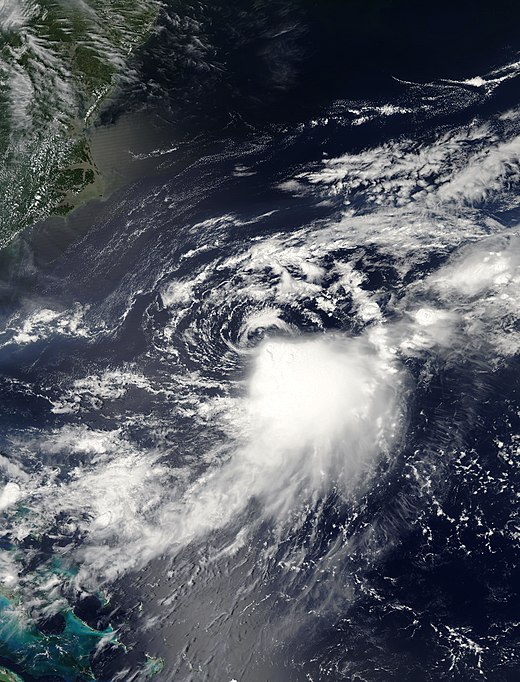
Wikimedia commons, TS Franklin, 2005

Despire dire forecasts, it’s a dud year for hurricanes
“The preseason predictions were all dire, using words like “extremely active” and “above-normal” to describe the forecast for the 2013 Atlantic hurricane season. The National Oceanic and Atmospheric Administration (NOAA) predicted that seven to 11 hurricanes would form, while AccuWeather predicted eight.  However, the season so far has been a welcome if unexpected dud, with not a single hurricane yet through the first week of September. (A typical full June-November hurricane season, based on weather records that go back to 1950, has seven hurricanes.)’

Really? Scientists know so much about how the wind blows that they can predict how many hurricanes there will be? I don’t think so. They do not know as much about hurricanes as they think they know.

Climate change AKA global warming? Nah.

Climate change is on ice: UN scientists reveal the world’s barely got any hotter in the last 15 years
In a report Report compiled by over 800 scientists and used 9,000 scientific studies UN scientists said today they are ’95 per cent’ certain that climate change is man made, but still could not explain why the world has barely got any hotter in the last 15 years.”

The earth is not as solid as we think and the wind is not as constant as we think and the sun is not as active (or inactive) as we think. The Tribulation will be a time when all the cycles and taxonomies and orderliness of what has been a seeming normal will morph into a new normal: the horror of uncreation. Man wasn’t around when God created the stars and the earth but he will be around when He uncreates it.

For example, the wind won’t blow.

“After these things I saw four angels standing at the four corners of the earth, holding the four winds of

Hans Holbein the Younger 1497/98-1543,
The angels holding back the four winds
Series/Book Title: Apocalypse

the earth, that the wind should not blow on the earth, on the sea, or on any tree” (Revelation 7:1).

The sun is cooling now but later it will turn hot, so hot it will burn men in an instant–

“The fourth angel poured out his vial upon the sun; and power was given unto him to scorch men with fire. And men were scorched with great heat, and blasphemed the name of God, which hath power over these plagues: and they repented not to give him glory” (Revelation 16:8-9)

Hail will be supersized, 100 lbs, and crush mens’ heads.

“And great hailstones, about one hundred pounds each, fell from heaven on people; and they cursed God for the plague of the hail, because the plague was so severe.” (Revelation 16:21)

The Tribulation  will be a time when God will uncreate the earth, unspooling it from the seeming normalcy humanity has enjoyed, to now when things are starting to go haywire, to future then when nothing will be normal.

Spurgeon wrote that in the creation, “The light which broke in upon the primeval darkness was of a very mysterious kind, and came not according to ordinary laws, for as yet neither sun nor moon had been set as lights in the firmament.

MacArthur wrote of the uncreation of Revelation: “The present laws of thermodynamics, which state that matter can not be created nor destroyed,  will no longer be in effect. As a result, “he universe “will be burned up,” it will be totally consumed. (2 Peter 3:10-13). The absolute reverse of creation will occur. It didn’t take eons of evolution to create the universe, nor will it take eons to uncreate it. The uncreation of the universe, like its creation, will take place by the word of God.” (source “Revelation 12-22 MacArthur New Testament Commentary  By John F MacArthur”)

All praise our holy God who creates, makes things orderly in their time, makes things disorderly in their time, and will dissolve the universe when it is time!

Posted in creation, God, octopus

Where’s the octopus? Science and God

So, let me get this straight, octopi see a visual cue, match it exactly by changing color and *skin texture*, do it while being color blind, not a reflexively but via but brain analysis, and fool humans by accomplishing all this in 2 seconds. Wow!

Four minutes of delicious science whereupon we learn we humans:

–are less skilled than an octopus at seeing the world

and

–God is amazing!


By faith we understand that the universe was created by the word of God, so that what is seen was not made out of things that are visible. (Hebrews 11:3)

Worthy are you, our Lord and God, to receive glory and honor and power, for you created all things, and by your will they existed and were created. (Revelation 4:11)

Posted in birds, creation, movie review

Movie review: "Birders:The Central Park Effect", comments on creation & biophilia

E. Prata photo

Birders: The Central Park Effect is a movie about, well birds and the people who look at them.

Each spring when the great migration of birds from the southern climes in Central & South America migrate north to Canada to breed, and then in the fall when they migrate south to their homes in the south again, huge flocks of birds descend on Manhattan’s Central Park. Of the millions which pass over, thousands at any given day will choose to swoop down and take their several day rest in the greenery that is this magnificent park. The northeast corridor is pretty well filled with wall-to-wall cities, and Central Park is just too good of a stopping place to ignore.

This one-hour film is a documentary which documents this fact, it reveals what drives birders who stumble around the woods looking up with binoculars, and it lovingly and lushly films the stars of the show: the birds.

E. Prata photo

One woman who is featured is Starr Saphir. (pronounced, sapphire). Starr has been leading bird-watching tours of the Park for almost 40 years. Her love for the park, for birds, and for leading people to birds is evident in her voice and eyes as she describes the winged creatures that she has counted and the beauty she has been privileged to share with newcomers to the hobby.

The documentary opens with Spring, and the birds’ arrival. It chronicles the park in all four seasons and ends with spring again. The people interviewed range from famous (novelist Jonathan Rosen) to anonymous bird lovers. About 200 species stop by the park during Migration, about a quarter of all species found in the US.

The star of the show is the nature that is presented as the backdrop for the birds, all the more remarkable for being totally man-made. (Central Park is totally man-made and carefully managed, down to switches which govern the pipes that gush water from pretend brooks and streams). A few sobering facts are given, for example, that in the last four years, (the movie was released in 2012), bird counts of many different species has been dropping by as much as 50%. The documentary however thankfully stays away from preaching ecology, and simply lets the birds and their watchers be the star of the show. One thing I really enjoyed was that since this documentary is set in New York City, and most New Yorkers are highly literate, these people could speak well and used language in almost poetic and vivid ways.

E. Prata photo

For example, of the birds, one man said “I realized the trees were hung with ornaments!” Like that.

For Christians, within the first 6 minutes, there are three objectionable comments:

–Oh My God!
–Holy frikken Moses!

Both of the above occur at 2:20 into it.

–and one man used the real f-word. (6:41 into it)

After that, there is no language, no adult situations, no innuendo, and no one is underdressed. It is an interesting little documentary and a pretty movie. I recommend it.

As far as spiritual matters go, I have some additional thoughts. All the people interviewed and even those who weren’t but were simply filmed, brave the cold, the rain, their schedules, all to go look at a bird in the wild. Why?

One man attempted to explain this innate attraction to nature, by saying that “the birds awaken something in my soul. If I had one.” He wasn’t joking.

Another interviewee said that he feels strongly attached to the Park as well. He said that the nature there soothes him and he feels more complete when he is there, among the birds. He said that scientists have a name for this feeling: “biophilia.”

The Online Free Dictionary defines biophilia as a psychological term, “an innate love for the natural world, supposed to be felt universally by humankind”

The biophilia hypothesis is stated on Wikipedia as “an instinctive bond between human beings and other living systems. Edward O. Wilson introduced and popularized the hypothesis in his book, Biophilia (1984). He defines biophilia as “the urge to affiliate with other forms of life”. The term “biophilia” literally means “love of life or living systems.” It was first used by Erich Fromm to describe a psychological orientation of being attracted to all that is alive and vital. Wilson uses the term in the same sense when he suggests that biophilia describes “the connections that human beings subconsciously seek with the rest of life.” He proposed the possibility that the deep affiliations humans have with nature are rooted in our biology.”

Yes. Deep affiliations with nature are rooted in us. Genesis 1 and Romans 1 shows us this. We do not need modern psychology to coin a term and explain the obvious.

In Genesis 1, God created man, and set Him in the perfect Garden, and gave him a command to take care of it and to name and take care of the animals. God revealed Himself in creation and since we are made in His image we share that affinity with creation, and also are a part of it. (Genesis 1:26-30, Genesis 2:15, Romans 1:20, Romans 1:23).

As Adam, He made us in His image, and since he had instilled in Adam a command to take care of His creation. When Adam and Eve sinned, he ejected them from the Garden and cursed the ground. Even though we have a sin nature now and try to exercise dominion of the earth thru flesh, and do it badly, we still possess that innate love for creation and the instinct to shepherd it. However also because we have a sin nature, satan corrupts our tie with the natural world, from gentle shepherding as creatures made in His image, to idolaters worshiping the creation instead of the Creator. Satan claims our flesh nature and corrupts what is a natural feeling of love for the One who created the creation, including ourselves, part of that creation and creatures we are.

E. Prata photo

So biophilia is a fun-to-say psychology word and not much else. It stops there. It simply acknowledges the affinity we have with creation, but does not acknowledge the creator. The interviewees in the documentary acknowledged their attraction to nature, acknowledged the beauty of the birds, acknowledged the wonder of precise migration patterns, but did not acknowledge the Creator who made it all.

It’s not biophilia. It’s God. And praise Him for it all!

“O Lord, how manifold are your works! In wisdom have you made them all; the earth is full of your creatures.” (Psalm 104:24)

E. Prata photo

————————————

Further reading:

What the bible says about God and the natural world

Posted in amazing grace, art of farmland, burning man, creation, frogs

Fun stuff! Beautiful, too!

Here are a few fun things for you.

Who knew frogs could have so much personality!

This is a completely charming story about the Italian penchant for doing The Owl Jacket or Giacca Civetta. It has nothing to do with religion and everything to do with Italy and Italians and a novelist trying to remember that thing the woman told him that time. Read it.

I LOVE naps! Now we have the official report on the art and science of the perfect nap! (HT Challies)

photo credit: mysza831 via photopin cc

Here was some good stuff from twitter yesterday.

I like this guy Curmudgeon…

Sigh. I really hope so. I feel like I’ve been chained to the new version forever. Joel Rosenberg made a some good comments yesterday on Twitter:

Thanks Joel Rosenberg, for your faithful updates, insights into the Mid-East, and your continual call for prayer.

~~~~~~~~~~~~~~~~~~~~~~

Burning Man is over. They burned the man and the orgiastic art seekers went back home. But the photos are cool.

Lisa Wood’s photo series Art of Farmland is incredible. I am on a photography run, I guess!

In these dramatic landscapes, photographer Lisa Wood perfectly blurs the line between reality and abstraction. The series, entitled Art of Farmland, documents the gorgeous countryside of the artist’s hometown in Sun Valley, Idaho. However, as viewers gaze upon the visually stunning images, it becomes evident that these aren’t your typical farmland scenes. By blending multiple exposures and utilizing timelapse techniques, Wood transforms an everyday moment into a playfully surreal adventure. The artist merges geometric lines and patterns with bold, vibrant colors to create the painterly compositions. She says, “My hope for the viewer is to look at rural landscapes in a different way and to hopefully appreciate both the imagination behind the images and the moods they evoke.”

Enjoy our great and quirky and fun world. Happy Sunday everyone.