This week I’ve had a burden for the evangelical church. Today I wrote a long essay about the Roman Catholic Church’s infiltration to the last religious battleground, the evangelical church. What sparked this burden is the speed with which the RCC has infiltrated Protestant evangelicalism with their doctrines of demons, and how many evangelical leaders have fallen under Rome’s sway.
It has been a tough week. Reading about Franklin Graham’s partnering with Pittsburgh’s Bishop Zubik and the many attendees at the Graham Crusade who were directed to the Catholic Church next door pained me deeply… learning about the RCC’s ‘new evangelism’ into Protestant waters starting wit its leaders shocked me … and Victoria Osteen’s blasphemous comments to 16000 applauding goats that’s circulating among social media angered me much … all caused this deep burden I feel for the shrinking organization we know as the evangelical church.
The Osteen 38-second video is above so you can compare her words with the words I’m going to post next.
Phil Johnson
As I prepared to make a pot of soup to end this Labor Day weekend, I searched for a sermon to listen to. I decided on Phil Johnson’s latest sermon at Grace Life (the small group section at MacArthur’s Grace Community Church). Though the Osteen video came out after his sermon, Pastor Johnson could have been saying these exact words directly to Mrs Osteen:
Churches worldwide are full of people who aren’t the least bit interested in scripture, or doctrine, or truthfulness. They just want to have a good experience and feel good about themselves. More than that, they want to hear that God feels good about them, and that He exists to do their bidding.
In general, imagine my happy shock and surprise to hear that my burden for the evangelical church was shared by Johnson and his articulation of it was (not shockingly) much better than mine-
Unless you live in total isolation and never read any news about the church and our testimony to the wider world, you must be aware that the evangelical movement worldwide is currently undergoing a doctrinal and philosophical meltdown of catastrophic proportions. By any measure you could possibly employ, the evangelical movement right now is more backslidden and more spiritually bankrupt than medieval Catholicism was just before the dawn of the Protestant Reformation. The evangelical movement of our generation has become a monstrosity. Doctrinal, moral, and political corruption are the rule rather than the exception, and some of the largest and most visible evangelical and charismatic churches today are populated with people who absolutely love to have it that way.
Of course, it is not good that the evangelical church is in such catastrophic disarray. But I am relieved to see that the extreme burden I’ve felt for the evangelical church is not unwarranted.
My opinion-conclusion from what I see for the evangelical church was that it is the last days with the Tribulation church forming right before our eyes. Though Pastor Johnson didn’t speculate into the Tribulation, he did say,
“I would go so far as to say the desperate need for critical thinking and careful discernment has never been more urgent.”
“Contrary to the way most people today like to think and act, we desperately need clear boundaries and careful watchmen who are willing to speak plainly and wield the sword of God’s Word wisely for the protection of the flock and the preservation and proclamation of sound gospel truth. We especially need people skilled in discernment now.”
Please enjoy his sermon. It is a refreshing teaching on exactly what is wrong with the Prosperity movement. he said we all enjoy an uplifting sermon for edification but sometimes reproof and correction are needed just as much. You will be educated, blessed, and at the very least, will know how to respond when someone charges you with being “mean to the brethren.”
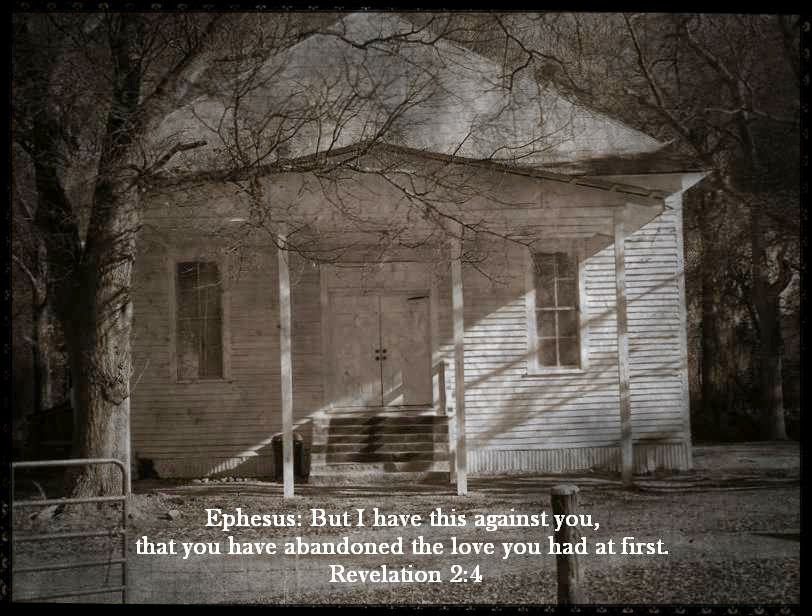
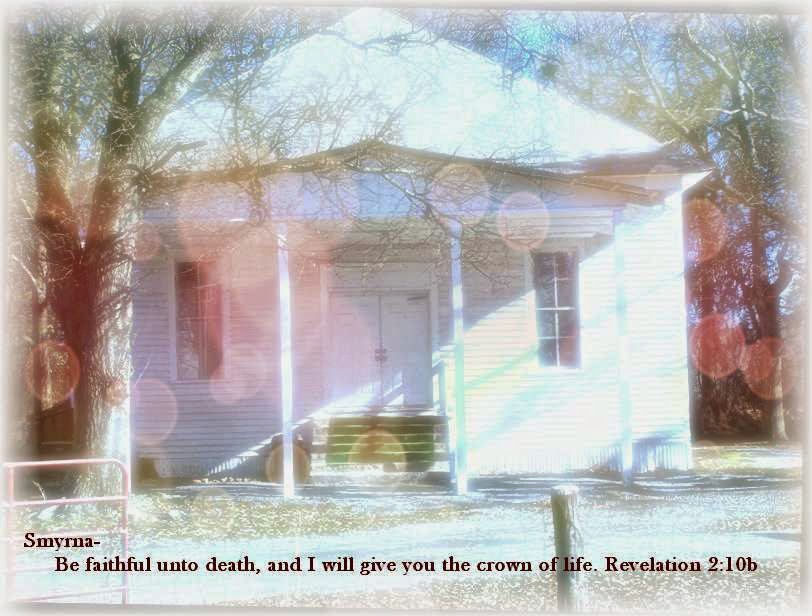
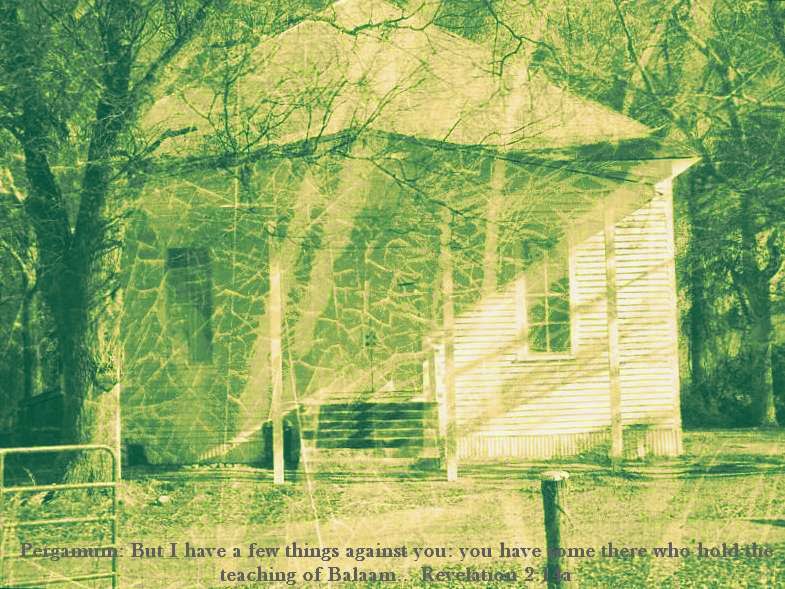
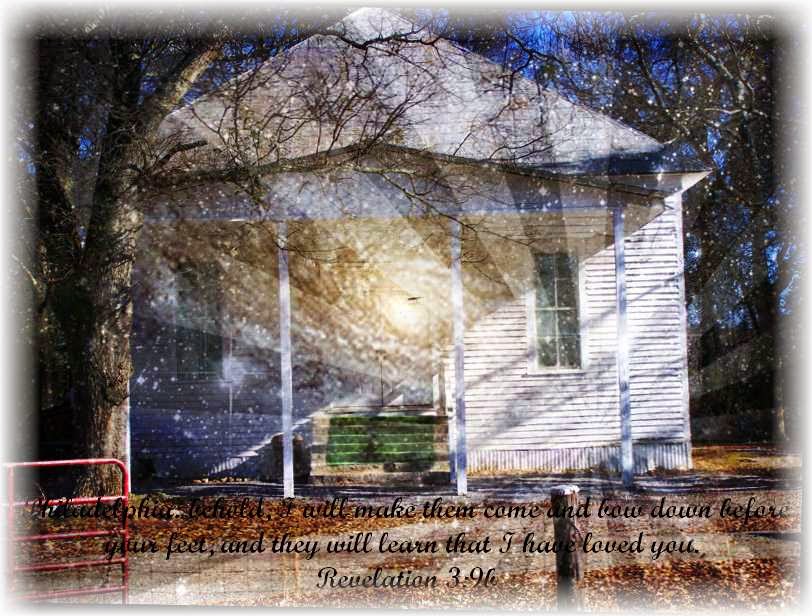
This is a creative, artistic rendering of my view of the 7 churches in Revelation. The original photo, which I took, is of an abandoned church in the area in which I live. Photographic manipulation and imagination did the rest.
In the first century, there were 7 churches Jesus caused John to write messages for. These were actual churches with actual congregations, doing and saying actual things. Jesus told apostle John, exiled at Patmos, what to write to these congregations. Jesus spoke commendations, criticisms, and instructions. Not all 7 churches were commended. Not all 7 churches were criticized. All had an instruction, though.
The church at Smyrna and the church at Philadelphia were not criticized. The church at Laodicea was not commended. The rest had both.
The churches were: Ephesus, Smyrna, Pergamos, Thyatira, Sardis, Philadelphia, Laodicea.
Can you imagine being assembled on Sunday, hearing a knock on the church door, a messenger arriving and handing a scroll to your pastor, and the pastor reads a letter from the head of the Church, Jesus Christ Himself? Jesus is very much alive and in charge of His global body of worshipers, AKA His bride. He was directly involved then, and He is directly involved now.
Each of the seven churches was not only an actual church but is also a type of church dealing with a problem mentioned in the letters. The problem is not unique to that church for that time. There are always the same kind of systemic problems many churches deal with and have been recurring throughout the centuries. Always, there is a church somewhere that is busy but not alive. Always, somewhere, is a church that is indifferent and lukewarm. On this earth, there is a collection of churches gracefully enduring suffering, or being persecuted. And so on.
Please read Revelation 1-3, it is not hard. Those chapters offer the reader plain language and it’s not heavily symbolic. Meanwhile here are my renderings of the churches in Revelation with their pictorial representation of the problem (or commendation) they had. Below the photo essay is a short artist’s statement of how the interpretation came about.
~~~~~~~~~~~~~~~~~~~~~~~~~
~~~~~~~~~~~~~~~~~~~~~~~~~
Artist statement:
Ephesus: I was struck by the fact they had abandoned their fervent love for Jesus. I imagined how hearing this, John might have felt like he had ashes in his mouth and ears. “Nothing cold as ashes, after the fire is gone.” (Loretta Lynn). The photo is as if ashes were smeared on it.
Smyrna: No criticism. Only light, the crown of life in heaven, and joy. The bubbles are angels surrounding the church Jesus commends in love and encouragement.
Pergamos: Compromise was their problem. Anyone who ever had a house built knows that if the contractor compromises on the concrete foundation, cracks appear at the first frost-freeze-thaw cycle. Nothing cracks a structure or an organization faster than compromise. Hence, the cracked door and walls.
Thyatira: This church had a problem with a seductress teaching sexual immorality and the people tolerated it. It is a harlot church, literally. Hence the lipstick on the walls and the hearts and fireworks and pink.
Sardis: Revelation has a change in tone here. Sardis is dead. I used tombstone engraving font for the verse.
Philadelphia: No criticism. This church is loved eternally from above. Its door will never close. Hence the sunburst coming out, the eternal stars above to indicate they will be taken before the wrath, and the font in script like a love letter. This church is beloved in heaven.
Laodicea: Indifferent. Jesus hates that worst of all. He excoriates it with a lengthy invective no other church received in their message. He will vomit this church from His mouth. Hence the bilious green splat from heaven.
More on spiritual gifts: I asked the question in prior blog entries on whether the spiritual gifts that were given as a sign are ceased now. (tongues, interpretation of tongues, miracles, healing). I came to the conclusion that scripture seems to say they are concluded.
There are many other permanent, edifying spiritual gifts that remain to this day. The spiritual gifts are endowments given by the Holy Spirit. As Theology professor Wayne Grudem says, “these are the supernatural graces which individual Christians need to fulfill the mission of the church.” I won’t take time to do a series on all of them, better scholars than me have weighed in on explaining them. However today I do want to look at one particular gift, though: distinguishing of spirits.
Here is the verse from 1 Corinthians 12:10 in several different translations:
“to another the working of miracles, to another prophecy, to another the ability to distinguish between spirits, to another various kinds of tongues, to another the interpretation of tongues.” (ESV)
“To another the working of miracles; to another prophecy; to another discerning of spirits; to another divers kinds of tongues; to another the interpretation of tongues:” (KJV)
“He gives one person the power to perform miracles, and another the ability to prophesy. He gives someone else the ability to discern whether a message is from the Spirit of God or from another spirit. Still another person is given the ability to speak in unknown languages, while another is given the ability to interpret what is being said.” (NLT)
The word for distinguishing in Greek is diakrisis, and it means an act of judgment. Not the kind of judgment in court, but “properly, a thorough judgment, i.e. a discernment (conclusion) which distinguishes “look-alikes,” i.e. things that appear to be the same” goes the definition from Strong’s. (source)
Pastor Charles Spurgeon once said that “discernment is not simply a matter of telling the difference between what is right and wrong; rather it is the difference between right and almost right.”
In the bible one example of the gift of distinguishing of spirits was when Peter was able to tell instantly when both Ananias and Sapphira were lying to him and thus to the Holy Spirit.
“But a man named Ananias, with his wife Sapphira, sold a piece of property, 2and with his wife’s knowledge he kept back for himself some of the proceeds and brought only a part of it and laid it at the apostles’ feet. 3But Peter said, “Ananias, why has Satan filled your heart to lie to the Holy Spirit and to keep back for yourself part of the proceeds of the land? 4While it remained unsold, did it not remain your own? And after it was sold, was it not at your disposal? Why is it that you have contrived this deed in your heart? You have not lied to men but to God.” 5When Ananias heard these words, he fell down and breathed his last. And great fear came upon all who heard of it. (Acts 5:1-5)
How did Peter know? Ananias had made a claim, and there doesn’t seem to have been enough time to pass for Peter to have heard any different from other sources…except from the Holy Spirit. And the exact same thing happened when Ananias’s wife Sapphira came in three hours later and laid some money down. She also claimed it was the full amount. Peter pronounced her death and immediately she fell down and breathed her last. (Acts 5:7-10).
Paul had the same thing happen, and the gift of discerning of spirits manifested itself in a way that showed him though the girl was saying something truthful, was at root an evil from a demon.
“As we were going to the place of prayer, we were met by a slave girl who had a spirit of divination and brought her owners much gain by fortune-telling. 17She followed Paul and us, crying out, “These men are servants of the Most High God, who proclaim to you the way of salvation.” 18And this she kept doing for many days. Paul, having become greatly annoyed, turned and said to the spirit, “I command you in the name of Jesus Christ to come out of her.” And it came out that very hour. (Acts 16:16-18)
The Holy Spirit had given Paul and Peter the ability to discern if what the person was saying was a lie or the truth, or was a half-truth, or was truth but was from an evil spirit.
We all have a certain amount of discernment. We should practice it, pray for it, and be diligent about it. As we grow in our faith, we employ the discernment knowledge we have gained as we strive with the Spirit. But there are other people who have been given a gift of discerning the spirits. These people seem to be able to tell earlier that something is false. They are ahead of the curve so to speak.
“There are certain individuals, however, who have the God-given ability to distinguish between the truth of the Scriptures and erroneous and deceptive doctrines propagated by demons. Although we are all exhorted to be spiritually discerning (Acts 17:11; 1 John 4:1), some in the body of Christ have been given the unique ability to “spot” the forgeries in doctrine that have plagued the church since the first century. But this does not involve a mystical, extra-biblical revelation or a voice from God. Rather, the spiritually discerning among us are so familiar with the Word of God that they instantly recognize what is contrary to it. They do not receive special messages from God; they use the Word of God to “test the spirits” to see which line up with God and which are in opposition to Him. The spiritually discerning are those who “rightly divide” (2 Timothy 2:15) the Word of God in a thoughtful and diligent manner.”
“This kind of gifted Christian can intuitively identify truth from error, hypocrisy from genuineness, and false prophets are everywhere today and I believe there are some people who are gifted by God to unmask false prophets. I think some of them write books. I think some of the people who have done good work in the cults and in the occult may be exercising the gift of discernment, the capacity to see through something to the core of its hypocrisy.”
The gift of discernment of spirits is a gift the Spirit has given to me. So, how does a person with this gift use it? How is the church edified by proper use of a gift of discerning the spirits?
“The gift can be exercised in many ways. Let me just share what possibly could be the use of it today. It could be used to reveal demonism in any form, any form. It could be used to reveal false prophets and spiritual phony’s. This person can spot a spiritual phony without missing, usually. Sometimes someone say to me, “You better not put that person in such a such position. You’d better not have that person come to your church and do, because something’s not right, protecting the church. I think the gift can even be used to see the intrusion of carnal elements into worship. The gift can discern one in whom the Holy Spirit is genuinely working. The same person will often say to me, “You know there’s a person really energized by the Spirit of God. I can see it.” They are the watchmen of the church.
Tim Challies wrote a book on discernment. He said, “This is not merely a gift, but a responsibility.”
You shouldn’t accumulate knowledge just for the sake of knowledge. Once you know something is true or false, you have a responsibility to do something about it. You have a responsibility to praise the Savior if you find a true teaching, but if you find a false teaching you have to say something about it, as well.
I tell my fellows at church that I am a carbon monoxide alarm. Carbon monoxide gas is poisonous and odorless. It kills, but people only detect its presence when they start to feel sleepy and even then it may be too late. False doctrine is like that, odorless, undetectable except for some symptoms that appear in people who are under its influence. If you detect a false teaching, or an evil spirit at work or a carnality creeping in, or whatever it may be as MacArthur outlined, DO something. What I do is speak to my pastor or the teacher of the class. I make a report. I tell the men, right away. I let them know what I found, how I found it, where I found it, and the methods I used to find it. This is so they can check for themselves. I also offer the scriptural foundation that in my opinion shows the teaching or carnal thing is false so they can compare it to the Word. If they deem it false, my prayer next becomes that they do something about it and therefore it will not be tolerated.
Remember the condemnation of the church at Thyatira. The people were tolerating a false prophetess. Jesus was unhappy about that. (Revelation 2:20). If you discern something is off somewhere, you have a responsibility to speak up about it.
It isn’t an easy ministry. I don’t go looking for falsity. The blogs that have a badge on their top menu bar “member of heresy hunters” or some such…I disagree with that. I don’t spend my time hunting evil. I spend my time hunting good. There is too much evil to keep up with and it always finds me anyway. Instead, I try to stay on the center line of the narrow road of His goodness by listening to sermons, praising Jesus, learning the word, exhorting about Him everywhere I go.
Sometimes in other places or in other churches when I did make a report on this or that, my report was rejected summarily without prayer or consultation to the scriptures. Sometimes I was identified as a bad influence rather than the false doctrine being bad. Shooting the messenger does happen. Poor Jeremiah, thrown into a nearly bottomless cistern… That is why having the gift of discernment of spirits is a responsibility and not an intellectual game and not a personal playground. It comes with consequences, sometimes.
Challies said,
“Satan and his spirits can be discerned in appearance. Satan invades the Christian community with teachers and leaders who counterfeit the truth. These people will always introduce teaching that is foreign to Scripture. … Though her [the slave girl’s] words were true, the spirit behind them was false and sought to lure people with a little bit of truth so that the opportunity could be used to heap reproach upon the gospel.”
And there is the nut of it. Whether you don’t have the specific gift but are maturing in your faith and gaining discernment, or you do have the spiritual gift of distinguishing spirits, not bringing reproach on the Gospel is the goal. Jesus is to be uplifted, always. It is HIS Gospel, it is HIS church, it is HIS doctrine. So even though the responsibility is heavy, the joy is wonderful when the body works together to maintain a level of purity in a local church. It is joy when we see the melding of the separate gifts result in something pleasing to the One who delivered us from the evil that we are now reporting and protecting the fellow sheep from.
In some cases, the sheep never even knew that a creeping poison almost touched them. They are happily ministering and functioning in their spiritual gifts unknowingly protected from yet another foray by satan. Praise the Lord for mature churches where all gifts of the body work together to edify His congregation and exalt Jesus, the ultimate goal of any church!
Michael Raiter at The Briefing has a very good and interesting essay on the state of congregational singing. He wrote it in 2008 and I think the situation he raised is even more evident now. I’ll post the first third of the essay but I encourage you to read it fully. After this excerpt Mr Raiter goes on to a good biblical exposition of congregational singing. I recommend the piece.
So, how is the singing at your church?
———— It seems like genuine, heartfelt congregational singing is experiencing its dying gasps. But why does it matter and why should we care? Mike Raiter brings us back to the Bible to inject our singing with new life.
I was at a convention recently, seated near the rear of the auditorium. The music team at the front were ‘leading’ (and I use that word advisedly) and we were singing. Well, we were meant to be singing. And so I did what I’ve done quite often lately: I closed my eyes and listened to the singing. The song leaders with their microphones were clear and distinct. I could identify each of the several instruments accompanying the singers. But if you blocked out the ‘worship team’, all that was left around the building was a barely audible murmur. I opened my eyes and looked around. Most folk were either standing silently, not even making a pretence of singing, or were little engaged in the activity.
I turned to a friend next to me and commented, “No-one’s singing”. He looked at me as if I’d just observed that no-one was flying. Of course they’re not singing; we haven’t really sung here for years. Whatever was happening that morning, it was most decidedly not congregational singing. In many churches, genuine, heartfelt congregational singing has been in its death throes for some years now. So I feel motivated to write about it. Surely we should be concerned that we’ve allowed our congregational singing to come to this.
Now, I know I’m not talking about every church. And I may not be talking about your church. But I travel around a great deal. In fact, I’m in a different church on most Sundays, and it’s true of virtually everywhere I go. I can’t remember ever coming home to my wife after church on a Sunday and saying, “Now, honey, that church really knows how to sing”. What’s it matter?
But more about that later. What’s the big deal about singing, anyway? Does it really matter if we sing well, poorly or not at all? Singing is yet another one of those topics about which Christians disagree—sometimes quite passionately. Focusing on the Old Testament, one writer concludes that “it is evident … that music played an important part in Hebrew culture”.1 His implication is clear: music was an important part of the life of God’s people before the coming of Jesus, and so it should also be important for us who live after our Lord’s first coming.
Another Christian leader, preferring to focus on the New Testament, concedes that there is a place for music in the life of the church but “it is in no way a major place”.2 He argues that singing was peripheral to the life of God’s people back in the early church, and therefore there is no basis for making it any more important in the life of the church today.
It is evident that the Old Testament gives a significant place to music. Three of its books are songs, or collections of songs (Psalms, Song of Solomon and Lamentations). In fact, one scholar claims that as much as one half to two-thirds of the Old Testament is poetry! Does this emphasis give us some clues about the place we ought to give to singing and music in church today?
But on the other hand, perhaps music and singing is like circumcision, temple attendance and Sabbath observance: it’s commanded in the Old Testament, but fulfilled by Jesus and the apostles in the New. They broadened and reinterpreted the definition of ‘worship’ to embrace a life of faith and obedience. Can we say that those who want to emphasize the importance of music for the church today are still stuck in an old covenant view of worship? Are all these things matters of Christian freedom? In Christ, you’re free to sing or not to sing, but what you are not free to do is bring music in from the margins.
EDITED to remove hoax reference to Wal-Mart CD refusing to stock Vineyard CD of racy worship lyrics. ———————————– I wrote about the current trend we are experiencing in the Jesus is my boyfriend issue a week or so ago. In it I mentioned that the trend we’re currently experiencing in some Christian and/or evangelical quarters is to reduce Almighty God to our boyfriend or husband, and how this not only diminishes His august Majesty but introduces an inevitable sexual component to this unwanted trend.
In this essay I am going to extend the trend forward to a place that is obvious once you think about it. I alluded to it when I mentioned in that Jesus is my boyfriend essay women as ‘camp followers’. I’ll answer answer the question of “why are mega-pastors like Ed Young, Mark Driscoll, and others introducing sex into the pulpit and why is contemporary music turning into breathlessly romantic and sometimes sexual songs about Jesus?” Here is my answer:
Because satan is preparing for the re-introduction of temple prostitution/sexual divine where the ancient pagan practices of sexual rites constitute a vital offering to deities. Now stick with me as I make my case. It is long so get comfortable.
Since time immemorial, worshipers have sought a union with the divine. We all have eternity in our hearts, (Ecclesiastes 3:11). We all have a conscience. (Romans 9:1). We all have knowledge that a higher being created the world. (Romans 1:19). Some of us suppress this truth. (Romans 1:18). Some respond and are saved by the blood of Jesus when we repent. When we repent, we finally recognize our union with Him, He sends the Spirit to dwell in us, and we are united to Him through covenant, marriage, and adoption.
However back to Romans 1. Those folks who refuse Jesus take a different path. They still seek union with the divine but because they are under satan’s sway, they have to live with his version of it. For those who suppress the truth, they respond to the union with the divine in ever increasingly corrupt ways. The trajectory is always down, as the progression in Romans 1 shows us.
In my opinion, the most overt unholy element of the current unholy perverse downgrade is the union of the sexual in worship.
Everything old is new again. We always come full circle. If you get a globe (remember those?) put a felt marker on the dot of your town, and spin the globe all the way around allowing the marker to draw a line, where will you end up? Back on your town. It is the same way with cultural trends. New Age is really old age. Today’s Personal Revelation is really old Gnosticism. Today’s Charismatic ecstatic experiences are really old Catholic mystic visions. Nothing satan does is new. Why should he expend energy creating new ways to pervert worship when all the old ways still work?
At root of the oldest way to pervert worship is sex. Let’s go back to Genesis and put our marker on the dot of the Garden, and draw that line through to today and you’ll see we will end up where we began.
In Genesis 3 satan tempted Eve. He told her that the fruit was good to make her wise. (Gen 3:5). She saw it was good and a delight. The word delight as used here in the Hebrew means ‘exceedingly, greedily, lust(ing), pleasant.’ She lusted. She didn’t just say, “oh, look, a piece of fruit!” She’d seen it every day so far! Satan made her see it differently, through exceedingly greedy lustful eyes. Satan joined that lust of the eyes with the lust for wisdom and we have the beginning of his tactic to unite the lust of the eyes with the pride of wanting higher wisdom.
Let’s advance that tactic of uniting the sexual and the divine, the erotic and the Gnostic, to Genesis 6:2, where “the sons of God saw that the daughters of man were attractive. And they took as their wives any they chose.” It means what it says, people. Unholy sexual union with heavenly beings.
Let’s advance the scene to Exodus 32:6, the Golden Calf- “And they rose up early the next day and offered burnt offerings and brought peace offerings. And the people sat down to eat and drink and rose up to play.”
What happens when you are congregated with all your friends and family, sit down to eat and drink, and rise up again to play? Clarke’s commentary says of the word play
“And it appears they went much farther, for it is said they rose up to play, letsachek, a word of ominous import, which seems to imply here fornicating and adulterous intercourse; and in some countries the verb to play is still used precisely in this sense. In this sense the original is evidently used, Genesis 39:14.”
Paul wrote of that scene, “Now these things took place as examples for us, that we might not desire evil as they did. Do not be idolaters as some of them were; as it is written, ‘The people sat down to eat and drink and rose up to play.’ We must not indulge in sexual immorality as some of them did.” (1 Cor 10:6-8).”
It was an orgy, OK? The context indicates this very strongly. If they were worshiping an idol they were under satan’s sway and under satan’s sway with the additional accelerants of food and drink and dance, they went the extra mile and indulged sexually. It was another case of the union of the sexual and the divine.
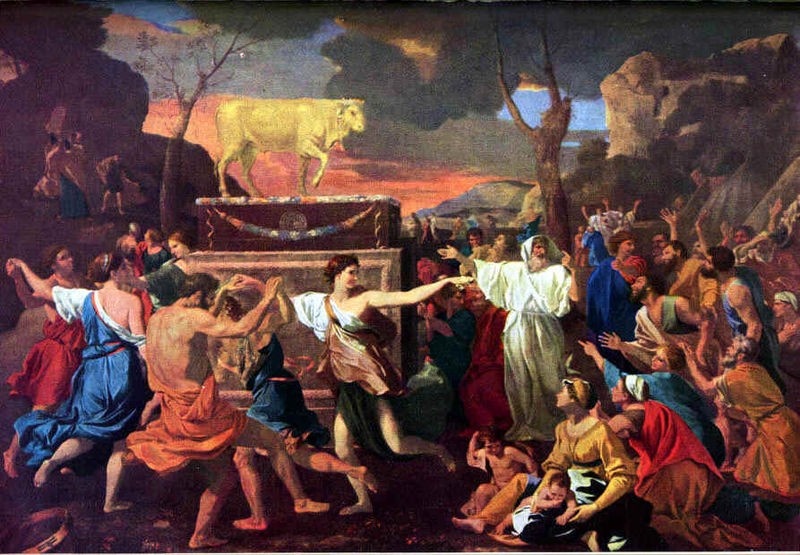
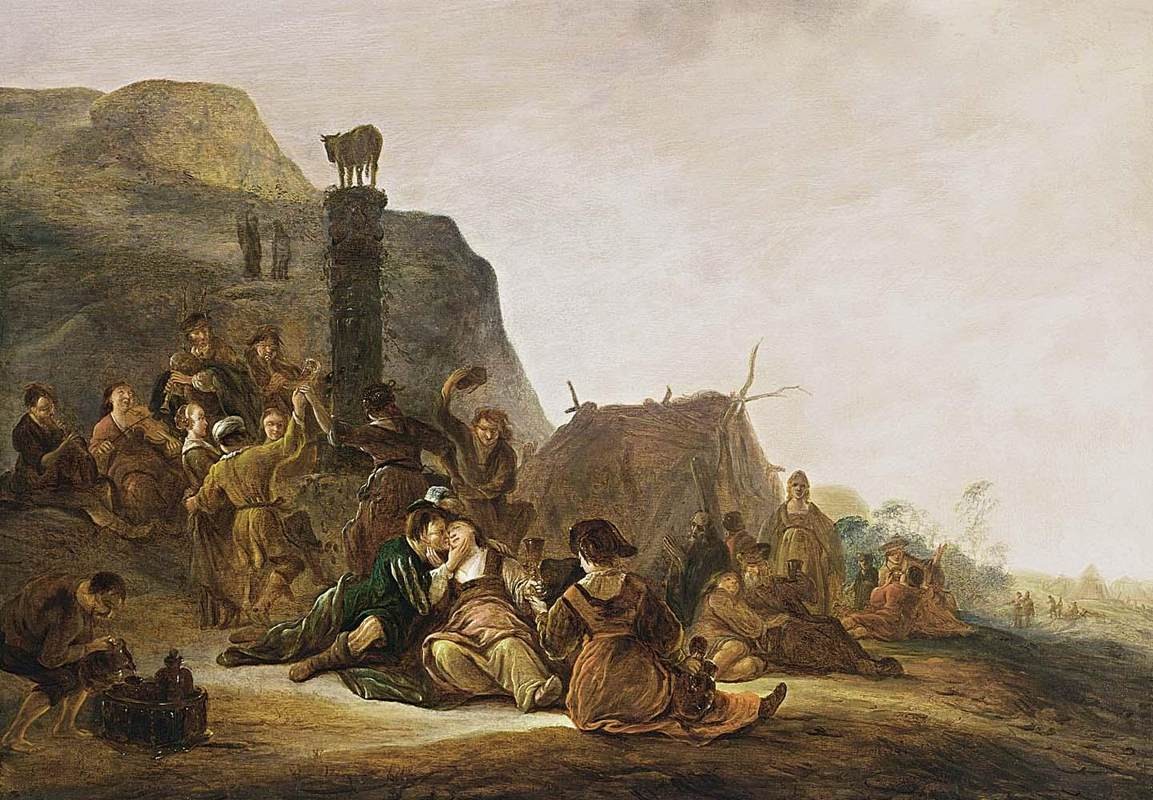
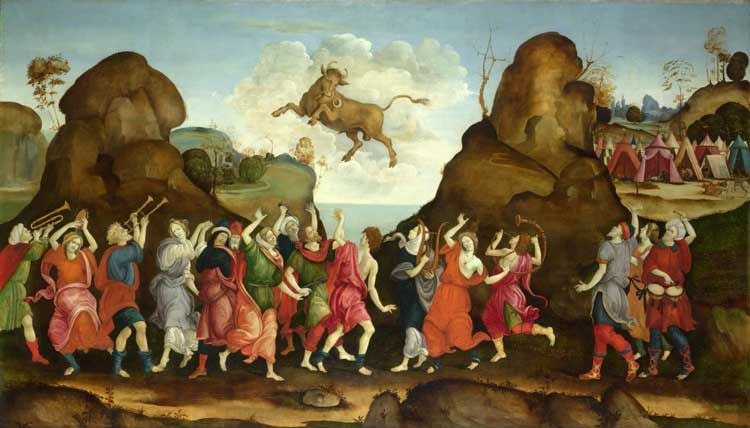
Scenes of the Golden Calf revelry in ancient art. Note how often they are shown partially dressed-
Adoration of the Golden Calf, Nicolas Poussin
Gerrit de Wet – The Adoration of the Golden Calf
Van Leyden Lucas – Dance of Jews around the Golden Calf
Let’s advance the scene again, to the times of the pagans until Jesus came. The ancient Greek historian Herodotus was the first to state that the ancient Mesopotamians practised temple prostitution. This is really tough on the heart to read:
“The foulest Babylonian custom is that which compels every woman of the land to sit in the temple of Aphrodite and have intercourse with some stranger once in her life. Many women who are rich and proud and disdain to mingle with the rest, drive to the temple in covered carriages drawn by teams, and stand there with a great retinue of attendants. But most sit down in the sacred plot of Aphrodite, with crowns of cord on their heads; there is a great multitude of women coming and going; passages marked by line run every way through the crowd, by which the men pass and make their choice. Once a woman has taken her place there, she does not go away to her home before some stranger has cast money into her lap, and had intercourse with her outside the temple; but while he casts the money, he must say, “I invite you in the name of Mylitta” (that is the Assyrian name for Aphrodite). It does not matter what sum the money is; the woman will never refuse, for that would be a sin, the money being by this act made sacred. So she follows the first man who casts it and rejects no one. After their intercourse, having discharged her sacred duty to the goddess, she goes away to her home; and thereafter there is no bribe however great that will get her. So then the women that are fair and tall are soon free to depart, but the uncomely have long to wait because they cannot fulfil the law; for some of them remain for three years, or four.”
Temple prostitution was a practice in most cultures. Deuteronomy 23:17 forbids followers from indulging in temple prostitution.
“None of the daughters of Israel shall be a cult prostitute, and none of the sons of Israel shall be a cult prostitute.”
Khajuraho Group of Monuments
Divine and sexual union is a central teaching in Tantric Buddhism, where sexual practices and rites constitute an important offering to Tantric deities. The temple Khajuraho at left is a monument to the Hindu and Jain gods, and is described by UNESCO World Heritage sites as “decorated with a profusion of sculptures that are among the greatest masterpieces of Indian art.” Most of the sculptures are graphic sexual acts. In one of the sculptures a man is having relations with a horse. Masterpiece, eh?
Even after Jesus, the carnal/sensual remained as a part of worship in many cultures, even Catholicism. The sexual as worship was practiced by Catholic and other mystics in the Middle Ages. The late Middle Ages from 1300-1500 was the height of the Catholic Mystical period especially for women. These females, especially Teresa of Avila and Hildegard of Bingen, experienced and wrote about their personal, intimate, erotic, ecstatic and divine union with God through overtly erotic experiences when overcome with their ‘visions’.
Other female mystics were, starting in the 1200s, Abbess Gertrude of Hackeborn, Mechthild of Hackeborn, Mechtild of Magdebourg, and Gertrude the Great. Their visions are largely based on the Song of Songs and filled with eroticism and the Body of Christ. As we approach the current age, we find Mark Driscoll setting off a firestorm with his graphic and heinous teaching of the Song of Solomon. It was so bad it earned a 4-part rebuke from John MacArthur. Did I not tell you that everything old is new again?
Julie B. Miller, writes, “Scholars of women’s religious history and spirituality readily agree that medieval and early modern women mystics utilized the vocabulary and imagery of sexual love to describe their passionate and intense relationships with the divine.”
In Ruth Evans’ book “Medieval Virginities” we read that in much current scholarship the erotic language of women medieval mystics is not thought to be entirely allegorical. Rather, the religious experience of these women is often regarded as intrinsically erotic…
Jean Gerson, a medieval male mystic himself, noted this trend in 1415 and warned against it. But there is a clamor to accept mysticism today and all that comes with it, including the re-emergence of accepting a union of the sexual.
OK, you get the idea. So what does this globe trotting that have to do with today? Because that old notion of uniting the sexual with worship is ba-ack! BIG TIME. It is not in the pagan religions though and it is not in the Catholic religion. It is in traditional Christianity!
It started a few years ago in books with ‘frank’ explorations of sex within the confines of a one-man, one-woman Christian marriage. Lately Ann Voskamp explored the idea of sexual imagery with Jesus like this: “God makes love with grace upon grace, every moment a making of His love for us. [C]ouldn’t I make love to God, making every moment love for Him? To know Him the way Adam knew Eve. Spirit skin to spirit skin?”’ The trend continued with certain sexually topical sermons in the emergent churches. It quickly descended to stunts, like this one from Ed Young with his 24-hour “bed-in” and “7 day sexperiment.”
Ed Young and his 24-hour bed in, sexperiment
It continued with Mark Driscoll of Mars Hill.
Mark Driscoll ‘Obsessed With Sex,’ Says Critic; Followers Ecstatic to See Pastor Go ‘Mainstream’ “The popular and controversial book about sex and relationships penned by Seattle megachurch pastor Mark Driscoll has one critic claiming there is a new craze for “sex talk” in the church, while the pastor’s followers seem excited that Mars Hill manages to promote a biblical approach to sex among secular audiences.”
This downward trend continued with lesser-known pastors taking the Young and Driscoll stunts as permission to be even more “open” about sex in the pulpit. The sex focus became prevalent, palpable, and more disgusting. I’m talking over only the last 4 years. It has happened that fast.
It continued further, with Driscoll preaching the Song of Solomon is a salacious way. Elder of the faith John MacArthur publicly rebuked Driscoll in a 4-part essay called “The Rape of Solomon’s Song.” In the first essay he said, “Mark Driscoll has boldly led the parade down this carnal path.”
He is more blunt in this essay about Driscoll’s version of proper sermon topics and language here, in the essay called “Grunge Christianity.”
“[I]t would certainly be accurate to describe both his vocabulary and his subject matter at times as tasteless, indecent, crude, and utterly inappropriate for a minister of Christ. In every message I listened to, at least once he veered into territory that ought to be clearly marked off limits for the pulpit. … Apparently the shortest route to relevance in church ministry right now is for the pastor to talk about sex in garishly explicit terms during the Sunday morning service. If he can shock parishioners with crude words and sophomoric humor, so much the better. The defenders of this trend solemnly inform us that without such a strategy it is well-nigh impossible to connect with today’s “culture.”
MacArthur is referring to a particular sermon Driscoll had preached in Scotland that was extremely sexually graphic, offensive, and tasteless. I won’t even link to it.
So as this parade of carnality now permeates the pulpit, added to this is dance and me-oriented romantic lyrics in praise songs. Am I exaggerating the nearness of the return of temple prostitution? Methinks not.
Look at Passion Worship Band’s lyrics to “Madly”:
We are madly in love with you We are madly in love with you We are madly in love with you We are madly in love with you And all of my life and nothing less I give to you my righteousness…
WE have righteousness to give to Jesus? NO!
Or these sensual lyrics:
You are my desire, no one else will do ‘Cause nothing else could take your place To feel the warmth of your embrace Kelly Carpenter – “Draw Me Close”
Or these–
You call me child and I’ll call you Father Kisses from heaven of joy and laughter … I want to lavish my love on you, Jesus. David Harper – “I Want to Lavish”
Included in racy or romantic lyrics are breathless sexy singing arrangements. Todd Friel warned about this amorous phrasing and sexy singing delivery. Humorously but not so funny, there is a list of 6 lyrics from secular love songs and Christian praise songs. It is impossible to tell them apart. Add to that terrible turn of events, the widespread recent inclusion of dance and skits to ‘praise and worship’ music time during services…
Praise Dancing is now emerging as a ‘ministry.’ It is also called “body worship.” You notice the unintended double meaning, I hope. Increasingly we see dance movement accompany contemporary music as part of the worship service.
Here is an example of a body worship praise dance called Total Body Worship Too… at a Baptist Bible fellowship.
During the dance, people got up and danced themselves, others rushed forward to capture the moment in film or video. The pastor was dancing along the side. As the dance went on, the dancers increased their tempo and simply gyrated and flung their arms all around with no obvious choreography. It is chaotic worship that focuses attention on the body and not Jesus Christ. Pardon me, but I see no ministry here.
“Praise dancing is a ministry,” says 17-year-old Ariana Starks at a recent Saturday morning practice at St. James, where she shimmied her shoulders to vibrant gospel music. “Most young people go to church and find it boring. This is a way to attract people into the house of God who wouldn’t normally want to come. … “The Lord is using us through the art of dance to preach the word of God,” says Debra Crenshaw, founder of the Fremont-based Christian dance company Dance For His Glory. “It can be entertaining, and people can get enjoyment from it, like the purpose of secular dance. But that’s not our sole purpose.” Dance as worship is an age-old custom that can be traced back to the ancient Israelites who danced during Jewish festivals and ceremonies. Sufi Muslims have also been connecting with the divine through inspirational dance for centuries, going back to the whirling dervishes. ” (source).
Did you catch that? ‘Connecting with the divine’ through the body. A physical act. not a spiritual one of the mind and heart. Oy.
Contemporary music already has relinquished much of its mooring to biblical doctrine, and marrying the romantic Jesus boyfriend theme of contemporary music lyrics with bodily expressions of the divine love, on the pulpit or stage, is yet another example of the sexual carnal intrusion ready to burst on the scene in full force when the Spirit is taken out of the way. Challies speaks to praise dancing here.
Modern day cults always have a sexual component and ritualized sex. It is one way you can tell it is a cult!
Our globe has come full spin and where we started with satan in the Garden with wanting higher knowledge to be like God and lusting after the pleasurable fruit. (The lust of the eyes and the pride of life). We are that much closer to the golden calf dancing of Exodus and the pagan practices of ritualized sex at the pagan temple.
Hillsong Church dancing
“The Worship of the Golden Calf” by Filippino Lippi (1457-1504)
The Holy Spirit restrains sin. It is one of His ministries. Prior to the Flood judgment, God removed the Spirit (Genesis 6:3). He will do so again before the Tribulation judgment (2 Thessalonians 2:7). Can you imagine the flooding-in of the sexual when there is no restraint, if there is THIS much of the sexual is already present, even in evangelical churches?
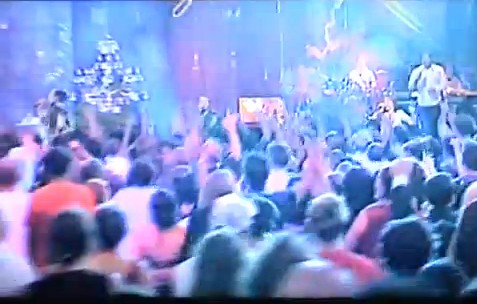
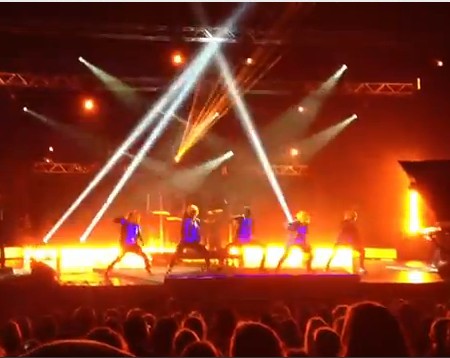
Below is a still from a video of Elevation Church – Charlotte, NC Code Orange Christmas dance to advertise the Code Orange revivals in January at Elevation Church
I didn’t want to put salacious pictures in front of you, but I’d like to close with a challenge: as you view some of these ‘praise concerts’ at churches complete with dancers, mimes, props, Charismatic laughter, body gyrations, loud music and hypnotic drum beats, synchronized hopping, keep in mind the Pastor Ed Young in his bed, the imagined picture in your head of the temple prostitutes, and ask yourself, isn’t it obvious where the romanticizing Jesus movement, mystical ecstatic experience, Song of Solomon sex talking preachers are headed the moment the Holy Spirit is out of the way? The final union of the sexual and the divine- satan’s way.
This is a sad story. But there is a hopeful side. 🙂
Banks foreclosing on US churches in record numbers “Banks are foreclosing on America’s churches in record numbers as lenders increasingly lose patience with religious facilities that have defaulted on their mortgages, according to new data. The surge in church foreclosures represents a new wave of distressed property seizures triggered by the 2008 financial crash, analysts say, with many banks no longer willing to grant struggling religious organizations forbearance. Since 2010, 270 churches have been sold after defaulting on their loans, with 90 percent of those sales coming after a lender-triggered foreclosure, according to the real estate information company CoStar Group. In 2011, 138 churches were sold by banks, an annual record, with no sign that these religious foreclosures are abating, according to CoStar. That compares to just 24 sales in 2008 and only a handful in the decade before. black and white, but with small to medium size houses of worship the worst. Most of these institutions have ended up being purchased by other churches. The highest percentage have occurred in some of the states hardest hit by the home foreclosure crisis: California, Georgia, Florida and Michigan.”
This is a church in GA that has a hard time to keep going. It has been opened, closed, sold, renovated, closed again…
When I first arrived in Georgia, I was astounded to see the number of churches that seemed to adorn each corner. “There are a lot of churches,” I thought. “This must be a very religious place.”
When I traveled on the ice breaking ship Relais Nordik to Blanc Sablon on the border of Quebec and Labrador/Newfoundland, there was a church on the tundra. Its white clapboard stood out starkly against the springy green tundra moss.
To help you get a picture of where Blanc Sablon is, here is a map–
I thought, “Wow, the church is so far-reaching, even the tiniest place at the edge of the continent has a church.”
It is easy to identify the church with the buildings that we see. And for a large part, it is. We are commanded to congregate as Hebrews 10:25 tells us. It is the building where we praise Jesus, sing, minister, tithe, encourage each other and hear the Word. It is appropriate to identify the building where we do those things with the church itself. But be careful not to exclusively identify His church with the buildings we commonly see.
But the building is not the Church. His body of believers is the Church. (Romans 12:5, 1 Corinthians 10:17, 1 Corinthians 12:27, Ephesians 4:12, Hebrews 13:3).
We are told that the church will grow weaker and less effectual as we near the end, and that many who were only Christians on the outside will fall away. (Revelation 3:8; 2 Thes. 2:3). We are seeing that now. Youths are leaving the church in droves, people are falling away from regular attendance, and in general the buildings are less and less central to a community’s spiritual and moral compass. It is no wonder that in these apostate times that church buildings, with the maintenance required, cannot be maintained. You can’t pay a pastor and support a building with only 50 people tithing.
But the Church is the body of believers scattered worldwide! We will soon be gathered to Him in the rapture and the dead resurrected, and the glorified saints of the Church Age will be in heaven, finally together in Him. No matter how empty your church building is becoming, remember that His Church is spotless, full, glowing, sanctified, holy, and He is as eager to gather us as a hen is to gather her chicks. (Luke 13:34).
Yes, it is sad that churches are failing. With the power given to us by the Holy Spirit, nothing should be impossible for us in Him (Mark 9:23). Christians should be more energized as they grow, not less. But the world has caught us, and many are falling and the churches with them. But His Church will never fail! Because the Church is not the building! Yes, churches are on every corner, yes churches are all across the world. The buildings are not His Church.
“Now when Jesus came into the district of Caesarea Philippi, He was asking His disciples, “Who do people say that the Son of Man is?” And they said, “Some say John the Baptist; and others, Elijah; but still others, Jeremiah, or one of the prophets.” He said to them, “But who do you say that I am?” Simon Peter answered, “You are the Christ, the Son of the living God.” And Jesus said to him, “Blessed are you, Simon Barjona, because flesh and blood did not reveal this to you, but My Father who is in heaven. “I also say to you that you are Peter, and upon this rock I will build My church; and the gates of Hades will not overpower it.” (Matthew 16:13-18)
Obama went to church for the third time in a year…and the guest speaker happened to be a Pro-Palestinian speaker Dr Ziad Asali. From Israel Today
“Before last Sunday, US President Barack Obama and his family had only been to church a handful of times since he became commander-in-chief. And two of those visits were for Inauguration Day and Easter. The Obama family’s sixth time at church in Washington, DC may also have been for a special occasion – to hear a pro-Palestinian activist teach about how Israel needs to surrender its biblical heartland for a phony “peace.” The president, his wife Michelle and their two daughters attended St. John’s Church, an Episcopal church just across the street from the White House, for the morning service on September 19. Low and behold, that is the same morning that guest speaker Ziad Asali of the American Task Force on Palestine (ATFP) had the podium. Asali and the ATFP pretend to want a lasting two-state solution to the conflict, but also advocate the demographic destruction of the Jewish state by supporting the demand that Israel open its gates to millions of so-called “Palestinian refugees.” The ATFP blames Israel for the current situation, and wants it to apologize for its rebirth as a nation-state, while Asali draws moral equivalency between Palestinian terrorism and Israeli counter-terrorism operations. Asali and the ATFP are likewise linked to a number of unsavory pro-Palestinian figures who were once on Obama’s guest list. Perhaps unsurprisingly, the US mainstream media ignored the fact that a Muslim with a thinly-veiled anti-Israel message was preaching on the day that the Obama family attended church for only the third time in the past year.”
WASHINGTON – President Obama attended church on Sunday for the first time since April as an increasing number of Americans believe – falsely – that he is Muslim, not Christian. The entire First Family walked from the White House across Lafayette Square Park to St. John’s Episcopal Church, the quaint house of worship informally known as the Church of the Presidents. The Obamas sat a few rows back from the altar among about 40 worshipers. The President and First Lady Michelle Obama, along with their daughters, went up for Communion. Obama last attended church in Washington on Easter Sunday, April 4. He has not joined a church in the capital, giving the reason that his presence – and that of his large entourage – would disrupt other people’s worship. His low-profile Christianity may be playing into the Muslim myth, however. A Pew poll last month showed 18% of Americans – and nearly one-third of Republicans – wrongly believe Obama is a Muslim. Former Secretary of State Colin Powell, a Republican who backed Obama, suggested yesterday the public doubts about Obama’s religion have more to do with a weak economy. “I’ll bet you a dollar if the unemployment rate was not 9.6%, but it was down to 4%, then you would find only 5% thinking he’s Muslim,” Powell said on NBC’s “Meet the Press.”
Yeah, that’s it. A high unemployment rate and the President’s choice of religion are tied together. So why didn’t anyone think Jimmy Carter was a Muslim?
What God says:
Zechariah 12:2-3 prophesies that Israel will be alone in the world, with no allies nor friends. We see this coming close to fulfillment today. Even their staunch friend and ally the US is abandoning them, and Obama can only be called a hostile enemy to Israel.
Many nations will try to remove Israel from her land and will fail. Not only will Israel have no friends in the world, but most of the world will be Israel’s enemy. Psalm 83 says that many nations speak of wiping her off the face of the planet. “They have said, “Come, and let us wipe them out as a nation, That the name of Israel be remembered no more.” (Psalm 83:4)
At the very end, all the nations of the world will attack Israel. “Judah will be besieged as well as Jerusalem. “On that day, when all the nations of the earth are gathered against her, I will make Jerusalem an immovable rock for all the nations. All who try to move it will injure themselves.” But, as Zechariah 12:9 states, “On that day I will set out to destroy all the nations that attack Jerusalem.” Between now and when the LORD saves His nation, His land, and His people, it will only become more tense in the Middle East and lonelier for Israel. Pray for them!









 the-end-time.org