
I read the following this morning, and it got me thinking:
As Self-Immolations Near 100, Tibetans Question the Effect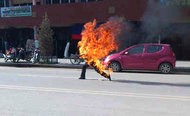 “A crowd of Tibetans came here to India’s capital last week, bearing flags and political banners and a bittersweet mixture of hope and despair. A grim countdown was under way: The number of Tibetans who have set themselves on fire to protest Chinese rule in Tibet had reached 99, one short of an anguished milestone. Yet as that milestone hung over the estimated 5,000 Tibetans who gathered in a small stadium, so did an uncertainty about whether the rest of the world was paying attention at all. In speeches, Tibetan leaders described the self-immolations as the desperate acts of a people left with no other way to draw global attention to Chinese policies in Tibet. … Billed as the Tibetan People’s Solidarity Campaign, the four-day gathering featured protests, marches, Buddhist prayer sessions and political speeches in an attempt to push Tibet back onto a crowded international agenda. If the Arab Spring has inspired hope among some Tibetans that political change is always possible, it has also offered a sobering reminder that no two situations are the same, nor will the international community respond in the same fashion.”
In Tibet prayer is going on most of the time. Tibetans pray in a special way. They believe that when certain sounds and words, called mantras, are said many times, they arouse good vibrations within the person. If a mantra is repeated often enough it can open up the mind to a consciousness which is beyond words and thoughts.
The reference in the article to the Arab Spring was the incident where “the catalyst for the escalation of Muslim protests was the self-immolation of Tunisian Mohamed Bouazizi. Unable to find work and selling fruit at a roadside stand, on 17 December 2010, a municipal inspector confiscated his wares. An hour later he doused himself with gasoline and set himself afire. His death on 4 January brought together various groups dissatisfied with the existing government system, including many unemployed, political and human rights activists, labor, trade unionists, students, professors, lawyers, and others to begin the Tunisian revolution” which in turn fueled the rest of the nations that ended up participating in the Arab Spring throughout 2011. You can read about Bouazazi’s story here. When Bouazazi died, protesters filled the streets chanting, “Farewell, Mohammed, we will avenge you. We weep for you today. We will make those who caused your death weep.” And they did. They made the world weep, and it is still weeping, but not in the way they intended.
The Tibetans keep burning themselves up but the people’s and the government’s reaction is not the same, and they wonder why. In the flesh, one reason is that the Tunisians themselves who reacted to the self-immolation of Bouazazi, protesting the current status and enacting change- mostly through violence. The Tibetans who self-immolate, expect the government to change as the reaction to the act of martyrdom. It won’t happen. In the spirit, though, ultimately all change is brought about by God. He sets up kings and governments and he takes them down. (Daniel 2:21, Psalm 75:7).
What got me thinking was the tragedy of it all. Neither Muslims nor Buddhists are saved. Therefore I think of the horrified reaction of Bouazazi and all 99 of the Tibetan monks who self-immolated. In Bouazazi’s case, he was angry and his act was borne out of frustration and rage against the corrupt government. In his last act of anger and frustration, he self-immolated a mere one hour after the government officials confiscated his fruit vendor scales.
The Tibetans who protest Chinese occupation in their homeland of Tibet also hope to make a positive change in a way that displays just as much frustration but in a non-violent way. Yet in all cases, the self-immolates woke up in hell. How horrible to have performed an ultimate act of self-sacrifice on behalf of your fellow countrymen only to find out to your eternal horror that your benevolent act landed you in hell, enduring God’s wrath forever. Whether Muslim or Buddhist, nice guy or evil one, upon your death it means that you will go to hell.
What do Tibetan Buddhists believe?
Tibetan Buddhism’s goal of spiritual development is to achieve a special enlightenment called Buddhahood in order to best help all other sentient beings attain this same state. Buddahood is a state of perfect omniscience, attained by self effort and/or adherence to teachings. (Omniscience is the state of knowing all things, having total knowledge).
The great mystic Padmasambhava (more commonly known in the region as Guru Rinpoche) merged tantric Buddhism with the local Bön religion to form what is now recognized as Tibetan Buddhism. While there are many forms of Buddhism, Tibetan Buddhism adheres to the following as some of its main principles:
–That all existence and manifestation can be found in one’s experience, that that experience is with one’s own mind, and that Mind is the source and the creator of all things.
–That Mind is an infinitely vast, unfathomably deep complex of marvels, its immensity and depth being inaccessible to the uninitiated.
–“Buddha-Mind is a GREAT ILLUMINATING-VOID AWARENESS”. The experience of enlightenment of the void is simple to state. It is the experience of awareness only, awareness that is aware of nothing at all except the existence of awareness itself.
–That the infinite compassion, merit, and marvels will spontaneously forth when this Buddha-Mind is fully unfolded. (source)
& etc. and so on.
When a Buddhist exalts one’s mind as the pinnacle of all experience and knowledge, it is really an exaltation of the self.

When a Tibetan Buddhist prays, they set up a prayer flag. These prayer flags were ones I took a photo of in San Francisco. Wikipedia says, “Prayer flags are used to promote peace, compassion, strength, and wisdom. The flags do not carry prayers to gods, a common misconception; rather, the Tibetans believe the prayers and mantras will be blown by the wind to spread the good will and compassion into all pervading space. Therefore, prayer flags are thought to bring benefit to all.”
So if the wind blows over the flag while you are walking near it, you will derive some benefit as its sacred air then passes over you…
To sum up, Tibetan Buddhism teaches by self-effort to become a little god. No? Yes, because they teach that one can attain by self-effort a perfect omniscience and a perfect compassion. However at the root of that perfect knowledge, is voiding one’s self of all sentience. Being aware of nothing is the goal, so that there are no hindrances to being able to help other people. First I must become perfect by emptying myself of all deisre, so than I can in turn help you, who is not perfect, being filled with desires.
Further, this little god-hood continues in a special level in Arya-bodhisattvas. These are ones who have attained a higher level and are able to escape the cycle of death and rebirth but compassionately choose to remain in this world to assist others in reaching nirvana or buddhahood. Yet no one can choose to escape the cycle of death, (and there is no rebirth, except for being born again in Christ) for God said,
There is no way to deny that a Tibetan Buddhist teaches a path through self-effort of becoming a little god. Being perfectly omniscient, perfectly compassionate, being able to create all things by your own self, and conquering death is what a god does. As James Stephens says in Ministry Today Magazine, “Buddhist theology and practice is antithetical to biblical Christianity. For instance, the Buddhist objective in meditation is to empty one’s mind while seeking union with the cosmos, ultimately buying into the Serpent’s ancient lie, “You shall become as gods.”
However the entire exercise is ironic, because though a Buddhist believes that all existence and manifestation can be found in one’s experience, it is ultimately the goal to destroy one’ awareness of one’s experience, and become void. Nothingness is the goal. How hopeless. How futile.
A Buddhist is without hope to begin with, and then spends a lifetime destroying any glimmer of any hope after that to become one big void. I can only see that despair is at the end of the road for a Buddhist.
Buddhism has deities, though Buddha himself is not generally thought of as a god. The Tibetan deities are, the Five Great Buddhas of Wisdom which are able to overcome a particular evil by performing a particular good, the Wrathful Deities, and Tara, the savior goddess.
I feel deep compassion for the Tibetan monks who have a desire to help humanity. Who devote their entire lifetimes to prayer and helps for their fellow man, Who even sacrifice their own lives in hope that their death will make a positive difference. But all their efforts are in vain. God does not listen to sinners. So the Tibetan monk’s prayer is unheard of by the only One who can answer. Tara does not exist. No Buddhist created anything of this earth. No person can become omniscient. Only God is omniscient.
The hubris in believing that man can attain these things on his own is a grave sin in itself.
Tara does not exist. The Wrathful Deities do not exist. They are figments of man’s vain imagination. Of the one true salvation deity, CARM.org describes salvation, “salvation is the state of being saved from God’s judgment upon the sinner. The only way to be saved is to trust Jesus for the forgiveness of one’s sins (John 14:6, Acts 4:12). All who do not trust Jesus alone, by faith (Rom. 5:1; Rom. 6:23; Eph. 2:8-9) are not forgiven and go to hell when they die (Matt. 25:46; John 3:18). When Jesus forgives someone, He forgives all their sins and gives them eternal life and they shall never perish (John 10:28).
When I drop my pencil, I go ‘oops’ When I stub my toe, I go “OOPS!” Those are mistakes that are easily recovered from. When a Muslim or a Tibetan Buddhist self-immolates, dies, and arrives in hell, ‘oops’ doesn’t begin to cover it. Discovering after all that the Christians were right, God does exist and He does require belief in Jesus to attain ‘nirvana’, is a mistake of eternal proportions. It barely is possible to comprehend the horror and fear of a person who hastened their own eternal destruction. It is why I don’t hate the Muslims who flew the planes into the Twin Towers, Pentagon and that Pennsylvania field. What can I possibly say about them that they are not saying themselves for all eternity? That God won’t say to them when they face Him on judgment day? I mourn the futility of the Tibetans’ acts, seeing as they are sinners in the hands of an angry God who will say- ‘I am omniscient, YOU thought you could become like Me?!
This blog entry was about the futility of false religions and the compassion Christians should have on people who are in the dark. If you are a Buddhist reading this, and wondering why you’re not further along the “path” to nirvana, please read the following article
I am a Buddhist, why should I consider becoming a Christian?
Unfortunately, Buddhist practices are creeping steadily into Christianity. If you are a Christian who senses that your friend, relative or your church is starting to mix Buddhism with Christian practices (such as “contemplative prayer” or contemplative meditation, yoga, chanting, etc) Matt Slick at CARM.org offers these resources for help:
“Two of the best resources that make a clear distinction between Christianity and world religions such as Buddhism are “Jesus Among Other Gods: The Absolute Claims of the Christian Message,” written by Ravi Zacharias, and “The Universe Next Door: A Basic Worldview Catalog,” by James Sire. Zacharias examines the truth claims of Jesus Christ and the exclusivity of the Christian message against the messages of other faiths, while Sire lays the philosophical foundations that undergird every worldview and then analyses the major religions and the solutions they offer to each worldview category/question.
Ray Yungen, author of “A Time of Departing,” and “For Many Shall Come in My Name,” and Warren Smith, author of “The Light That Was Dark,” and “A Wonderful Deception,” demonstrate that eastern meditative practices are not harmless as many Christians insist but are instead dangerous dabbling with occultism. You also may try such online resources as Probe Ministries, which has several informative pieces on the subject, as well as Leadership U which also has many good articles on Buddhism.”
Probe Ministries article on Buddhism
And this one from Probe, “Can Christians practice Buddhism?“
Christians should pray constantly in gratitude that He sent the spirit of repentance upon us and gave us the Light of Jesus in our souls. What a relief I am not in the dark anymore! Despite Buddhists’ attempts at a life of goodness and compassion, non-violence and prayer, Buddhists are still sinners in need of Jesus. Buddhists need witnessing to as well.
 the-end-time.org