Posted in biodiversity, israel, jerusalem

Great Cities of the Bible #4: Jerusalem

By Elizabeth Prata

Great Cities of the Bible #1: Damascus
Great Cities of the Bible #2: Babylon
Great Cities of the Bible #3: Rome
Great Cities of the Bible #4: Jerusalem

It all begins and ends with Jerusalem.

Actually let’s back up a bit. It all begins and ends with God.
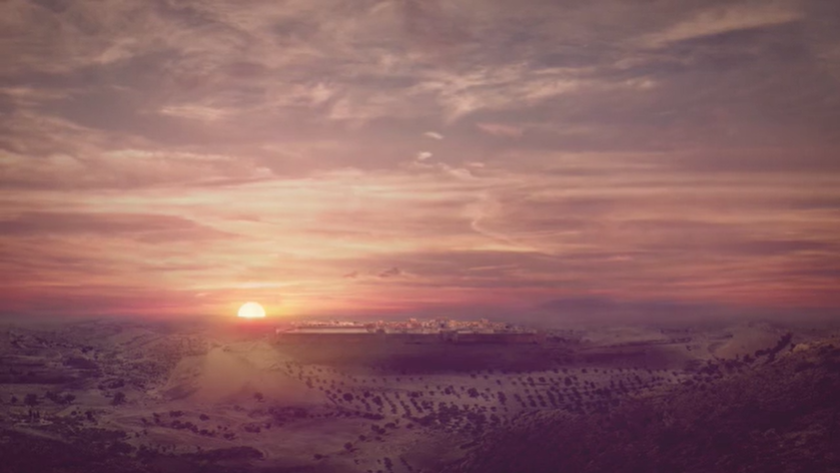
Sunset at Jerusalem. Source Faithlife media

Before the foundation of the world, God determined in His mind and His heart to select a people for Himself to have fellowship with. (Ephesians 1:4). He began with Adam and Eve, then made covenants through Noah, Abraham, David, and the entire People Israel. He revealed His extended operations and dealings with man by grafting in the Gentiles (all the world) to His promises of Redemption and grace through faith with any person who repents to Jesus, God’s Son.

Through all this Jerusalem has remained for almost the entire period the central city of God. Earlier named Salem, when we meet King Melchizedek of Salem, this city of Jerusalem is the true eternal city, not Rome as man has dubbed that ancient urban center.

Jerusalem! It is the eternal city, (Psalm 46:4Revelation 3:12) God’s city where He has set His name, (1 Kings 11:362 Chronicles 12:13) and is the city in which Immanuel (Matthew 1:23) will dwell in all His glory, (Zechariah 8:3) calling it Jehovah Shammah, The Lord is There. (Ezekiel 48:35). It is the nickname He uses when he calls His people. (Zechariah 3:2). When Jesus returns, “Then Jerusalem will be called the City of Truth, and the mountain of Yahweh of hosts will be called the Holy Mountain.'” Says Zechariah 8:3.

It is a place that figures solely as the most important land, city, and people in the history of the earth. All of history is dwindling down to one focal point: Jerusalem. So let’s take a look at this incredible place.


In all of history, there’s never been a distinct people group who dwelled outside of a national homeland for thousands of years yet retained their identity like the Jewish people have. There has never been a people on earth restored to their homeland after dozens of generations. There has never been a case where generations upon generations who forgot their own language and let it die, had it restored to the entire nation. No people, that is, except for God’s people in God’s land and in God’s city- Jerusalem. This is God’s hand.

This tiny nation is mighty in many ways, because her very existence has generated hate and war since her birth. Just existing provokes the entire world into hating her. Allowing her to make her own sovereign decisions as a nation inflames the world (satan).

Ancient maps placed Jerusalem in the center of the page. They knew that Jerusalem is God’s city and is the fulcrum of history, the axle of the wheel, and the center of the world stage. In the Jewish tradition, the Ark in the Temple in Jerusalem, through which God dealt with his people through the High Priest, it is the Foundation marking the “navel of world”. Ezekiel 5:5, “This is Jerusalem; I have set her at the center of the nations.

We read a similar reference in Ezekiel 38:2, “to seize spoil and carry off plunder, to turn your hand against the waste places that are now inhabited, and the people who were gathered from the nations, who have acquired livestock and goods, who dwell at the center of the earth.”

And what of this land? What is it like? It is wonderful! From deserts of the southern Negev to the snow-capped mountains to the north, to the 270 miles of coastline along the Mediterranean and to the frontier at the east, it is a diverse land.
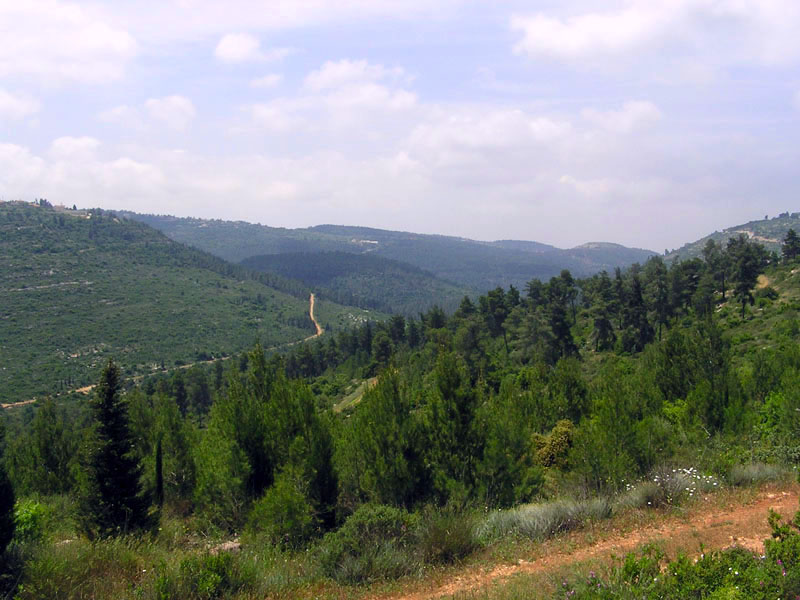
Mountains of Judea, source Wikipedia commons
Northern coast. Source Wikipedia commons
Jordan’s Rift Valley, Source Wikipedia commons
Acacia tree in Negev Desert, Makhtesh Gadol, Wiki photo

Jerusalem itself is about 2500 feet in elevation. It sits on a plateau within the mountains, which includes the Mount of Olives, and Mount Scopus. Valleys surround the city. We read in the Psalms some “Psalms of Ascent” because when Jews made the annual trek to the City for Passover, they climbed to the old City. They were ascending.

As the mountains surround Jerusalem, So Yahweh surrounds His people From now until forever. (Psalm 125:2).

And many mountains do surround the city, almost like a rampart. Some count the peaks numbering 7, and refer to the Revelation 17:9 verse describing a city of seven mountains upon which the harlot sits as Jerusalem, not Rome.

1. Mount Scopus,
2. Mount of Olives
3. Mount of Corruption
4. Mount Ophel
5. Mount Zion/Moriah (AKA the Temple Mount)
6. New Mount Zion
7. the Roman Antonia Fortress peak

The Kidron Valley runs to the east of Old Jerusalem and the Mount of Olives is actually separated from it. Along the southern side of old Jerusalem is the Valley of Hinnom, a steep ravine where hell or Gehenna is mentioned and the trash heaps blazed night and day. In biblical times, lush forests surrounded the city, forests of almond, pine, and olive. These forests are gone now. Due to the steep incline, farmers used a terracing system to keep the soil in place and those can still be seen today.

I’d mentioned that Jerusalem was the primary city for the Israelites for “most” of their life, but in the early years of the Israelite kingdom, the Ark of the Covenant was sometimes moved around to several sanctuaries, especially those of Shechem and Shiloh. Shiloh was the capital for almost 400 years, before the first temple was built. Jeremiah 7:12a says

“But go now to My place which was in Shiloh, where I made My name dwell at the beginning,

After King David’s capture of Jerusalem, the Ark was moved to Jerusalem. Its presence there signified the presence of the LORD within the Holy of Holies. Sadly, the people’s idolatry, bloodshed, and disobedience meant that eventually the glory would depart from the Temple (Ezekiel 9-10). This happened in advance of the Babylonian sacking of the temple. In fact, God’s glory would never again occupy a temple or a building on earth.

Today the glorious temple is mostly gone. Only the grounds and the Western Wall (a retaining wall) are left of the original building. Atop the grounds lies the Dome of the Rock, the 3rd most holy site in Islam. Will there be a third temple? Some believe so, that the events of Ezekiel 37 indicate a future restoration of the temple with Jesus bodily present and with His people:

And the nations will know that I am Yahweh who sanctifies Israel, when My sanctuary is in their midst forever.

Jerusalem today is a bustling city, the intersection of three religions- Islam, Christianity, and Judaism. One day the ‘City of Truth’ will know only 1 true religion, and its inhabitants will worship Yahweh properly. What a day that will be!

Posted in biodiversity, israel, jerusalem

Jerusalem! part 1: The Land. Israel’s biodiversity, geography, & wildlife

Jerusalem! Introduction

Jerusalem! Part 2, The Nation

Jerusalem! Part 3, Its glorious spiritual future

~~~~~~~~~~~~~~~~~~~~~~

It all begins and ends with Jerusalem.

Actually let’s back up a bit. It all begins and ends with God.

Before the foundation of the world, God determined in His mind and His heart to select a people for Himself to have fellowship with, to produce the Messiah through them, and for them to spread the news of a Savior to the world. (Deuteronomy 7:6). And so began the creation of worlds, and His creation of people. (Genesis 1).

However, simply because the Jews were chosen, did not mean they would be exempt from living out God’s holy standards. We know from much of the Old Testament, that they didn’t.

You only have I known among all the families of the earth; Therefore I will punish you for all your wrongdoing.” (Amos 3:2)

Out of the dispersed descendants of the builders of Babel, God called one man, Abram, with whom He enters into covenant. Some of the promises to Abram and his descendants were purely gracious and unconditional. These either have been or will yet be literally fulfilled. Other promises were conditional upon the faithfulness and obedience of the Israelites. Israel utterly failed.

The LORD made a promise to Abram, found in Genesis 12, telling Abram that the LORD chose Israel to be His nation and the Israelites to be His people.

Now the Lord had said to Abram: Get out of your country, from your family and from your father’s house, to a land that I will show you. I will make you a great nation; I will bless you and make your name great; and you shall be a blessing. I will bless those who bless you, and I will curse him who curses you; and in you all the families of the earth shall be blessed.” (Genesis 12:1-3).

God was actually delivering three distinct promises to Abram, later re-named Abraham.

He made a land promise, a national promise and a spiritual promise.

1. The Land Promise: “A land that I will show you.”
He also said to him, “I am the LORD, who brought you out of Ur of the Chaldeans to give you this land to take possession of it.” (Genesis 15:7). Genesis 15:18-21 describes the boundary of the promised land in terms of the territory of various ancient peoples:

“On that day the LORD made a covenant with Abram and said, “To your descendants I give this land, from the river of Egypt to the great river, the Euphrates – the land of the Kenites, Kenizzites, Kadmonites, Hittites, Perizzites, Rephaites, Amorites, Canaanites, Girgashites and Jebusites.”

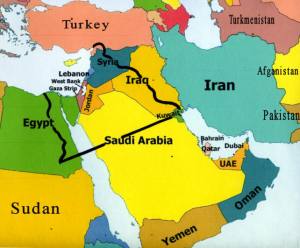
This land promise has never been fulfilled. The land that God promised His people the Israelites is very extensive. It would encompass all of today’s Syria, Jordan, Lebanon, Gaza, part of Iraq to the Euphrates & Tigris, the Nile Delta of Egypt, and part of Saudi Arabia.

Ancient maps placed Jerusalem in the center of the page. They knew that Jerusalem is God’s city and is the fulcrum of history, the axle of the wheel, and the center of the world stage. In the Jewish tradition, the Ark in the Temple in Jerusalem, through which God revealed himself to His people, rested on the Foundation stone marking the “navel of world” (‘omphalos’).

Ezekiel 5:5, “This is Jerusalem; I have set her at the center of the nations.

And what of this land? What is it like? It is wonderful! From deserts of the southern Negev to the snow-capped mountains to the north, to the 270 miles of coastline along the Mediterranean and to the frontier at the east, it is a diverse land.

Mountains of Judea, source Wikipedia commons
rosh hanikra view. Source Avishai Teicher via Wikimedia CC
Jordan’s Rift Valley. Source Wikipedia Commons
Acacia tree in Negev Desert, Makhtesh Gadol, Wiki photo

The wildlife of Israel includes the flora and fauna of Israel, which is extremely diverse due to the country’s location between the temperate and the tropical zones, bordering the Mediterranean Sea in the west and the desert in the east. (Wiki: Wildlife of Israel)

God called it a land flowing with milk and honey. (Exodus 3:8). A land with abundant milk means that it had abundant grasslands and pastures upon which the grassy lands could support abundant cattle (or goats). I have read in several Jewish commentaries that the honey is not bee nectar but the syrup one extracts from dates or figs. Either bee or fig, it evokes the same sense of abundance, this time from lush and growing vegetation.

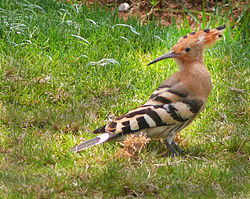
Hoopoe looking for insects. Author Hari K Patibanda, CC license

According to Israel Birding website, “Israel is situated at an intercontinental junction- a bottleneck for migration routes. An estimated 500 million (!!) birds pass through every spring and autumn, with 530 species in record.”

The bird migration bottlenecks over Israel because when the migrating birds of Europe migrate, there’s the Mediterranean to the west and the Black Sea to the east. Every migration south or north they fly over Israel. There are so many flocks and Israeli aviation and military planes had so many bird strikes that the Israelis developed special radar to avoid downed planes from bird flocks.

Israel’s climate varies from semi-arid to temperate to subtropical. The region is home to a variety of plants and animals; at least 47,000 living species have been identified, with another 4,000 assumed to exist. 116 species of mammals are native to Israel, as well as 511 bird species, 97 reptile species, and seven amphibian species. There are also an estimated 2,780 plant species. There are insects belonging to roughly 27 orders in Israel, out of about 29 worldwide“. (biodiversity in Israel).

So the landforms, birds, insects, and now mammals are extremely abundant and diverse. Incredible since Israel is only the size of New Jersey.

From Nature Israel, “From ancient times Israel’s native mammals have had an important role in Jewish culture, featuring in colourful biblical metaphors and prophecies, as symbols of the tribes of Israel or discussed at length in the dietary codes so central to the Jewish culinary tradition. The young David battles a bear and a lion, and Samson struggles with a juvenile lion. Torah scrolls are written on parchment from deer or antelope skins, the Jewish New Year is commemorated by blowing on the ram’s horn and the very Land of Israel itself is described as the “Land of the Gazelle”.

Song of Solomon 8:14 mentions the gazelle in terms of its speed. One of the sons of Zeruiah was compared to the speed of a gazelle in 2 Samuel 2:18.

Sadly (or not sadly for the locals…) the lions and bears are now extinct, but most of Israel’s native mammals familiar from the Bible and folklore remain – the jackal and the gazelle, the rock hyrax and the ibex, the wolf and the leopard, the wild boar and the hare.

Psalm 104 mentions many different kinds of vegetation, birds, and mammals of Israel.

rock badger

mountains are for the wild goats; the rocks are a refuge for the rock badgers.” (Psalm 104:18). Proverbs 30:24 says the following animals are ‘exceedingly wise’ and the hyrax, or rock badger, is one of those, “the rock badgers are a people not mighty, yet they make their homes in the cliffs;” (Proverbs 30:26). (Above, rock badger)

As mentioned, lions and cheetahs are now extinct in Israel, but imagine young David, armed only with a slingshot, guarding his flock against wolves, lions, bears, leopards, and cheetahs. Not to mention hyenas and jackals. Leopards still exist in Israel today, as do other wild felines including caracals (a kind of lynx), bog cats and wild cats.

Bears are mentioned in 2 Kings 2:24 as animals that came out of the woods and tore up 42 youths who were mocking Elisha. Of course the lion is prominent in fact and in metaphor in the Land. Proverbs 30:30 says of the lion, “the lion, which is mightiest among beasts and does not turn back before any;“. The LORD used lions as a judgment when Assyrians settled in the Land and did not worship the LORD. (2 Kings 17:25).

The Lord has blessed His land with biodiversity, geographical diversity, a wondrous climate, and beautiful flora and fauna of all kinds. After the restoration when the curse is reversed, it will finally be all that He intends it to be, His city, His dwelling, named “The Lord is there” (Ezekiel 48:35. (Jehovah Shammah!)


Further Reading

What does it mean that the Jews are God’s chosen people?

Posted in biodiversity, israel, jerusalem

Great Cities of the Bible #4: Jerusalem

By Elizabeth Prata

Great Cities of the Bible #1: Damascus
Great Cities of the Bible #2: Babylon
Great Cities of the Bible #3: Rome
Great Cities of the Bible #4: Jerusalem
Great Cities of the Bible #5: Capernaum

It all begins and ends with Jerusalem.

Actually let’s back up a bit. It all begins and ends with God.

Sunset at Jerusalem. Source Faithlife media

Before the foundation of the world, God determined in His mind and His heart to select a people for Himself to have fellowship with. (Ephesians 1:4). He began with Adam and Eve, then made covenants through Noah, Abraham, David, and the entire People Israel. He revealed His extended operations and dealings with man by grafting in the Gentiles (all the world) to His promises of Redemption and grace through faith with any person who repents to Jesus, God’s Son.

Through all this Jerusalem has remained for almost the entire period the central city of God. Earlier named Salem, when we meet King Melchizedek of Salem, this city of Jerusalem is the true eternal city, not Rome as man has dubbed that ancient urban center.

Jerusalem! It is the eternal city, (Psalm 46:4Revelation 3:12) God’s city where He has set His name, (1 Kings 11:362 Chronicles 12:13) and is the city in which Immanuel (Matthew 1:23) will dwell in all His glory, (Zechariah 8:3) calling it Jehovah Shammah, The Lord is There. (Ezekiel 48:35). It is the nickname He uses when he calls His people. (Zechariah 3:2). When Jesus returns, “Then Jerusalem will be called the City of Truth, and the mountain of Yahweh of hosts will be called the Holy Mountain.'” Says Zechariah 8:3.

It is a place that figures solely as the most important land, city, and people in the history of the earth. All of history is dwindling down to one focal point: Jerusalem. So let’s take a look at this incredible place.


In all of history, there’s never been a distinct people group who dwelled outside of a national homeland for thousands of years yet retained their identity like the Jewish people have. There has never been a people on earth restored to their homeland after dozens of generations. There has never been a case where generations upon generations who forgot their own language and let it die, had it restored to the entire nation. No people, that is, except for God’s people in God’s land and in God’s city- Jerusalem. This is God’s hand.

This tiny nation is mighty in many ways, because her very existence has generated hate and war since her birth. Just existing provokes the entire world into hating her. Allowing her to make her own sovereign decisions as a nation inflames the world (satan).

Ancient maps placed Jerusalem in the center of the page. They knew that Jerusalem is God’s city and is the fulcrum of history, the axle of the wheel, and the center of the world stage. In the Jewish tradition, the Ark in the Temple in Jerusalem, through which God dealt with his people through the High Priest, it is the Foundation marking the “navel of world”. Ezekiel 5:5, “This is Jerusalem; I have set her at the center of the nations.

We read a similar reference in Ezekiel 38:2, “to seize spoil and carry off plunder, to turn your hand against the waste places that are now inhabited, and the people who were gathered from the nations, who have acquired livestock and goods, who dwell at the center of the earth.”

And what of this land? What is it like? It is wonderful! From deserts of the southern Negev to the snow-capped mountains to the north, to the 270 miles of coastline along the Mediterranean and to the frontier at the east, it is a diverse land.

Mountains of Judea, source Wikipedia commons
Northern coast. Source Wikipedia commons
Jordan’s Rift Valley, Source Wikipedia commons
Acacia tree in Negev Desert, Makhtesh Gadol, Wiki photo

Jerusalem itself is about 2500 feet in elevation. It sits on a plateau within the mountains, which includes the Mount of Olives, and Mount Scopus. Valleys surround the city. We read in the Psalms some “Psalms of Ascent” because when Jews made the annual trek to the City for Passover, they climbed to the old City. They were ascending.

As the mountains surround Jerusalem, So Yahweh surrounds His people From now until forever. (Psalm 125:2).

And many mountains do surround the city, almost like a rampart. Some count the peaks numbering 7, and refer to the Revelation 17:9 verse describing a city of seven mountains upon which the harlot sits as Jerusalem, not Rome.

1. Mount Scopus,
2. Mount of Olives
3. Mount of Corruption
4. Mount Ophel
5. Mount Zion/Moriah (AKA the Temple Mount)
6. New Mount Zion
7. the Roman Antonia Fortress peak

The Kidron Valley runs to the east of Old Jerusalem and the Mount of Olives is actually separated from it. Along the southern side of old Jerusalem is the Valley of Hinnom, a steep ravine where hell or Gehenna is mentioned and the trash heaps blazed night and day. In biblical times, lush forests surrounded the city, forests of almond, pine, and olive. These forests are gone now. Due to the steep incline, farmers used a terracing system to keep the soil in place and those can still be seen today.

I’d mentioned that Jerusalem was the primary city for the Israelites for “most” of their life, but in the early years of the Israelite kingdom, the Ark of the Covenant was sometimes moved around to several sanctuaries, especially those of Shechem and Shiloh. Shiloh was the capital for almost 400 years, before the first temple was built. Jeremiah 7:12a says

“But go now to My place which was in Shiloh, where I made My name dwell at the beginning,

After King David’s capture of Jerusalem, the Ark was moved to Jerusalem. Its presence there signified the presence of the LORD within the Holy of Holies. Sadly, the people’s idolatry, bloodshed, and disobedience meant that eventually the glory would depart from the Temple (Ezekiel 9-10). This happened in advance of the Babylonian sacking of the temple. In fact, God’s glory would never again occupy a temple or a building on earth.

Today the glorious temple is mostly gone. Only the grounds and the Western Wall (a retaining wall) are left of the original building. Atop the grounds lies the Dome of the Rock, the 3rd most holy site in Islam. Will there be a third temple? Some believe so, that the events of Ezekiel 37 indicate a future restoration of the temple with Jesus bodily present and with His people:

And the nations will know that I am Yahweh who sanctifies Israel, when My sanctuary is in their midst forever.

Jerusalem today is a bustling city, the intersection of three religions- Islam, Christianity, and Judaism. One day the ‘City of Truth’ will know only 1 true religion, and its inhabitants will worship Yahweh properly. What a day that will be!

Posted in biodiversity, israel, jerusalem

Jerusalem! part 1: The Land. Israel’s biodiversity, geography, & wildlife

Jerusalem! Introduction

Jerusalem! Part 2, The Nation

Jerusalem! Part 3, Its glorious spiritual future
~~~~~~~~~~~~~~~~~~~~~~

It all begins and ends with Jerusalem.

Actually let’s back up a bit. It all begins and ends with God.

Before the foundation of the world, God determined in His mind and His heart to select a people for Himself to have fellowship with. (Ephesians 1:4). And so began the creation of worlds, and His creation of people. (Genesis 1). Thereafter, several different dispensations occurred, being the various methods and means God used to enact this fellowship. A dispensation is a period of time in which man is tested in respect to obedience to some specific revelation of the will of God. These dispensations in my opinion are used to show man that he cannot attain God’s standard of holiness on his own. I personally believe that in the Millennium when all people enter as either righteous or glorified righteous, Jesus is physically present on earth, and the demons and satan are bound in the abyss (so no temptation), that it will again be revealed that man cannot adhere to God’s holy standards. This is proven by the final battle occurs. (Revelation 20:7-10)

In the Garden of Eden, after man sinned, he was no longer innocent, therefore God’s next method to persuade man to willingly love and serve Him was to appeal to his conscience. This Dispensation of Conscience, which began with man being expelled from the Garden of Eden and ended with the flood, lasted for approximately 1,656 years. “This dispensation is referred to as “The Age of Conscience” because of the fact that man was tested on the basis of obedience to his own conscience – that is, to his knowledge of what was right or wrong. Since there were no “laws” until after the flood, man was free to obey, or disobey, the dictates of his own conscience. Because man’s conscience was awakened in him as a result of his eating of the Tree of Knowledge of Good and Evil, man became conscious of sin and, as a result of this consciousness, became responsible to God for his conduct on the basis of his conscience. God’s purpose during this “Age of Conscience” was to prove to man that, when left to his own choice between right and wrong, nothing but failure can result.” (source)

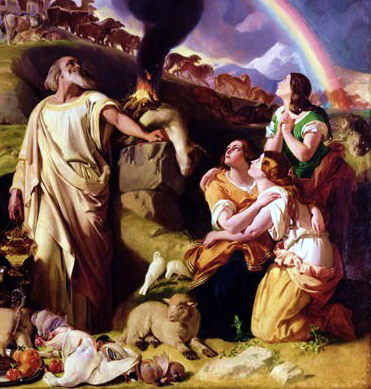
The Noahic Covenant began the next dispensation, the Age of Government. After that, when the flood

Noah’s Sacrifice by Daniel Maclise, 1806-1870

waters subsided from the earth, we began the Age of Promise. “Man under promise Out of the dispersed descendants of the builders of Babel, God called one man, Abram, with whom He enters into covenant. Some of the promises to Abram and his descendants were purely gracious and unconditional. These either have been or will yet be literally fulfilled. Other promises were conditional upon the faithfulness and obedience of the Israelites. Every one of these conditions was violated, and the dispensation of promise resulted in the failure of Israel and closed in the judgment of bondage in Egypt.”

During this dispensation, the LORD made a promise to Abram, found in Genesis 12.

The LORD chose Israel to be His nation and the Israelites to be His people. Now the Lord had said to Abram: Get out of your country, from your family and from your father’s house, to a land that I will show you. I will make you a great nation; I will bless you and make your name great; and you shall be a blessing. I will bless those who bless you, and I will curse him who curses you; and in you all the families of the earth shall be blessed.” (Gen. 12:1-3).

God was actually delivering three distinct promises to Abram, later re-named Abraham.

He made a land promise, a national promise and a spiritual promise.

1. The Land Promise: “A land that I will show you.”
“He also said to him, “I am the LORD, who brought you out of Ur of the Chaldeans to give you this land to take possession of it.” (Genesis 15:7). Genesis 15:18-21 describes the boundary of the promised land in terms of the territory of various ancient peoples: “On that day the LORD made a covenant with Abram and said, “To your descendants I give this land, from the river of Egypt to the great river, the Euphrates – the land of the Kenites, Kenizzites, Kadmonites, Hittites, Perizzites, Rephaites, Amorites, Canaanites, Girgashites and Jebusites.” This is the “borders of the Land” (Gevulot Ha-aretz).

This land promise has never been fulfilled. The land that God promised His people the Israelites is very extensive. It would encompass all of today’s Syria, Jordan, Lebanon, Gaza, part of Iraq to the Euphrates & Tigris, the Nile Delta of Egypt, and part of Saudi Arabia.

To compare, today the Arab League includes 21 separate Arab states spanning an area of more than 5,000,000 square miles (12.9 million sq. km.) However, there is only one Jewish state consisting of 8,000 square miles (20,715 sq. km.). It is called Israel. It is only slightly larger than Massachusetts.

Ancient maps placed Jerusalem in the center of the page. They knew that Jerusalem is God’s city and is the fulcrum of history, the axle of the wheel, and the center of the world stage. In the Jewish tradition, the Ark in the Temple in Jerusalem, through which God revealed himself to His people, rested on the Foundation stone marking the “navel of world” wiki omphalos. Ezekiel 5:5, “This is Jerusalem; I have set her at the center of the nations.” We read a similar reference in Ezekiel 38:2, “to seize spoil and carry off plunder, to turn your hand against the waste places that are now inhabited, and the people who were gathered from the nations, who have acquired livestock and goods, who dwell at the center of the earth.”

And what of this land? What is it like? It is wonderful! From deserts of the southern Negev to the snow-capped mountains to the north, to the 270 miles of coastline along the Mediterranean and to the frontier at the east, it is a diverse land.

Mountains of Judea, source Wikipedia commons

Northern coast. Source Wikipedia commons

Jordan’s Rift Valley, Source Wikipedia commons
Acacia tree in Negev Desert, Makhtesh Gadol, Wiki photo

The wildlife of Israel includes the flora and fauna of Israel, which is extremely diverse due to the country’s location between the temperate and the tropical zones, bordering the Mediterranean Sea in the west and the desert in the east. (Wiki: Wildlife of Israel)

God called it a land flowing with milk and honey. (Exodus 3:8). A land with abundant milk means that it had abundant cattle (or goats), and that means abundant grasslands and pastures. I have read in several Jewish commentaries that the honey is not bee nectar but the syrup one extracts from dates or figs. Either way, it evokes the same sense of abundance, this time from vegetation.

According to Israel Birding website, “Israel is situated at an intercontinental junction- a bottleneck for

A Hoopoe, Israel’s national bird

migration routes. An estimated 500 million (!!) birds pass through every spring and autumn, with 530 species in record. This website features Israel’s latest birding news.”

Israel’s climate varies from semi-arid to temperate to subtropical. The region is home to a variety of plants and animals; at least 47,000 living species have been identified, with another 4,000 assumed to exist. 116 species of mammals are native to Israel, as well as 511 bird species, 97 reptile species, and seven amphibian species. There are also an estimated 2,780 plant species. There are insects belonging to roughly 27 orders in Israel, out of about 29 worldwide. (biodiversity in Israel)

From Nature Israel, “From ancient times Israel’s native mammals have had an important role in Jewish culture, featuring in colourful biblical metaphors and prophecies, as symbols of the tribes of Israel or discussed at length in the dietary codes so central to the Jewish culinary tradition. The young David battles a bear and a lion, and Samson struggles with a juvenile lion. Torah scrolls are written on parchment from deer or antelope skins, the Jewish New Year is commemorated by blowing on the ram’s horn and the very Land of Israel itself is described as the “Land of the Gazelle”. Song of Solomon 8:14 mentions the gazelle in terms of its speed.  One of the sons of Zeruiah was compared to the speed of a gazelle in 2 Samuel 2:18.

Sadly the local lions and bears are now extinct, but most of Israel’s native mammals familiar from the bible and folklore remain – the jackal and the gazelle, the rock hyrax and the ibex, the wolf and the leopard, the wild boar and the hare.”

Psalm 104 mentions many different kinds of vegetation, birds, and mammals of Israel.

mountains are for the wild goats; the rocks are a refuge for the rock badgers.” (Psalm 104:18). Proverbs 30:24 says the following animals are ‘exceedingly wise’ and the hyrax, or rock badger, is one of those, “the rock badgers are a people not mighty, yet they make their homes in the cliffs;” (Prov 30:26). (Left, rock badger)

Lions and cheetahs are now extinct in Israel, but imagine young David, armed only with a slingshot, guarding his flock against wolves, lions, bears, leopards, and cheetahs. Not to mention hyenas and jackals. Leopards still exist in Israel today, as do other wild felines including caracals (a kind of lynx), bog cats and wild cats.

Bears are mentioned in 2 Kings 2:24 as animals that came out of the woods and tore up 42 youths who were mocking Elisha. Of course the lion is prominent in fact and in metaphor in the Land. Proverbs 30:30 says of the lion, “the lion, which is mightiest among beasts and does not turn back before any;”. Proverbs 28:1b “but the righteous are as bold as a lion.” The LORD used lions as a judgment when Assyrians settled in the Land and did not worship the LORD. (2 Kings 17:25).

The Lord has blessed His land with biodiversity, geographical diversity, a wondrous climate, and beautiful flora and fauna of all kinds. After the restoration when the curse is reversed, it will finally be all that He intends it to be, His city, His dwelling, named “The Lord is there” (Ezekiel 48:35. (Jehovah Shammah!)