Posted in bible reading plan, Uncategorized

Bible Reading Plan thoughts: Till Shiloh Comes

And the whole congregation of the children of Israel assembled together at Shiloh, and set up the tabernacle of the congregation there. And the land was subdued before them. (Joshua 18:1)

Our Bible Reading Plan for today is Joshua 16-20. There is a lot of land-giving and border-setting in these passages. The Land is extremely important. But even more interesting to me is the mention of Shiloh.

This mention of the city 25 or so miles north of Jerusalem intrigues me. This is partly because it was the location of the tabernacle for 400 years. From this point on and for the next 4 centuries. the Israelites worshiped here.

And I’m intrigued partly because it could be a prophetic, Messianic title for Jesus. Genesis 49:10 KJV has the prophecy-

The sceptre shall not depart from Judah, nor a lawgiver from between his feet, until Shiloh come; and unto him shall the gathering of the people be.

For some reason the phrase “till Shiloh come” moves me. I certainly have no real knowledge of either the city of Shiloh nor the prophecy as stated in Genesis 49. So let’s dig in. Here is what we know about the place of Shiloh-

SHILOH A town in Mount Ephraim. Its location is described in the Bible as ‘a place which is on the north side of Beth-El, on the east side of the highway that goeth up from Beth-El to Shechem, and on the south of Lebonah’ (Judg. 21:19). Shiloh was a religious center of the tribes and after the conquest of the country by Joshua the tabernacle of the congregation was set up there (Josh. 18:1). It was there also that Joshua distributed allotments to the tribes who had not previously received them (Josh. 18:2–10). The house of God (Judg. 18:31) in which Eli and his sons officiated was at Shiloh, and God appeared there before Samuel (1 Sam. 1:19; 3:1 ff.). Source: Negev, A. (1990). In The Archaeological encyclopedia of the Holy Land

Shiloh itself as a name or a word has been difficult to interpret with lots of academic discussion.

The only possible mention of Shiloh in the Pentateuch is at Gen 49:10, where the word occurs within Jacob’s blessing of Judah. However, the interpretation of this word is contested. There are five interpretations of this word (Fitzmyer, The One, 29):

• It is a personal name.
• It is the name of the city.
• It is an Akkadian loanword meaning “ruler” or “prince.”
• It means “to whom it belongs,” referring to the scepter.
• It should appear as two words meaning “tribute to him.”

If the occurrence in Gen 49:10 is a reference to the city of Shiloh, then it is spelled differently here than elsewhere in the Old Testament. Source The Lexham Bible Dictionary.

And one more:

The book of Psalms contains one reference to Shiloh (Psa 78:60), and the book of Jeremiah contains five. Besides the passing geographical reference in Jer 41:5, all of the references in these two books indicate that Yahweh purposely rejected Shiloh as the place where He would make His name dwell, choosing Jerusalem instead (Psa 78:60; Jer 7:12, 14; 26:6, 9). Schley suggests Psalm 78 refers to Yahweh’s abandonment of Shiloh with the loss of the ark (Psa 78:60–61), while Jeremiah refers to the later destruction of the city (Schley, Shiloh, 171–72). Finkelstein disagrees, arguing instead that they refer to the same incident (Finkelstein, Shiloh, 385–387). Ultimately, both texts speak of the theological reality of the importance of Jerusalem. Source: The Lexham Bible Dictionary.

shiloh.png
Ruins of an ancient synagogue at the site of the city of Shiloh.
Source Holman Illustrated Bible Dictionary (p. 1487).

What happened to the city of Shiloh?

No explicit biblical reference was made to Shiloh’s final fate. According to archaeological evidence, Shiloh apparently was destroyed about 1050 B.C. by the Philistines. Supporting this was the fact that when the Philistines finally returned the ark of the covenant, it was housed at Kiriathjearim rather than Shiloh (1 Sam. 7:1). Also, Jeremiah warned Jerusalem that it might suffer the same destructive fate as Shiloh (7:12).
Centuries later, Jeremiah used Shiloh and the tabernacle as illustrations to warn Jerusalem that it was not safe merely because it housed the temple (7:12–14). Hearing the same message again, the people sought to kill Jeremiah (26:6–9). Holman Illustrated Bible Dictionary

That was Shiloh the place. What about Shiloh the Messiah, if that is how the word is to be interpreted?

nor a lawgiver from between His feet until Shiloh come,” that’s the messianic promise. Shiloh means the one who is right it is or the one to whom it belongs. There’s going to be a king and He’s going to hold the sceptre and He’ll be from the line of Judah. Now watch the end of the verse, “unto Him shall the gathering of the people be.” Listen to me, the first time Jesus came was the gathering of the people to Him. No, John says He came unto His own and what? His own received Him not. He was in the world, the world was made by Him and what? The world knew Him not. That prophecy has not yet been fulfilled beloved. Therefore He must return. ~John MacArthur

Praise God for the soon return of Shiloh, the messiah, Jesus the Christ.

Posted in bible reading plan, Uncategorized

Bible Reading Plan thoughts: Abram Built an Altar

I first published part of this on The End Time 8 years ago in 2010. It aligns well with our Bible Reading Plan reading for today.

________________________

Genesis is such an amazing book of the bible. In re-reading Genesis 12, I was again astounded by the depth and complexity of human history and our relationship with God. Gen. 12 is the famous chapter in which God called Abram (later name changed to Abraham) and made a significant promise:

I will make you a great nation; … I will bless those who bless you. And I will curse him who curses you; And in you all the families of the earth shall be blessed.” (Gen 12:2a & 3a)

You can be sure that the promise of God is solid, and that we are seeing the curse of nations who curse Israel beginning before our eyes. In verse 7 of Genesis 12, “Then the LORD appeared to Abram,” God appeared to Abraham. God appeared to Abram! Think on that for a moment. The El-Shaddai, the I AM, the ALMIGHTY, appeared to a man, walked with him, spoke to him, comforted him, and commanded him. It is a shuddering thought to ponder the gravity of those moments. That gravity was not lost on Abraham, who built altars to Him all over the Land wherever he went. Abraham did not build houses for himself, he built altars to God.

Then the LORD appeared to Abram and said, “To your descendants I will give this land.” And there he built an altar to the LORD, who had appeared to him. And he moved from there to the mountain east of Bethel, and he pitched his tent with Bethel on the west and Ai on the east; there he built an altar to the LORD and called on the name of the LORD. So Abram journeyed, going on still toward the South.

Abraham built altars right away, to mark his obedience to the LORD, and to sacrifice and worship. When Abraham came back from Egypt, “to the place of the altar which he had made there at first. And there Abram called on the name of the LORD.” (Gen. 13:3-4) which is another way of saying worship and sacrifice. When Abraham and Lot had separated and Abram moved to the region of Hebron, he “built an altar there to the Lord” (Gen. 13:18).

Abraham communed with the LORD by building altars for worship. Building an altar is an intentional, physical act. Worshiping on front of an altar is an intentional, physical act. When Abraham returned from Egypt, Abraham saw the altar he had originally made and ‘called on the name of the LORD’ in worship and thanks. In this case, the altar was a reminder of his relationship with the great I AM.

We do not need to build altars, but we do need to be as dedicated and as intentional as Abraham in our relationship with God and Jesus and the Holy Spirit, our Triune God. You note that when Abraham and Lot separated, there was no mention of Lot building an altar to the LORD. Lot was with Abraham when Abraham got the calling from God (Gen. 12:5) and was with Abraham throughout the blessing of his peoples’ increase. Lot saw God working in his family’s life. He reaped the blessings of Abraham’s obedience. But Lot did not build an altar.

And from the biblical record we see how the distance between man and God can slowly grow when we fail to consistently commune with the LORD. Lot crept toward Sodom, closer and closer he pitched his tent, until he was finally living inside the city with all its sin and perversity. Though the sins of the city grieved Lot greatly (2 Pet. 2:6-8) Lot did not build an altar. And in the end, Lot lost his city, his possessions, his family, his wife, (“Remember Lot’s wife” Luke 17:32) and sin fell upon his daughters, who lay with their father.

We do not build altars … but we pray. Our part of the correspondence between ourselves and God/Jesus/Holy Spirit is maintained through prayer, corporate worship, Bible study, and fellowship in the body of the believers. Is your heart an altar to I AM? Do you pray constantly? Do you worship in faith and obedience, as Abraham did? No? Remember Lot’s wife.

Build an altar of prayer in your life. There will be comfort and attention of the I AM Himself!

altar

Posted in bible reading plan, Uncategorized

Bible Reading Plan thoughts: Setting our Minds

But now we are released from the law, having died to that which held us captive, so that we serve in the new way of the Spirit and not in the old way of the written code. (Romans 7:6).

Toshiba Exif JPEG

Hallelujah! He has made a way for us to be released from both the eternal convicting aspect of the Law (which does not save but only informs) and the bondage of sin through His Son and His Spirit.

For those who live according to the flesh set their minds on the things of the flesh, but those who live according to the Spirit set their minds on the things of the Spirit. (Romans 8:5).

I notice the active facet of this verse. They have set their minds. Paul means that Christians purposely intend setting our minds on the things of the Spirit. It doesn’t happen by osmosis. In another epistle, Paul said:

Finally, brothers, whatever is true, whatever is honorable, whatever is just, whatever is pure, whatever is lovely, whatever is commendable, if there is any excellence, if there is anything worthy of praise, think about these things. (Philippians 4:8).

The phrase ‘set their minds’ comes from the Greek word phronousin, the meaning from Strong’s is defined,

5426 phronéō (from 5424 /phrḗn, “the midriff or diaphragm; the parts around the heart,” J. Thayer) – properly, regulate (moderate) from within, as inner-perspective (insight) shows itself in corresponding, outward behavior. 5426 (phronéō) essentially equates to personal opinion fleshing itself out in action (see J. Thayer). This idea is difficult to translate into English because it combines the visceral and cognitive aspects of thinking.

Again, I mention the intention. We have to purposely set our minds to know, then act. Christianity is a thinking religion. We are constantly transforming our mind into the mind of Christ, day by day, step by step, inch by inch…

To live by the Spirit we set our minds on the things of the Spirit.

John MacArthur on Romans 8:5, The Transforming Work of the Spirit, part 1

There is as clear a definition of the distinction between a believer and a non-believer as you will find anywhere. Believers set their minds on the things of the Spirit. Non-believers set their minds on the things of the flesh. That couldn’t be more clear. Again, I remind you that this is a matter of behavior. Listen carefully. Behavior based on the word “walk” in verse 4, but behavior is a product of what? The mind. Thinking.

What are the things of the Spirit that we set our minds on? From the same sermon,

These people are in the realm of the Spirit and are drawn by the truest impulses in their heart to the Spirit. They submit to His direction. They concentrate their attention, purpose, desire on whatever is precious to the Holy Spirit. They love what He loves. They… That’s what it means when it says, They…they seek the things of the Spirit.”

Think on these things…

Posted in bible reading plan, Uncategorized

Bible Reading Plan thoughts: Sins in the heart

In our Bible Reading Plan today we read Matthew 5-7.

But I say unto you, That whosoever looketh on a woman to lust after her hath committed adultery with her already in his heart. (Matthew 5:28)

Here’s a bit of history for you. President Jimmy Carter was the 39th President of the United States. He was elected in November 1976 when I was almost 16. He served one term until I was 20 years old.

He was an active Christian, the first one I’d had any ‘contact’ with. In my personal life growing up, religion didn’t play a role at all. I knew no Christians. Because Carter was a public figure, President, his beliefs were public and often passed before my eyes in TV interviews and newscasts as he was interviewed about them.

During Carter’s campaign he was interviewed by a freelance writer for an article to be published in Playboy Magazine. Carter offered unprompted,

“I’ve looked on a lot of women with lust. I’ve committed adultery in my heart many times.”

Time Magazine’s opinion of the incident was put this way:

The decision to do an interview with Playboy magazine was possibly not the best call of President Carter’s tenure. Yet, it was all going pretty well until he started talking about the Bible and adultery. Now, Carter’s not actually admitting anything shocking. Most men would probably say, “Yep, been there.” But presidents rarely (and for good reason) venture into the land of “too much information”: Ideally, they should exist on a higher plane than the rest of us. It was an uncomfortable moment for America.

I agree with the secular view of offering too much unprompted information. We all want to dwell in a fiction of our leaders being above reproach. But since Carter said it, and I heard it, I was left with the problem of trying to figure out what it meant. Having no knowledge of the Bible, I was strenuously trying to reconcile my own knowledge of sin, which I called immorality. I didn’t understand that sin came from a completely depraved heart. Being unsaved, I thought sin was a private matter, nobody’s business. Adultery I well understood, having two parents who both indulged in it. It seemed wrong to me but I was too young to have any firm basis for saying so. However I believed that thoughts about adultery were one’s own and thus a private matter.

I learned after salvation that God reads the heart and knows the intentions of man. Sin actually springs from the heart and mind. All sins, even the unacted-upon sins, even thoughts only, are just as damaging. But back then, it was perplexing to me that a man should feel ashamed of his ‘normal’ thoughts. As long as he didn’t act on it, I thought he should be termed “a good man.” I thought Carter was silly for saying anything about it.

The Matthew verse today shows me that I was the silly one. Carter might have made a political faux pas, but he was biblically correct. It’s wrong to commit adultery in your thoughts. What a radical thought. It was to me then, and the reactions of the listeners of the sermon on the mount and others later thought so too. (Matthew 7:28-29; John 6:60). Guard your thought life.

sat heart

Posted in bible reading plan, Uncategorized

Bible Reading Plan thoughts: The Howl in Isaiah

Our Bible Reading Plan for today is Isaiah 12-17. The cycle in the Prophets is one of promise of judgment, judgment, repentance, and restoration. Repeat. The judgment parts are rough. In the passage from chapter 13, in the KJV we read,

Howl ye; for the day of the LORD is at hand; it shall come as a destruction from the Almighty. (Isaiah 13:6)

The promised judgment was coming soon, and it did. This chapter also looks ahead to the final judgment of Babylon in the Day of the LORD as seen in Revelation 18:2. Isaiah 12 was a comforting passage, a song of praise. Then we get to the promise of destruction against that most unholy of cities: Babylon. I read once someone termed the Bible as a tale of Two Cities: Babylon and Jerusalem. They weren’t far off.

Of course, what the cities represent is what it’s all about. Unholiness of Babylon, the world and its systems, and the holiness of Jerusalem, where God has set His name and soon will dwell personally.

Having come to the Lord later in life, I vividly remember being inside the unholy world system and wondering why I felt uncertainty, restlessness, and fear at different times. The specter of death with the unknown beyond will definitely do that to you.

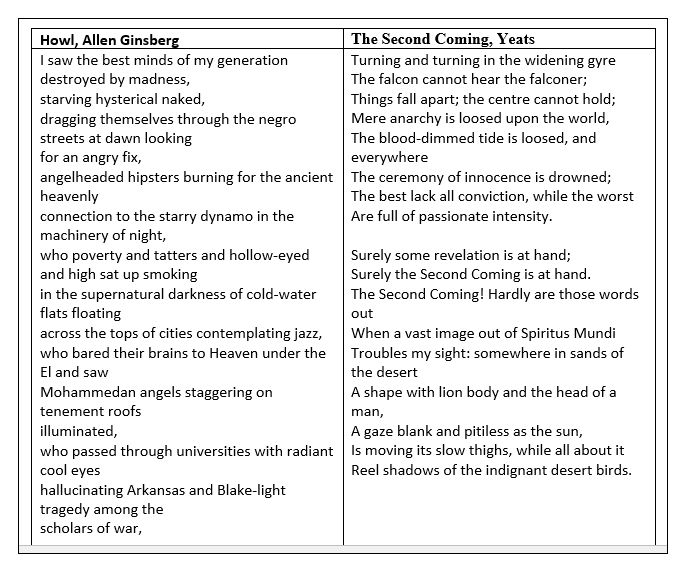
In the KJV the word ‘howl’ made me think of Allen Ginsberg’s famous poem called Howl. Its imagery burns into one’s mind with a sulfur strike white hotness emblazoned like a photo negative. It’s an angry poem, raging against the darkness and essentially crying out “Why is it like this? Why?” The Psalmist wrote in Psalm 2:1, Why do the heathen rage, and the people imagine a vain thing? and Howl (as are so many poems) is just the pagan version of that scripture.

Ginsberg said some of the imagery in the poem came from a bad peyote trip he’d taken where he saw the apartment building he was staying in morphed into the face of a child-eating demon he later called Moloch.

In the Bible, there really is a child-eating demon-god named Moloch to whom the people sacrificed their children.

Romans 1:18 says that the unrighteous suppress the truth. They are aware of the truth, and despite pressing it down away from consciousness, at some level they connect with it. They detect its convicting tendrils creeping upward from the polluted recesses of their heart, only to be smashed down in howling rage. We see that in Ginsberg’s Howl, and we see it in Yeats’ poem The Second Coming, where Yeats used religious imagery to make his point.

Yeats hadn’t taken a peyote button, but he was heavily involved in occult practices such as calling up demons and channeling and seances and the like. He sought visions, and he got them. So, similar to Ginsberg, the imagery in Yeats’ vision tapped the well of dark truth suppressed deep within his soul. Not comprehending it, the pagans rage. Yeats’ soul seethed and stormed, you can feel that his poem is a bellow into the gaping maw of black eternity, only to be silently swallowed by a dark and depraved infinite, and in the end, pitiful howl making no more noise than an owl’s winged whisper.

In the Isaiah passage today, the LORD promises destruction upon Babylon. Their near future and their far future contain the coming of the LORD in wrath for their unrighteous deeds. He is telling them in advance, ‘Howl, for your destruction is sure!’ This is the end which the pagans rail against. It is the end that all the unrighteous suppress in wickedness, but still lay coiled nasty to spring up and swallow souls whole. Howl, you Babylonians. Wail, you pagans, because justice, knife sharp and cleanly pure, will separate you from this earth with a flick.

fri howl

~~~~~~~~~~~~~~~~~~~~~~~~~~~~~~~

Comparing the language and imagery used in various pagan poems.

poempoem 2

Posted in bible reading plan, Uncategorized

Bible Reading Plan thoughts: Eliphaz v. Job

Our Bible reading today brings us to Job 5-6

Eliphaz rebukes Job
Behold, blessed is the one whom God reproves;
therefore despise not the discipline of the Almighty. …
Behold, this we have searched out; it is true.

Hear, and know it for your good
(Job 5:17, 27)

Job’s physical misery was extreme, his wife was tempting him, and now Job had to deal with his friend’s insensitive advice. Oy. With friends like Eliphaz, who needs enemies?

In the Bible Gateway list of All Named Men of the Bible, (they also have lists of unnamed men, and the same for women, it’s a handy list!) they describe Eliphaz thus:

Teman was noted for its wisdom and this Temanite descendant was a law unto himself. His name means “refined gold” but his fine gold was that of self-glory and of self-opinion from which he would not budge. As a wise man he gloried in his wisdom, and represented the orthodox wisdom of his day. This wise man from the East declared that God was just and did not dispense happiness or misery in a despot fashion, committing people to what He deemed best.

In his first speech (Job 4, 5), Eliphaz begins by informing Job of all his affliction, namely, sin. Approaching Job in a courteous yet cold manner, Eliphaz seeks to prove that all calamity is judgment upon sin. The crux of his argument is: “Remember, I pray thee, who ever perished being innocent? or where were the righteous cut off?” (Job 4:7).

Eliphaz was so sure Job had sinned and so sure he knew God and His plan well enough to rebuke Job for Job’s invisible sins.

I think it’s a skill to be sure about what you believe, yet teachable. We should be settled in our convictions, but pliable as we add wisdom and understanding as we grow in sanctification.

Here is an example: Theologian RC Sproul, who was recently called home to heaven, for most of his career believed in an old-earth. After more study, changed his mind and believed in a literal 6-day, young earth in the end. (source).

Sadly Eliphaz was too dogmatic. He would not countenance the fact that there might be something he did not know. He was sure of his philosophical construct: that God did not penalize the righteous. Suffering comes from personal sin, either overt or hidden. But there was something Eliphaz did not know: the conversation God had initiated with Satan about Job’s piety.

Here, David Clines (recommended as best Job Commentary) weighs in:

Eliphaz here announces the premise on which the whole speech depends: if Job is suffering (and he is) and God has nothing to gain or lose personally from Job (and he hasn’t) and God is just (and he is), then Job is suffering for his sins. And is he is suffering much (as he is), it follows that he has offended much. And if there is no evidence of Job’s sins, then all his sins must be secret and observable ones. However what undermines Eliphaz’s logic is something he does not know, but we readers know; that God indeed has much to gain (or lose) from Job’s behavior; for Job is a test case for the gratuitousness of piety. If Job does not remain pious when all his blessings have been taken away, it proves humans serve God for the sake of the rewards and it shows religion up as a self-seeking practice of humans.

Eliphaz relied on the strength of his logic, rather than the frailty of human knowledge in the face of God’s higher wisdom.

True wisdom remains in God only. Whether we veer from settled conviction to extreme dogmatism, through it all we should maintain a teachable spirit. By Chapter 22, Eliphaz was blatantly calling for Job to repent of his evil wickedness (Job 22:21-23) because Eliphaz was sure Job had sinned.

Job did not heatedly rebut. He humbly expressed his longing to maintain fellowship with God so he could experience God’s love and goodness and hear from him the meaning of all his suffering. (John MacArthur Study Bible).

Who had the more teachable spirit?

Let the wise hear and increase in learning, and the one who understands obtain guidance, (Proverbs 1:5).

teachable.jpg

Posted in bible reading plan, Uncategorized

Bible Reading Plan thoughts: Reading the introductions

The Bible Reading Plan for today is to read Psalm 6-8. I’ve resolved of late to read the introductions of the passages and not skip them. Also, to read the endings and read the notes, like these in the Psalms I’m about to discuss. If all scripture is profitable, then I shouldn’t skip the intros, conclusions, lists of names, genealogies, or musical directions, lol.

Often David or the other Psalmist would make notes to the musicians who were going to play the songs, like this that begins Psalm 6-

For the director of music. With stringed instruments. According to sheminith. A psalm of David.

Of course, once I read the note and see something like ‘Sheminith’, I got curious. Like, what is a Sheminith?

I read in Easton’s Bible Dictionary about Sheminith:

That the Hebrew of shemini is an ordinal number, eight. The Easton’s Bible Dictionary says sheminith is Eight; octave, a musical term, supposed to denote the lowest note sung by men’s voices (1 Chronicles 15:21; Psalm 6; 12, title).

Nobody really knows for sure. Other Bible dictionaries defined it slightly differently, but along the same lines. Some said, ‘we dunno, the word has passed out of use and understanding.’ It’s still interesting to look these things up, though.

Psalm 7 is a Shiggaion. Easton’s Bible Dictionary defines Shiggaion,

From the verb shagah, “to reel about through drink,” occurs in the title of Psalm 7. The plural form, shigionoth, is found in Habakkuk 3:1. The word denotes a lyrical poem composed under strong mental emotion; a song of impassioned imagination accompanied with suitable music; a dithyrambic ode.

Psalm 8 is “according to The Gittith: A stringed instrument of music.”

This word is found in the titles of Psalm 8, 81, 84. In these places the LXX. render the word by “on the wine-fats.” The Targum explains by “on the harp which David brought from Gath.” It is the only stringed instrument named in the titles of the Psalms. Easton’s Bible Dictionary

Well, that was about as clear as mud.

I do know that once we’re in heaven, we’ll likely be singing. (Revelation 5:9). Will we be singing these Psalms in heaven, properly as David originally wrote them, (According to sheminith, a Shiggaion, or with The Gittith?). I hope so. Wouldn’t it be nice if we did!

Meanwhile I resolve not to skip the intros, conclusions, lists, or notations. All scripture is profitable… I don’t always understand how scripture profits me, but I trust that it does.

~~~~~~~~~~~~~~~~~~~~~~~~

Further reading

I always enjoy Phil Johnson’s knowledge of the Psalms and his clear delivery in explaining them.

Here is a page of Phil preaching the Psalms, including one we are to read today, Psalm 8. Interestingly, Phil introduces his sermon by explaining what can be known about the mysterious term ‘according to the Gitteth’.

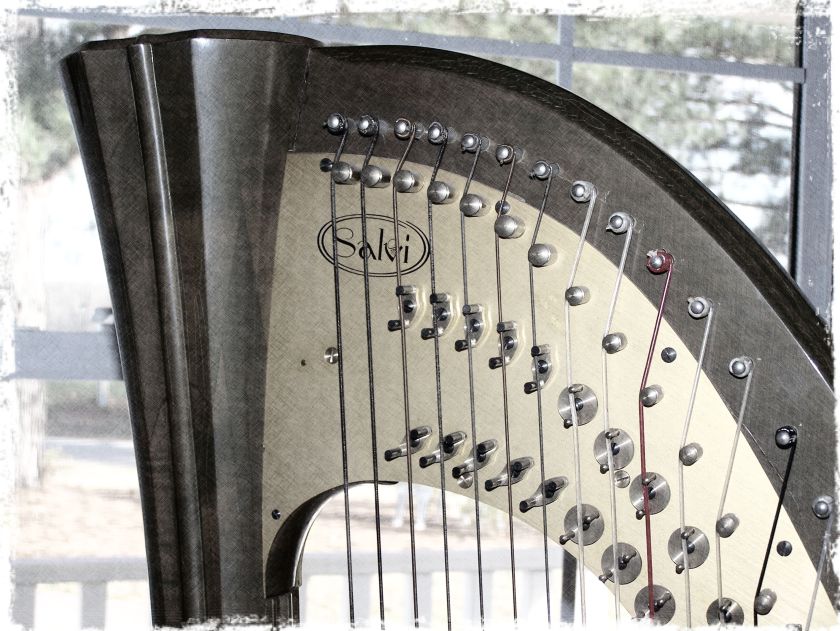
wed harp

Posted in bible reading plan, Uncategorized

Bible Reading Plan thoughts: The LORD hardened their heart and killed them all

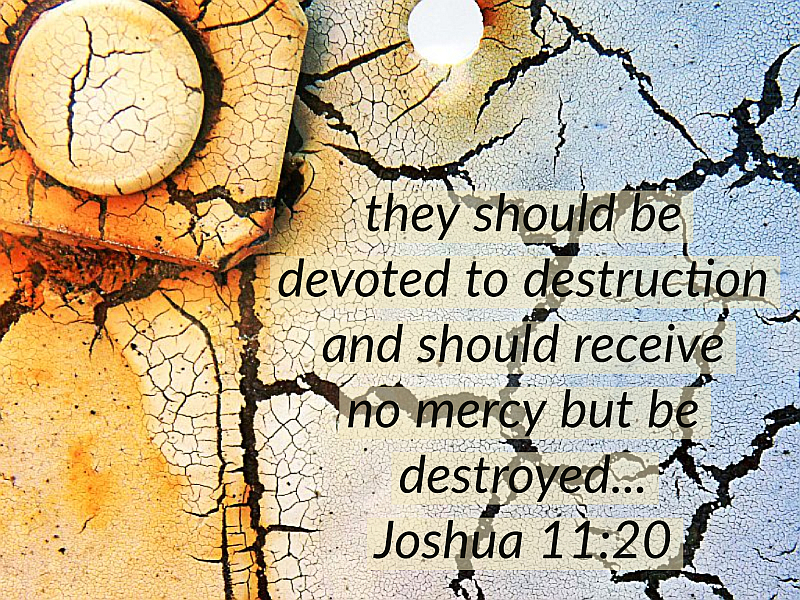
For it was the Lord’s doing to harden their hearts that they should come against Israel in battle, in order that they should be devoted to destruction and should receive no mercy but be destroyed, just as the Lord commanded Moses. (Joshua 11:20).

The Bible Reading Plan passage for today is Joshua 11-15. I read and re-read this verse from chapter 11. It’s a hard passage. It’s Old Testament passages like these where God gets his stern and tyrant reputation.

The John MacArthur Study Bible helps here:

God turned the Canannites’ hearts to fight in order that Israel might be his judging instrument to destroy them. They were willfully guilty of rejecting the true God with consequent great wickedness, and were as fit to remain in the land as vomit spewed out of the mouth (Leviticus 18:24-25).

Individual and national sin is a serious offense against God. RC Sproul called it cosmic treason. And for all that, God is patient. He waited 400 years for the Amorites’ sin to come to full measure. (Genesis 15:16). He gave the false prophetess Jezebel who was teaching his children sexual immorality and eating food sacrificed to idols time to repent. (Revelation 2:21). Whether it is an individual person or a national sin, He is patient. It is said in 2 Peter 3:9 that God is not willing that anyone should perish, but that all should come to repentance. This is the same God. He is immutable, unchangeable, the same yesterday, today, and forever.

His patience and willingness to give time to repent does not mean that he will forget His promise to deal with sin. Sin is a crime and all crimes have punishments. For the Canaanites, that day eventually came, and they were judged for their cosmic treason.

Our God is in the heavens; he does all that he pleases. (Psalm 115:3).

tues cracked and hardened.jpg