But what fruit were you getting at that time from the things of which you are now ashamed? For the end of those things is death. (Romans 6:21)
Paul is asking this rhetorical question in the majestic section of “The Wages of Sin.” What has sin profited you? What fruit, then, has sin produced?
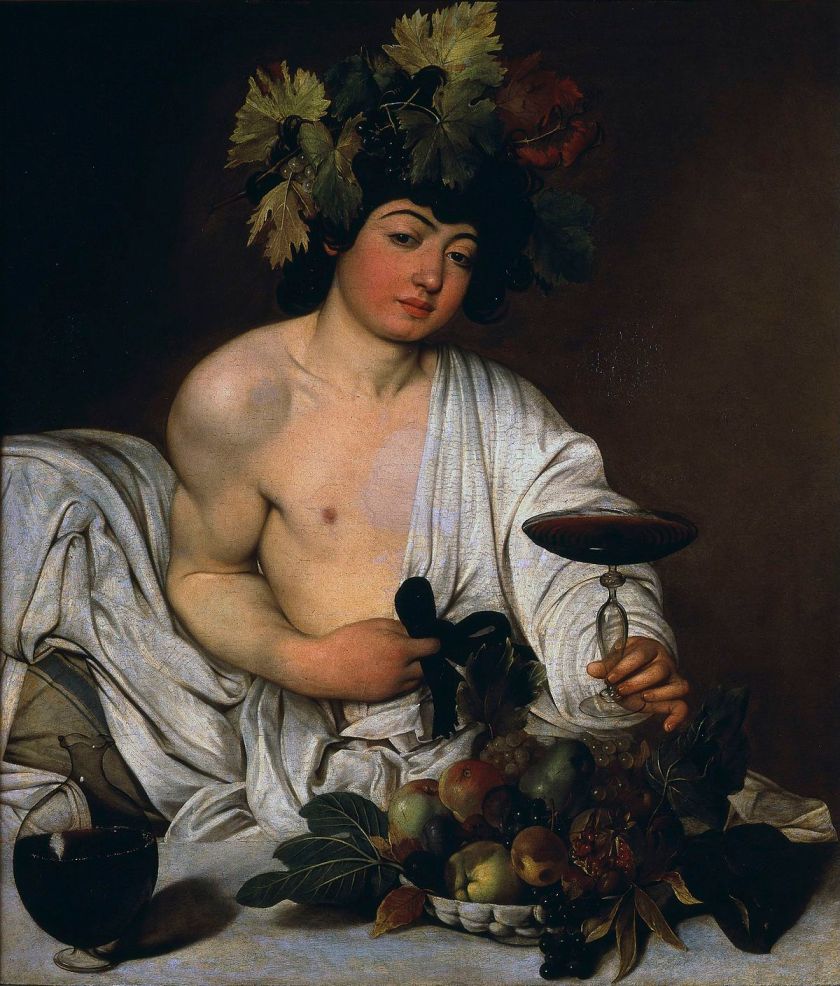
I’m a lover of art. I saw Caravaggio’s Bacchus in the Uffizi some years ago. Caravaggio’s Bacchus is a decadent painting, becoming more so as one gazes at it. Bacchus was the Roman god of the grape harvest, winemaking and wine, of ritual ecstasy, fertility and so on. Dionysus was the parallel Greek god. Here he is:
How is it decadent, one asks? We see the heavy-lidded youth, the Bacchus, reposing against his dirty sheets, with his own covering having slipped off, exposing his fleshy upper torso. He fingers the opening suggestively. His face appears ruddy, from outdoor farm work in the vineyards, or perhaps more to the point, the florid blush of too much wine. On close inspection, the bowl of fruit shows its over-ripeness. The pears are bruised and browning. The figs are burst and oozing. The peaches are in obvious decay.
Decay, rot, decomposition is the theme of the entire portrait. And anyway, it’s a false god.
But the fruit of the Spirit is love, joy, peace, patience, kindness, goodness, faithfulness, gentleness, and self-control. (Galatians 5:22-23)
Does sin bring the fruit of love? Does sin bring the fruit of peace? Does sin bring the fruit of patience? Does sin bring the fruit of kindness? Does sin bring the fruit of goodness? Does sin bring the fruit of faithfulness? Does sin bring the fruit of gentleness? Does sin bring the fruit of self-control?
Can you think of any sin which brings any of the good fruit of the Spirit? Does jealousy bring love? Does bitterness bring self-control? Does gossip bring kindness? Does adultery bring peace?
Or does sin’s fruit bring decay, rot, and decomposition? The fruit of love only grows brighter as it ripens. The fruit of sin brings festering putrefaction, flies, and disease. Eventually, death.
For the wages of sin is death, but the free gift of God is eternal life in Christ Jesus our Lord. (Romans 6:23).
Flee from that sin, sister. Resist it, slay it. God has given us His Spirit to aid us in this, and the free gift of eternal life is ours so we can enjoy His Holy self forever.
In the verse above, Paul is admonishing the Corinthians for over-valuing tongues (glossolalia). The church was entranced by the ‘show’ of tongues and interpretation of tongues. They had become unduly entranced by this next ‘shiny new thing’ (kind of like a mega-pastor with a fog machine or a boy with a new slingshot).
Pulpit Commentary says-
The Christian should always be childlike (Matthew 11:25; Matthew 19:4), but never childish (1 Corinthians 13:11; Ephesians 4:14).
Good advice. To often in this day and age, pastors leave one fad to leap on the next so as to appear relevant. Surfing from Jabez Rugs to Daniel Fasts, Courageous Resolutions to Love Dares, Promise Keepers to Beth Moore bracelets, Be Still meditations to Labyrinths, Seeker Sensitive to Emergent, tongues to healings, it often leaves out the most important: JESUS.
Pastor Phil Johnson speaks harshly about the Flaws of a Fad Driven Church. A Charismatic fascination with tongues had swerved the Corinthian Church from its underpinnings and caused all sorts of divisive issues.
Going further, Gill’s Exposition says,
The apostle here has chiefly reference to the gift of speaking with tongues, these Corinthians were so desirous of; which when they had it, was only to talk like children; and for them to prefer it to other gifts, which were more useful and beneficial, discovered their judgment to be but the judgment of children; and if they desired this, and made use of it for ostentation, it showed a childish vanity, from which the apostle here dissuades.
Matthew Henry says –
Children are apt to be struck with novelty and strange appearances. They are taken with an outward show, without enquiring into the true nature and worth of things. Do not you act like them, and prefer noise and show to worth and substance; show a greater ripeness of judgment, and act a more manly part; be like children in nothing but an innocent and inoffensive disposition. A double rebuke is couched in this passage, both of their pride upon account of their gifts, and their arrogance and haughtiness towards each other, and the contests and quarrels proceeding from them.
Note, Christians should be harmless and inoffensive as children, void of all guile and malice; but should have wisdom and knowledge that are ripe and mature. They should not be unskilful in the word of righteousness (Heb. 5:13), though they should be unskilful in all the arts of mischief.
In today’s cluttered world, there are many things that compete for attention. In the Church it is the same. Fads, things that seem good or even biblical, are simply stumbling blocks. It’s hard to understand how a Spiritual Gift could be one of those stumbling blocks, but this simply proves that satan can make hay out of anything. He made a piece of fruit Eve saw every day look so good that Eve was drooling over it and with her husband caused the downfall of man! Disobedience can come anywhere at anytime.
The childish mischief is complicated but the solution is simple. Jesus. Stay in your word, stay praying, stay streamlined in your quiet time. Strip away the clutter, lay aside every weight, focus on the Holy One.
Yesterday I wrote about how the ancients winnowed and threshed. Now here is the Parable of the Weeds (Tares)
“He put another parable before them, saying, “The kingdom of heaven may be compared to a man who sowed good seed in his field, but while his men were sleeping, his enemy came and sowed weeds among the wheat and went away. So when the plants came up and bore grain, then the weeds appeared also. And the servants of the master of the house came and said to him, ‘Master, did you not sow good seed in your field? How then does it have weeds?’ He said to them, ‘An enemy has done this.’ So the servants said to him, ‘Then do you want us to go and gather them?’ But he said, ‘No, lest in gathering the weeds you root up the wheat along with them. Let both grow together until the harvest, and at harvest time I will tell the reapers, Gather the weeds first and bind them in bundles to be burned, but gather the wheat into my barn.’” (Matthew 13:24-30).
Here is Jesus’ explanation of the parable.
Then he left the crowds and went into the house. And his disciples came to him, saying, “Explain to us the parable of the weeds of the field.” He answered, “The one who sows the good seed is the Son of Man. The field is the world, and the good seed is the sons of the kingdom. The weeds are the sons of the evil one, and the enemy who sowed them is the devil. The harvest is the end of the age, and the reapers are angels. Just as the weeds are gathered and burned with fire, so will it be at the end of the age. (Matthew 13:36-40).
You see, the church is filled with tares as well as wheat. Satan came in and secretly brought in destructive heresies and false workers to spew them in order to bring reproach onto the name of Jesus and hinder His kingdom on earth. To illustrate this, Jesus told the parable of the weeds, posted above.
The weed is likely darnel, which enemies used to sow into an enemy’s field. This was agricultural sabotage. It was a disaster in the ancient days, so much so that Rome passed a law prohibiting it and levied severe penalties to anyone caught doing it. It is a catastrophic way to destroy the economy of your enemy, because the darnel looks exactly like wheat, until the very last moment when the full ear blooms. Darnel is called “false wheat” in many parts of the world. In the Bible it is also known as tares.
In Montana they are combating Persian darnel infestation. Montana State University Extension reports, “At high densities, Persian darnel could cause crop yield loss of up to 83 percent, 70 percent and 57 percent for spring wheat, canola and sunflower, respectively.” An 83% loss of your grain certainly is catastrophic.
Persian Darnel – A hidden problem pamphlet says: “Persian darnel is hard to spot in the emerging crop as it looks similar to wheat and/or wild oats,” says Steve King, technical service representative for Bayer CropScience. “So growers don’t know they have it and don’t use a herbicide that controls it. They find out about the infestation at harvest, which is not a good surprise.” … Discovering an infestation in the combine not only hurts yields, but can significantly impede harvest.
We know that false Christians populate the church. The Parable of the Tares tells us this. Also, the following verses are a few that tell us that there will be false ones among us. (2 Corinthians 11:13-15; 2 Timothy 3:5; Titus 1:16).
Satan’s sowing of false Christians into the church is certainly devastating.
In fact, the Bible’s note that the false ones’ future pleas to Jesus tell us there will be “many” who were false. They will say, “Lord, Lord, did we not…” and He will say “Depart from me you workers of iniquity, I never knew you.” (Matthew 7:21-23). These are people who looked the Christian part, acted the part, even attended church and prophesied in His name.
We can often get a sense of whether a person is genuinely saved or not. We can compare their life that is allegedly sanctified to the Word and if they bear no fruit we suspect the worst. We can pray for them in that case. But we can’t uproot the wheat because we don’t truly know for sure if they are wheat or darnel. That is not our job.
Forerunner Commentary explains, “The bad seeds grow to become poisonous weeds that allow only the healthiest of the wheat to survive. … Only when the wheat has matured can the tares be detected. Then the tares are gathered together in bundles in the field and destroyed by fire. … Many who are not in the process of conversion resemble those who are. Just like true Christians, they go to church, pray, and read the Bible, but they are only religious hobbyists. Jesus calls them “sons of the wicked one” (Matthew 13:38), and being tares, they will be destroyed. [Mathew G. Collins, Forerunner Commentary.]
If you are indeed a repented, forgiven, Bible-believing, submitted-to-Jesus true Christian, great! If you are not sure, wondering if you could be a tare not a wheat, then here are a few resources for you along the lines of assurance:
“His winnowing fork is in His hand, and He will thoroughly clear His threshing floor; and He will gather His wheat into the barn, but He will burn up the chaff with unquenchable fire.” (Matthew 3:12 LSB)
The way the ancients used to process their wheat is to gather it from the field, place it on the hardened threshing floor, and thresh and winnow it. The threshing-floor is a hollowed out spot with a packed earthen floor on the top of a hill where the late afternoon wind kicks up. The first part of the process is threshing. They thresh the wheat stalks by passing a sledge over them on the threshing-floor. Dragging the sledge over the stalk rolls the chaff kernel off the wheat stalk. The chaff is waste, like a husk.
You can see one woman standing on a sledge in the photo. The sledge is the tied-together planks with turned up front. Sledging separates the wheat from the chaff. You want the wheat. The chaff is the hard kernel husk, and you don’t want that. It is inedible. As the threshing process goes on they mound the stalks in the middle of the floor.
A threshing floor in the hills of Galilee – the women threshing
Library of Congress
Next they take a winnowing fork, poke it into the mound, and toss all the material – wheat, chaff, straw, weevils, etc, – into the air. The wind carries the chaff away. The heavier wheat falls to the ground.
Primitive winnowing [picture] : [Palestine, World War II]
When they finish the threshing and winnowing, they gather the broken straws and bundle them for fuel to be burned. The wheat is gathered and tied together in bundles also and put into the barn.
The Matthew verse speaks to the judgment of Jesus. The chaff are unbelievers who will be burned with an unquenchable fire. That speaks to the fire of hell which will torment the unbeliever forever.
The wheat that has been gathered into the barn represents the raptured and resurrected saints gathered to Jesus to the place He has prepared for us.
I love Chris Rosebrough of Fighting for the Faith. He has been “Fighting for the Faith” for a long time. Fighting for the Faith is a discernment ministry that compares what popular pastors, preachers, teachers, conference speakers, self-proclaimed prophets and prophetesses and self-appointed apostles and apostlets say to the word of God. He is known by the moniker “Pirate Christian.”
He is also a Lutheran pastor with a congregation in Minnesota.
If you need a discernment person, Chris Rosebrough would be a safe discerner. (Along with Justin Peters and Steve Kozar). Rosebrough has been discerning for a long time. I remember looking (and looking and looking) for material discerning Beth Moore back in 2011 and there was very little that wasn’t 100% approving of her. One of the three pieces that I found back then was a review Rosebrough did on her Hebrews speech published in 2006. So, a long time.
As he says in his tagline above, he compares what self-professed Christians say to what the Bible says. Last week he reviewed a speech Beth Moore made on her Youtube channel, where she allegedly explained the David & Goliath event in 1 Samuel 17.
What Rosebrough does in this video is…well…a lot! He announced at the outset of the video that Beth Moore is not a sound teacher. But he does more than just announce. He then turns to the Bible and reads the entire passage from the Bible that the teacher is presenting. He reads before and after, for context. Rosebrough explains the passage as he reads; the context, the history, the background, the meaning of certain words. Full explanation. By the time he is finished the listener has a solid grasp on the passage.
Then, and only then, near the end of this video, Rosebrough turns to the Beth Moore speech. The reader has by now been given such a solid grounding, he or she can immediately see why Moore’s explanation of the verse is not only ridiculous, but nearly blasphemy.
His discernment technique is more than pointing a finger and saying “don’t listen to her!” He teaches (pastorally), he models discernment (spiritual gift usage), and he is clear (“able to teach”).
A few points from the video:
narcigesis: this is a combination of two terms, narcissism and eisegesis. Narcissism because Moore inserts herself and the reader into the text and makes US the point, and eisegesis because that is an interpretive method where the interpreter inserts a preconceived meaning INTO the text instead of exegeting it (drawing meaning FROM the text.
If you are listening to a teacher explain a passage and you realize they have made it all about you, or made it where we are the hero of the story and not Jesus, it’s narcigesis. You might think, “Well DUH!” but satan is subtle and often times you do not realize the passage has been twisted. But listening to Chris Rosebrough, you will learn how to spot it.
Screen shot from Moore’s speech. The tall figure is supposed to represent Goliath, which Moore says represents our problems.
Rosebrough ends the video this way:
Beth Moore is not a sound biblical teacher … She took a text that’s so obviously about Christ and makes it about you and about me shows that she’s not skilled at all in rightly handling God’s word and and pointing you to yourself as your own savior.
Please listen to the video to see not only why Moore is not a solid teacher, but how to approach a biblical text and how to approach discernment.
All by Kay Cude, poet. Used with permission. Right click the image to see larger in new tab, or read below.
LOOKING INTO THE EYES OF THE SIN OF THE FLESH BY Kay Cude, February 26, 2018
How do we guard our hearts if our flesh becomes the lone sentry? How do we make wise decisions if we are its fountainhead of wisdom? How do we walk righteously if our pathway is no longer narrow? How do we abide in Christ as His branch if we believe we are the Vinedresser? How do we judge Scripturally if we are practicing hypocrisy? How do we trust God’s instruction if we are dubious that in all things it applies to us? How do we forgive a trespass if we secretly harbor anger and vengeance? How do we discern rightly if we rely upon feelings and experiences instead of the leading of the Holy Spirit through the study of God’s Word? BY Kay Cude, February 26, 2018
“So then, brethren, we are under obligation, not to the flesh, to live according to the flesh–for if you are living according to the flesh, you must die; but if BY THE SPIRIT you are putting to death the deeds of the body, you will live.” (Romans 8:12-13)
“But I say, walk by the Spirit, and you will not carry out the desire of the flesh. For the flesh sets its desire against the Spirit, and the Spirit against the flesh; for these are in opposition to one another, so that you may not do the things that you please. But if you are led by the Spirit, you are not under the Law. Now those who belong to Christ Jesus have crucified the flesh with its passions and desires.” Galatians 5:16-17, 24
THE NECESSITY OF MORTIFICATION “Mortify therefore your members which are upon the earth. Do you mortify; do you make it your daily work; be always at it whilst you live; cease not a day from this work; be killing sin or it will be killing you.” John Owen, 1616-1683.
I wrote recently about Women on the Speaking Circuit and used the example of Jackie Hill Perry, Beth Moore, Diana Stone, Priscilla Shirer, Jennie Allen…
Women who have children at home but gallivant all over the world speaking to audiences of unknown women are doing their role a disservice. The children suffer. The husband suffers. Their church suffers from her absence and suffers from the lack of her ministrations to the younger women IN her life. Why teach women 1000 miles away when there are women who would benefit from her teaching, presence, hospitality, and example 2 feet away down the pew?
Woman are biblically urged to be at home, tend to their home, abide in their home, and perform duties oriented to the home. The Proverbs 31 woman did all she did FOR the home, which is biblically her sphere.
For women who start out and then their ministry gets big and known, there is a tipping point. When I ran my newspaper business it was all about sustainability, repeatability, and scalability. Can I personally sustain this? What are my limits in energy, time, and talent? Can I repeat this over and over day in day out, year after year? Is my business scalable?
“Scalability refers to a business or other entity’s capacity to grow to meet increased demand“, says Investopedia. Can I meet demand on this ministry without having a negative effect on my home and life’s sphere?
There is usually a tipping point where the ministry (and usually it’s a corporation) gets big and the woman who founded it needs to re-evaluate her goals and realistically decide what to do next. It has been my contention that the above named women, and others, made the wrong choice. They invested themselves in their growing ministry, which inevitably took them away from their Godly role at home and church, and they became celebrities, with all that entails, which is usually negative.
The temptation of fame, or money, or even ‘good’ intentions such as ‘serving women’ or ‘serving Jesus’ were too much and they grew their ministry into a parachurch that took their time, attention, and energy away from the place where Jesus said it should be: HOME.
I was at a point like that a while ago. I’m not famous or anything, but I did start to receive requests to come speak. Idaho, New England, North Carolina, further afield in Georgia, different places. I declined them at first because I am still working full time and the dates were during the school year. But it made me think. I do like speaking and teaching. That’s my profession after all. My educational niche is Literacy, bringing text to children and helping them understand it. Doing that with THE text, the Bible, would be great. And to be honest, it’s flattering to get requests and to be ‘in demand’. (Pride, thou art sneaky…)
But no. After prayer and thought, I spoke with my elders and worked through the issue. I finally decided that my role is home, not to grow a ministry to the point where I need to incorporate, develop contracts, and travel away from home and church. Even if I never said another word or wrote another essay, just being IN the pew every week, present and visible, is a ministry.
I’d thought is there not one women I can help here, in my sphere? In church? Of course. Then why go help other women?
I do have a burden for the women I’d named above, and others, watching the negative effect being absent from home had on their families. Watching the temptations of celebrity chip away at their core. How ambition and energy used to sustain a growing ministry impacts them, and sometimes, even their message.
Many of these ministries and conferences become their own parachurch. While laudatory in many cases, some of these organizations increasingly draw women away from their home church, infuse them with false doctrine, and re-seed them back to their church to infect it.
I’ve written about my concern over these gallivanting women, and these growing ministries/conferences/parachurches founded by women, several times.
These are just a few of the essays I’ve written on the topic over the years. You can see I am truly burdened about it.
It’s why I admire and applaud Brooke Bartz, founder of the online global conference Open Hearts in a Closed World. She founded her conference in 2020. There have been 4 annual conferences- ’20, 21, 22, and 2023. It grew rapidly, soon hosting world class speakers and musicians. It quickly was partnered with American Gospel TV and The Master’s University.
This year she fulfilled her goal of moving the conference under the ministerial shepherding of her church elders. She never wanted the conference to become its own parachurch. She wanted to remain submitted, focused on her own sphere. It takes a strong Spirit-filled woman to abandon celebrity. To stick to her goal of NOT allowing the event to grow to the point where one’s identity and dare we say, celebrity, are attached. Here is part of her announcement:
The rest of her statement is at the link above. I loved this part, “in my sphere of influence”. Ladies, our sphere of influence is not the world stage. It is not jetting to this country or that state to impart biblical knowledge, outside of one’s own church and out from under authority of a husband, elder, pastor, or male-led board.
Brooke brought glory to the Lord with the teaching and now more glory by handing it over to the men!
Frankly, I’ve never seen a growing ladies’ ministry be handed over to the men at its tipping point. I’m sure it’s happened out of public view? Perhaps. But this was public, firm, and Godly. I rejoice with Brooke in having a full heart and seeing this wonderful example.
We need to be content where God has placed us, which is the home…church….perhaps a job (if single or other circumstances dictate). We really are not called to be celebrities, jetting in private jets with bodyguards, fielding interviews with globally famous news outlets, holding board meetings, negotiating speaking invitations and book contracts, when all the while the kids are at home eating takeout. The grandkids miss their gramma. Where her spot in the pew is empty. Where the husband is left to pick up wifely duties.
The Lord knows best and we thrive best at home. When we submit to that, He is pleased. Congratulations to Brooke and her husband, and her co-workers in Open Hearts in a Closed World for making such a fantastic decision.
Left, Brooke Bartz, founder of Open Hearts in a Closed World online conference. The conference will continue. It will not be live streamed but it will be videotaped, and available to watch on Youtube after the conference ends. It will be under the authority of Sola Bible Church and that is the Youtube channel one may watch the conference after it concludes this July, as well as the Open Hearts in a Closed World Youtube channel. May the women there be edified and the Lord of our souls be glorified.
I love educator-comedian Gerry Brooks. He used to be a principal in Lexington, Kentucky. He now goes around speaking about the education profession. He is beloved, because he says accurate things about all aspects of schools from Central Office to principals, teachers, children, custodians, lunch ladies, bus drivers, and nurses, paras, parents. He advocates for them all (except for State Education Mandates, Central Office, and parents who don’t parent- that’s why he’s beloved). He says true things about our profession in a hilarious way in videos on Instagram and Facebook. He is highly sought after as a Professional Development speaker, and fills themed Education cruise ships. He has millions of followers.
But I’ve noticed lately that he’s added a tagline at the end of his videos. When he gets off the ‘phone’ in one of his skits, he will roll his eyes exaggeratedly and exclaim, “Good LORRRRD!”
This is unfortunate. Using the Lord’s name as a curse word or as a vehicle for human exasperation is in fact, using God’s name in vain, which violates the Third Commandment that says NOT to do this (Exodus 20:7).
Here is a GotQuestions short explanation about using the Lord’s name and there is more to it than just using it as a cuss word.
“You shall not take the name of the LORD your God in vain, for the LORD will not leave him unpunished who takes His name in vain.” (Exodus 20:7).
A Surprising Melee Erupted
I posted the above on my personal Facebook page. I tagged Brooks in it. It was a thoughtful and heartfelt post, gentle I thought, and related to my conscience and my decision. I posted the address to the Third Commandment and said I’d have to stop watching his videos.
Social media is perplexing to me. I never know what will catch people’s attention and take off, for good or for ill. This one took off for ill.
The verse literally says not to do it AND that people who do it will be punished. The Lord God above has promised punishment for those who use His name flippantly and vainly. This is serious!
Instead, hundreds of comments came flooding in. I didn’t know my post had made such a scene, because I’d posted it before school, and while in school and doing errands, I do not have access to social media. Nine hours later I arrived home to find the result of saying “don’t take the Lord’s name in vain”. I didn’t read them all but of the scrolling I did I saw only 2 positive and affirming comments agreeing with the Third Commandment. The rest were the usual ad hominem, or dismissing the exhortation “Good Lord” as NOT vain, redefining the name ‘Lord’, or just resorting to mocking.
Well OK then.
What Do the Commentaries Say?
Matthew Henry opens his comment on Exodus 20:7 this way:
The first four of the ten commandments, commonly called the FIRST table, tell our duty to God. It was fit that those should be put first, because man had a Maker to love, before he had a neighbour to love.
So not taking God’s name in vain is of first importance, and a duty.
Matthew Poole Comments:
You shall not use the name of God, either in oaths or in common discourse, lightly, rashly, irreverently, or unnecessarily, or without weighty or sufficient cause.
Is sufficient cause to take the Lord’s name in vain because you need a tagline to end a comedy skit? No.
GIll’s Exposition says,
Thou shall not take the name of the Lord God in vain,…. Make use of the name Lord or God, or any other name and epithet of the divine Being, in a light and trifling way, without any show of reverence of him, and affection to him; whereas the name of God ought never to be mentioned but in a grave and serious manner, and with an awe of the greatness of his majesty upon the mind.
Is Violating the Third Commandment now a ‘Respectable Sin’?
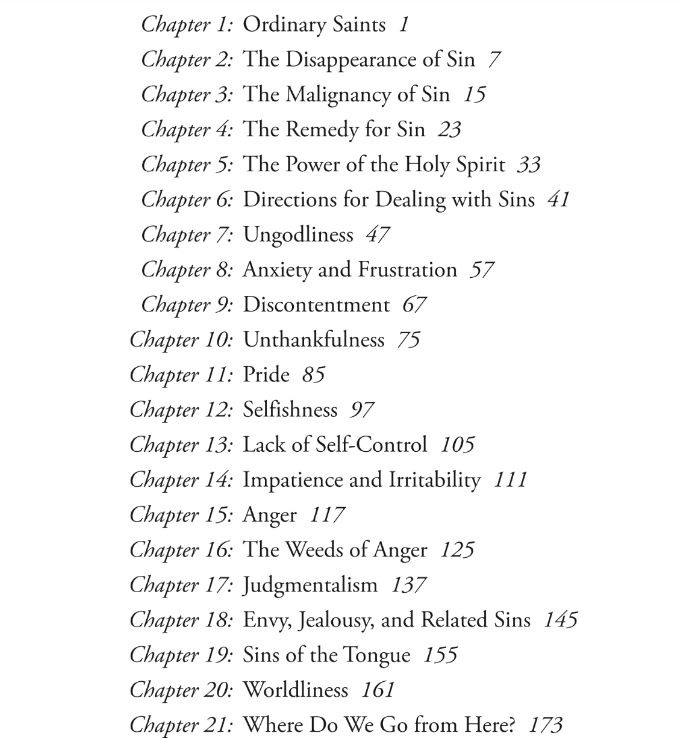
In Christendom there are a few (and getting fewer) sins we agree are bad. Homosexuality, transgenderism, child molestation, or abortion are pretty much agreed-upon as sins and are thus evil. But there’s lots more sins we tolerate. Jerry Bridges wrote an important book called “Respectable Sins: Confronting the Sins We Tolerate“. Here is the Table of Contents:
Wrong is Wrong
I’d never imagined that one of the Ten Commandments would be dishonored and dismissed to the extent that was. Apparently Brooks gets a pass on this because he’s popular.
It’s like when Michelle Lesley @MichelleDLesley said on Twitter “Why do doctrinally sound Christians keep giving Rosaria a pass on preaching to men? If it’s wrong when Beth Moore does it, it’s wrong when Rosaria does it.“
Contrary to popular opinion, a celebrity’s popularity does not excuse his or her violation of the scriptures. The acceptability of the content of their speeches does not excuse violation of the scriptures.
Comments like those replying to my Gerry Brooks post about taking the Lord’s name in vain say more about the individual saying the regretful things than anything else. And the bulk of comments being weighted toward accepting the sin of taking the Lord’s name in vain just tells me again where society is at the current point in history.
Keep Your Conscience Sensitive!
My admonition for you, dear reader, is to stand guard over your conscience. Be vigilant about the commandments. It is easy to fall into accepting things God does not want us to accept when it seems that ALL of Christian society is doing it. We ARE surrounded by paganism, atheism, and apostasy. We are living in a moment where we ask ‘Does a fish know it’s wet?’
We have to know when we’re wet. Even though we may feel submerged in sin all around us, keep your conscience clean and clear.
Peter’s conscience was absolutely seared after he had betrayed the Lord:
And Peter remembered the word which Jesus had said, “Before a rooster crows, you will deny Me three times.” And he went out and cried bitterly. (Matthew 26:75)
David’s conscience was bothered about his adultery and murder of Uriah-
When I kept silent about my sin, my bones wasted away Through my groaning all day long. 4 For day and night Your hand was heavy upon me; My vitality was drained away as with the heat of summer. Selah. 5 I acknowledged my sin to You, And my iniquity I did not cover up; I said, “I will confess my transgressions to Yahweh;” And You forgave the iniquity of my sin. (Psalm 32:3-5).
Those are pretty ‘big’ sins: betrayal, adultery, murder, for which their conscience should have been pierced.
But what we may in today’s time consider a ‘little’ sin was Daniel’s choice to eat or not eat the King’s food. Daniel’s conscience would have been wounded by eating the King’s delicacies.
But Daniel set in his heart that he would not defile himself with the king’s choice food or with the wine which he drank; so he sought permission from the commander of the officials that he might not defile himself. (Daniel 1:8).
Ignore the conscience long enough, it eventually scabs over from all the pricking. It gets seared. You know that seared skin has no nerve endings.
by the hypocrisy of liars, who have been seared in their own conscience, (1 Timothy 4:2).
Paul guarded his conscience. He said twice,
Now Paul, looking intently at the Sanhedrin, said, “Brothers, I have lived my life in all good conscience before God up to this day.” (Acts 23:1)
Paul’s Change of Plans- For our boasting is this: the testimony of our conscience, that in holiness and godly sincerity, not in fleshly wisdom but in the grace of God, we have conducted ourselves in the world, and especially toward you. (2 Corinthians 1:12).
We do our best to obey Jesus, when we fail we rush to repent (and will be forgiven), and we move on with renewed vigor to protect our conscience from becoming dull. Heed your conscience when you feel those prickings.
Celebrity Can Be Deadly
As for thin-skinned celebrities- here are my thoughts. Very often, celebrities live in a bubble. This means they are often isolated and insulated from anything that doesn’t explicitly affirm their every move. The more famous, the stronger the bubble. They only see or hear or expect affirmation and approval. I’ve been blocked by Beth Moore, Rick Warren, and now Gerry Brooks. We saw this with Alistair Begg recently. Internet famous, beloved by his congregation, never really had a melee about anything he’s said, then BAM! His advice to attend a trans wedding caught fire and people pleaded with him to reconsider. Not only didn’t he reconsider, but he came out with a defensive and angry sermon the next Sunday that revealed his disdain and contempt for Americans he’d held inside all along.
In 2010 Sarah Pulliam Bailey wrote a long article about Beth Moore, who had recently ascended to her international popularity. Look at the hoops Bailey had to jump through to get this interview:
[Moore is] closely protected by assistants who allow very few media interviews. After several interview requests from CT, her assistants allocated one hour to discuss her latest book and ask a few questions about her personal life. Each question had to be submitted and approved beforehand, I was told, or Moore would not do the interview. Follow-up interview requests were declined. I was permitted to see the ground level of her ministry, where workers package and ship study materials. But Moore’s third-floor office, where she writes in the company of her dog, was off limits.
It is dangerous to be protected from gentle correction, rebukes, or criticism. Dangerous to be protected from the people we are supposed to serve. The more protected, the thinner one’s skin.
If you say, “well, it’s dangerous these days to rub shoulders with a general populace’, I’d agree. So in this case perhaps, dispense with focusing on international celebrity and say no to speaking engagements, and concentrate on your church and your neighbor. I am going to write more about that in a real life example shortly.
I am grateful for a Spirit who sanctifies me and makes me realize that I am participating in a violation of the 3rd Commandment. If Brooks’ using the Lord’s name as a curse of exasperation previously and I didn’t realize it, I am doubly thankful for the Spirit bringing this to my attention so I could repent.
Conclusion
I hope and pray that the obvious thorn that flew into Gerry Brooks’ conscience will do its work to spiritually rebuke him for using the Lord’s name this way. And I pray that the people who affirmed this as a ‘respectable sin’ will also eventually find their bones melting like David’s in regret and then repent. I hope this happens before they meet Jesus, ‘for the LORD will not leave him unpunished who takes His name in vain.‘
Ligonier Essay: Using God’s Name Frivolously Yet, of all the Ten Commandments, only the third commandment adds the grave warning that God will not “hold guiltless” those who misuse His name (Ex. 20:7). Obviously, God does not hold anyone guiltless who does not repent and trust in Christ, but the attachment of this warning shows that the Lord pays special attention to how His name is used.
I like the Appalachian fiddle instrumental version of the old song Just a Closer Walk With Thee. Here are the lyrics, written by an anonymous or unknown author
I am weak, but Thou art strong; Jesus, keep me from all wrong; I’ll be satisfied as long As I walk, let me walk close to Thee.
Refrain: Just a closer walk with Thee, Grant it, Jesus, is my plea, Daily walking close to Thee, Let it be, dear Lord, let it be.
Through this world of toil and snares, If I falter, Lord, who cares? Who with me my burden shares? None but Thee, dear Lord, none but Thee.
When my feeble life is o’er, Time for me will be no more; Guide me gently, safely o’er To Thy kingdom shore, to Thy shore.
The only mention of anything sovereign is the word ‘kingdom’ in the last line.
I watched the TV series of Queen Elizabeth II, called The Crown. It’s an excellent series, well written, well acted, with sumptuous production values. It is Netflix’s most expensive series to date. They spent a lot of money replicating the surroundings of the kings and queens depicted, and nearly exactly replicated the events they lived through.
One thing that the first season’s series has firmly shown, is that while the crown is a successive institution, the people inhabiting it alternate. Yet the people inhabiting it are still distinct from the commoners. The Queen, her mother, her sister, her father, any of the sovereigns, are isolated. They live behind fences and high walls. When they appear in public they are again shielded. If they are walking, there is always a large distance between the rows of people and the Queen (or the King as it is now). They might walk past the people, but they do not walk with the people.
Jesus is our King. He is King of KINGS and Lord of LORDS! He is the highest of the high. Has any King ever invited the commoners to walk with Him? No! Did King Ahasuerus (Esther’s husband) invite people to walk with Him? No! He decreed that anyone entering his throne room without him having called them there would be put to death! Did King Herod go out and stroll around with Lydia and Timothy and James? No!
Jesus invites us to be His friend, He is our Father, our Brother, our Intercessor, our Priest, our Redeemer, and our Savior. Yet…walking with the King is unheard of!
We sing that song in a lively fashion when we hear it on the radio, because it’s familiar to us and it’s sweet. But think about the words, really think about them. We ask Jesus to walk closer to us And He will!
None of this is news to any of you. But it does us good to think about Him once in a while as the amazing Person He is, King, who does not isolate Himself behind fences and walls. In what other kingdom at any time or anywhere, does the King invite His people to walk with Him? The King who does not dismiss the commoners, but invites them to participate with Him in his sovereignty is to be praised in wonder and awe.
Our pastor preached a parable from Matthew the other day. He explained an anecdote from the biography of Adoniram Judson. Judson was raised Christian. He went to college. He roomed with a magnetic, charming non-believer named Jacob Eames who slowly drew Judson away from the faith. Judson did not share this with his parents, but after a while, Judson apostatized. After Judson graduated he finally told his parents he wasn’t a Christian any more.
He asked for his inheritance like the Prodigal, which was a horse and some money. His mom sank to her knees and started praying right then. Judson left anyway. He desired to write plays in New York City. Later, Judson found his life of sin was not as fulfilling as he thought it’d be. This perplexed Judson.
One day he was riding thru a small town he never went to before and lodged at an inn he was unfamiliar with. Innkeeper said there was only 1 room but in the next door room a man lay dying, probably not make it thru the night. Do you want the room? Judson said fine, ‘OK, I’ll take the room, I’m not afraid of death’.
All night people whispered coming and going, taking care of the unwell man. Judson heard moanings and groanings from the man. Finally the man was quiet. Judson was disturbed about the proximity of eternity for the man, thoughts which soon turned to himself. Am I ready for eternity? Judson thought. He became troubled.
Judson fell asleep, awakening the next day feeling good and bounded downstairs for breakfast. He inquired of the man. The Innkeeper said the man did indeed die. Judson was sad, and began to think about the man’s eternity. He asked if the Innkeeper knew the man’s name. “Oh yes, It was Jacob Eames.”
Just 21 years old, charming magnetic vibrant Eames was dead and facing hell forever. Judson was so shocked, because he knew this was from God; the happenstance of finding this little village, this inn, the last room, the dying man he used to room with in college just a year ago, heard his groanings of his last night on earth…now dead. Judson stayed stock still in shock for three hours.
He didn’t convert right then but this was a key moment. Adoniram WAS in fact, scared to death of death. He enrolled in seminary that year and soon after, became one of the very first missionaries to leave America for other tribes far away, dedicating his life to Christ.
The Lord does pursue His people.
I think of that heartbroken mother on her knees praying Adoniram as he left the house. I am sure she continued praying. If you have a prodigal child, don’t stop praying. If the child is one of His, Jesus will seek that lost sheep and bring him home. if he is not one of His, your prayers glorify Jesus in any case. And our chief end is to give Him glory no matter our own desires, circumstances, or feelings.
Further Resources:
Ligonier: 5 Minutes in Church History (audio with transcript): Adoniram Judson












 the-end-time.org
