By Elizabeth Prata
Do not lie to one another, since you stripped off the old self with its evil practices, and have put on the new self, which is being renewed to a true knowledge according to the image of the One who created it—a renewal in which there is no distinction between Greek and Jew, circumcised and uncircumcised, barbarian, Scythian, slave, and free, but Christ is all, and in all. (Colossians 3:9-11).
I put Scythian in bold because as I was reading this verse and I wondered ‘who are the Scythians?’ I don’t recall them being mentioned anywhere else in the Bible. Are they different from the barbarians who were listed just before the Scythians?
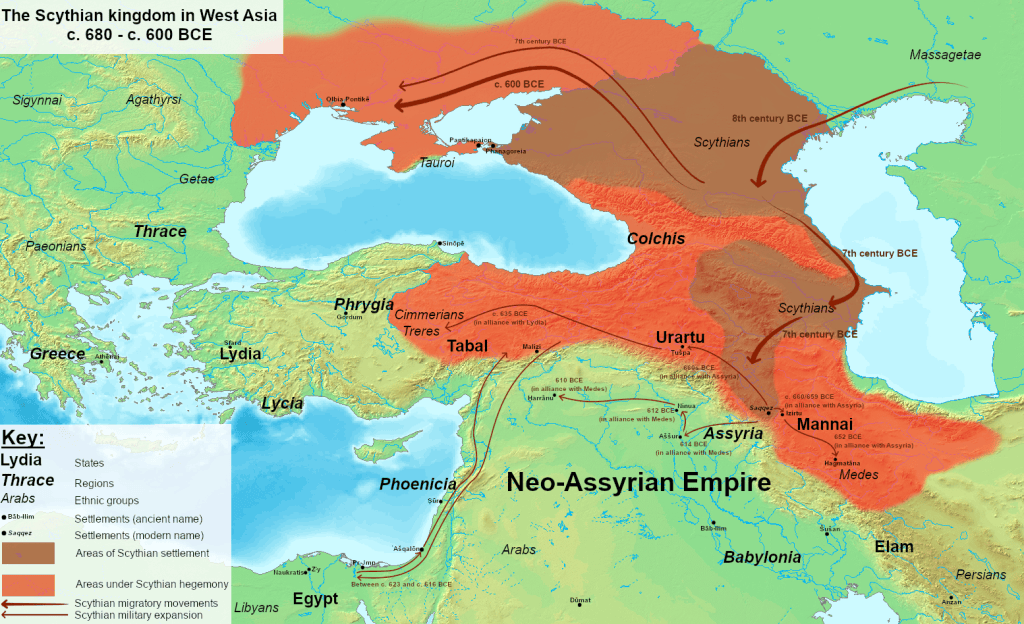
A Nomadic Warrior People
Topical Bible at Bible Hub states, The Scythians were nomadic warrior peoples who inhabited vast regions north of the Black Sea and into Central Asia. They appear in secular historical sources-such as those by Herodotus-and in significant archaeological findings that validate their cultural complexity and influence. Scripture’s mention of them is brief but vital in demonstrating the comprehensive inclusivity of the Christian faith.
The ancient historian Herodotus traveled extensively to do research for his eventual book “Histories.” In his research he wrote a bit about this nomadic people. Some of the things he wrote were legends exaggerated into truth, such as drinking wine from the skulls of their defeated enemies, but much of what he discovered was accurate. The Scythians’ burial mounds were called kurgans.
From The Historian’s Hut we read: The framework of Herodotus’ history of the Scythians is fairly accurate. He wrote that the Scythians were a fierce nomadic tribe that specialized in horsemanship and archery. As warriors, they were powerful enough to strike fear into the hearts of both the Greeks and the Persians. They even successfully repelled a massive invasion led by the Persian King Darius I in the late 6th-century, years before the Persians decided to launch their ill-fated campaigns against Greece. …at least 5,700 golden artifacts were uncovered in a Scythian burial mound (called a kurgan) excavated in Tuva, Siberia, yet not a single skull chalice was found among the horde of treasure. Similarly, furs and the fragments of cloth garments were discovered in the mound.
Surprise skills!
The Scythians as mentioned were warriors, both the men and the women. They were known for training hard and being exceptional at archery, especially with pinpoint accuracy while riding on their horses.
Normally when we think of a warrior tribe or people, we think of their barbarity. They are thought of as cruel, ignorant, indecent, or vulgar. Certainly the Jews thought so of the Scythians. The Scythians were a feared foe and cast a widespread shadow over their region.
Abbott called them “barbarians, even Scythians, the lowest type of barbarians.”
“They were thought of as more barbarian than the barbarian!” (JA Bengel, a German theologian of the early 1700s)
However, what did the archaeologist see when he squinted down the hole into the kurgan vault? Gold. LOTS of gold.
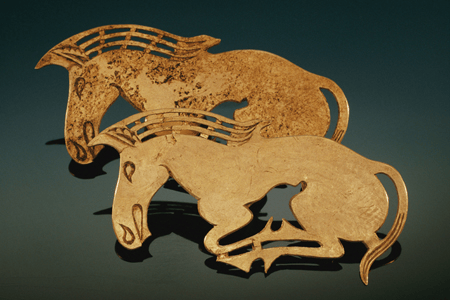
A seasoned archaeologist—he had spent a dozen summers on Russian excavation teams—Leus had just become the first person in 2,700 years to look into this chamber, a royal tomb of the shadowy people we call Scythians. Nomads and fierce warriors, they lived in Central Asia as early as the ninth century b.c., and their culture spread westward to southern Russia and Ukraine, and even into Germany, before gradually disappearing early in the Christian era. Source archived article Masters of Gold
They eventually excavated 44 pounds of gold from the Scythian kurgan. Often nomadic, warrior-culture tribes are assumed to have little artistic skill. Yet with this find, the Scythians were viewed in a new light. Not simply masters archers,
From this entry at the British Museum, “Introducing the Scythians“, we read, “When the Scythians weren’t being hide and seek champions, or being fobbed off with foreign princesses, they even developed a powerful new type of bow which was made from different layers of wood and sinew. It was much more powerful than a regular wooden bow, as the different layers increased the forces and energy when the string was released.”
No wonder they were so feared! But unlike many other barbaric tribes, they were master craftsmen too.
“The ornaments of Arzhan-2 “exhibit workmanship of the highest quality,” Nagler said. “The people were excellent craftsmen. This puts the Scythian quality of life in a new light. It rejects the stereotype that Scythians were just wild horsemen and warriors, migrating and destroying other people. They had a high level of cultural development.” But isn’t it true, I asked, that they fought and pillaged, as Herodotus wrote? “Yes,” Nagler replied, “but so did other peoples with well developed cultures: the Egyptians, the Greeks, the Romans.” (Source).
Division/No Division
As in our world today, there are divisions between people. Poor and rich, east vs west, victor and vanquished. In Jesus’ day there were similar divisions:
The Greek looked down on slaves and barbarians and Scythian. The Greek was the aristocrat of the Roman world and lauded it over anyone who was not Greek in his culture. The Jew looked down on the Gentile. Jews refused to enter a Gentile house, would not eat a meal cooked by Gentiles and would not buy meat prepared by Gentile butchers. When Jews returned to Israel, they showed their disdain for Gentiles by shaking off the dust from their clothes and sandals. Even the apostles were reluctant to accept Gentiles as equal partners in the church (cf. Acts 10-11). The Pharisee would pray each morning, ““I thank Thee, God, that I am a Jew, not a Gentile; a man, not a woman; and a freeman, and not a slave.”” (Source Precept Austin).
Whatever the nuances were about the Scythian, they were an interesting people. Beyond that cultural interest, there’s a theological truth here. Paul named the Scythians for a reason.
Paul was emphasizing the divisions in peoples, classes, and nations. He (probably) deliberately chose the Scythians to show that God is merciful to even ‘the worst of the worst’. He named barbarians, but also named Scythians. Apparently they were in a barbaric class by themselves! But God, full of mercy, chose some of them out of the world too, and Paul was saying, ‘Accept them’.
Spurgeon – In the new life there is no distinction of race and nationality. We are born into one family; we become members of Christ’s body; and this is the one thing we have got to keep up—separation from all the world beside: no separations in the church, no disunion, nothing that would cause it, for we are one in Christ, and Christ is all. …These distinctions all vanish when once we come to Christ; we are one in him, and every promise to believers is good to all who are in Christ Jesus, for “Christ is all, and in all.“
Joseph Barber Lightfoot (1828–1889), English Anglican theologian, biblical scholar, and Bishop of Durham from 1879 to 1889, said–
Regeneration brings true equality. People are not equal physically, mentally or economically in this life. Only the gospel can place people on equal footing with God and others. The Christian church should have no barriers for Christ breaks down all barriers and accepts all people who come to Him. Christians should be building bridges, not walls. In Christ all distinctions are transcended; at the foot of the cross the ground is level.
Is there a ‘Scythian’ in your life? Someone whom you tolerate outwardly but privately consider a barbarian? Disdain him or her? We all stand on the same blood-soaked ground under the cross of Christ.
Love one another, no matter who they were before the cross. Even the Scythian is your sister now.


