My church family is a family of readers. That’s good. I am a reader too. That means we are also talkers about books. We love to interact mindfully and intentionally about spiritual things. Our elders model this and encourage it. Our Family Groups, Book Clubs, and get-togethers are rife with conversations that are sparked with questions like, “Can you share any insights from your latest Bible reading?” “What do you think of the Bible Reading Plan segment for today?” “What books are you reading?”
The penetrating questions perform two functions. One function is that we are a like-minded bunch who love to read! We unite around literacy. This is good because it means we also read the Bible. Secondly, it keeps us accountable. It keeps me accountable anyway. When I read, I need to comprehend, and then retain and then share.
I’ve noticed that though I love reading and I’ve been a reader all my life, lately I was reading less. I read fewer books and the time I spent reading them was growing shorter and shorter. I was comprehending less too, and retaining almost nothing. I realized that most of my reading was done on a laptop. And that was weird because I dislike reading on screen.
I soon realized the type of reading I was doing was the issue. With my limited time to read after work, I was reading tweets, GroupMe chats, Facebook shares, short blogs, and the like. Digital reading predisposes us to reading superficially and quickly. Bible reading demands the opposite. Uh-oh.
In his book 12 Ways Your Phone is Changing You, author Tony Reinke exposed the issue. Several experiments had been done on reading and they were summarized in The New Yorker. (July 16, 2014). Turns out there is a difference in the way people read depending on if the text is on a screen or on a page.
On screen, people tended to browse and scan, to look for keywords, and to read in a less linear, more selective fashion. On the page, they tended to concentrate more on following the text. Skimming, [Ziming] Liu concluded, had become the new reading: the more we read online, the more likely we were to move quickly, without stopping to ponder any one thought.
Of Rakefet Ackerman and Morris Goldmsith’s experiment, published in the Journal of Psychology Applied it was discovered,
The screen, for one, seems to encourage more skimming behavior: when we scroll, we tend to read more quickly (and less deeply) than when we move sequentially from page to page. Online, the tendency is compounded as a way of coping with an overload of information. There are so many possible sources, so many pages, so many alternatives to any article or book or document that we read more quickly to compensate.
In addition, of Mary Dyson’s research, we read,
The online world, too, tends to exhaust our resources more quickly than the page. We become tired from the constant need to filter out hyperlinks and possible distractions. And our eyes themselves may grow fatigued from the constantly shifting screens, layouts, colors, and contrasts, an effect that holds for e-readers as well as computers.
Of Anne Mangen’s research,
The shift from print to digital reading may lead to more than changes in speed and physical processing. It may come at a cost to understanding, analyzing, and evaluating a text. Much of Mangen’s research focusses on how the format of reading material may affect not just eye movement or reading strategy but broader processing abilities.
Goodness! Reinke interviewed Trip Lee for the 12 Ways book, and Lee said the following. See if it resonates with you:
The more time I spend reading ten-second tweets and skimming random articles online, the more it affects my attention span, weakening the muscles I need to read scripture for long distances.
I certainly noticed a decline in my own analyzing, processing, and retention abilities. I needed to do something about this! I purposed to make a schedule of all the books I wanted to read this summer. I had a bunch laying around that were half read and others had been ‘on deck’ for over a year.
I’m blessed to have 9 weeks off from school during the summer, and my deep desire was to use the time well for Jesus. I also wanted to revive that atrophying reading muscle. So here’s what’s on my nightstand so to speak:
I am going through Exodus with Dr Abner Chou’s lectures, and Romans 1-8 with my church family on Tuesday nights. Also, I’m reading John MacArthur’s Romans commentary. Review: What can you say about the Bible! It’s great! A JMac Commentary? It’s great!
A few months ago, I read Erik Lundgaard’s The Enemy Within, a summarized version of Puritan John Owen’s Indwelling Sin. I was irked that I remembered little of it. I decided to read it again, and pair it with Owen’s actual book Indwelling Sin (an abridged and slightly modernized version.)
I like this pairing. The topic is difficult, as it necessitates a deep look into one’s own heart to purposely uproot the sin there. Lundgaard’s version is sort of like a Cliff’s Notes which gets me ready to read the same chapters in Owen the next day. Owen’s Indwelling Sin in Believers is a monumental, wonderful, convicting book. I highly recommend it. I bought the Banner of Truth Puritan Paperbacks version.
Here is a resource for Owen. He wrote three towering books on the subject of sin, a trilogy if you will, Indwelling Sin as mentioned, Mortification of Sin, and Overcoming Sin and Temptation. This writer has created a “Monster Cheat Sheet for the Mortification of Sin in Believers” that you might find helpful if you decide to read that Owen book.
Grace Abounding in the Chief of Sinners is a book by Pilgrim’s Progress author John Bunyan, another Puritan. The version I’m reading has not been modernized and I love it. Owen’s language is dense with lengthy run-ons. Bunyan’s isn’t, hence is easier to read. Hugh Martin said of the book,
Grace Abounding is among the greatest stories of God’s dealings with the human soul– to be put on a shelf beside such treasures as Augustine’s Confessions, Law’s Serious Call, and Baxter’s Autobiography, and Wesley’s own account of his spiritual travail.
One great thing about reading the Puritans and older books is that the thread of sin, evil, guilt, despair, salvation, comfort, and assurance is the same no matter what century one lives in. Here is a resource on Bunyan’s works- 3 Lessons from the Life of John Bunyan.
Art and the Bible is a small book dealing with the topic of beauty. We should use the arts to the glory of God, author Francis Schaeffer wrote, and I agree. “Francis Schaeffer first examines the scriptural record of the use of various art forms, and then establishes a Christian perspective on art.” Recommended.
For secular books, I’m into Moby Dick, with cliff’s notes. Here is RC Sproul on Moby Dick in his essay The Unholy Pursuit of God in Moby Dick:
It seems that every time a writer picks up a pen or turns on his word processor to compose a literary work of fiction, deep in his bosom resides the hope that somehow he will create the Great American Novel. Too late. That feat has already been accomplished and is as far out of reach for new novelists as is Joe DiMaggio’s fifty-six-game hitting streak or Pete Rose’s record of cumulative career hits for a rookie baseball player. The Great American Novel was written more than a hundred and fifty years ago by Herman Melville. This novel, the one that has been unsurpassed by any other, is Moby Dick.
I agree. Moby Dick is THE Great American Novel. It’s towering, lyrical, breathtaking. It is also demanding, difficult, cumbersome. Is it worth it? YES. But again with this one, I needed notes. I use Read Moby: A Guide for First Time Readers. Why did Sproul believe this is one of the greatest hundred books, ever?
its greatness is found in its unparalleled theological symbolism.
Read Dr Sproul’s recommendation above for why we should read this book.
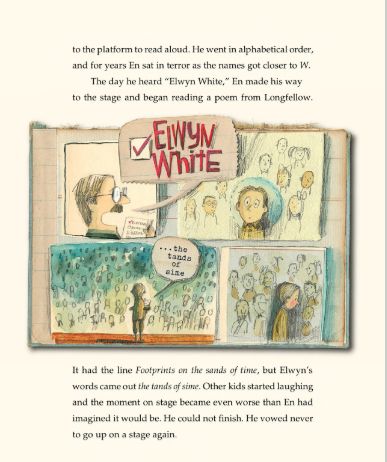
Some Writer! The Story of EB White by Melissa Sweet. This is a graphical book, one that includes ephemera, notes, and drawings. It’s a sweet and lovely book and I’m enjoying it tremendously.
PS if you like graphical books, Up The Down Staircase is another one that contains ephemera to tell the story.
“largely assembling her story through an accretion of found objects: bureaucratic circulars, homework assignments, wastebasket contents, doodles, and interoffice memos among teachers”
I am also reading a hilarious and wildly interesting book about the summer of 1927 in America by Bill Bryson aptly called One Summer 1927 America. He is such a good writer that the detailed sections on aviation (It was a Charles Lindbergh summer) and baseball (Babe Ruth summer) interesting, and I don’t gravitate to either subject but he makes them so fascinating I can’t put the book down. Recommended.
The Guernsey Literary and Potato Peel Pie Society by Mary Ann Shaffer, Annie Barrows. A friend sent me this book and it is soooo good. It is a story told through the exchange of letters. This, like Up the Down Staircase the Some Writer! are episolary novels.
Fun Fact: An epistolary novel is a novel written as a series of documents. The usual form is letters, although diary entries, newspaper clippings and other documents are sometimes used. Recently, electronic “documents” such as recordings and radio, blogs, and e-mails have also come into use. The word epistolary is derived from Latin from the Greek word epistolē, meaning a letter (see epistle).
The Elusive Mrs Pollifax is on deck for August when school starts again.
I am noticing that when I push away from the laptop and just read, whatever book it is, I feel more relaxed. Moreover, my mind is slowly adapting to literature again, and my comprehension is lengthening. Slowly.
Watch out that digital reading might be changing your mind for the worse. Set aside a time to read without distraction some good theological books, leisure books, and of course the Bible. The Bible demands attention, study, and meditation. Our minds are being shaped away from that kind of reading and this impacts our Bible reading.
The thing I hated worst was that after I read the Bible, I’d remember some fun insight or nugget about it to share the next day at work. Of late, I’ve not done that, because I can’t really remember. I dearly want to proclaim His glories among the people with whom I work. Hence, my summer of reading recovery.
I will meditate on Your precepts And regard Your ways. I shall delight in Your statutes; I shall not forget Your word. (Psalm 119:15-16)