Posted in theology

About head covering and those who teach it: Madaline Mikayla

By Elizabeth Prata

This essay is not about whether you should wear had coverings. It is about discerning those who tell you you should wear head coverings.

The advent of the internet and all its social media platforms and availability of widely distributed material is a blessing, especially for those in closed countries, disabled, or are without other means of reaching Christian content. However it is also a curse, because of course satan uses it to promote his agenda, which is to disseminate false material and raise up false teachers to confuse the sheep.

There are many preachers, evangelists, and teachers out there who occupy and use the biblical title. Some are good, others are false. But beyond those, there are an abundance of what we call Christian Influencers or Christian Content Creators who do not occupy a specific title (and some aren’t even attached to a specific church) but they still influence the sheep within the faith by publishing Christian content.

All are claiming your attention and many claim to be the real deal within Christianity. Not all are the real deal.

Recently I was asked about Madaline Mikayla.

She is a 29 year old online personality, AKA content creator, who publishes at the time of this writing on Youtube, TikTok, Facebook, and Instagram. She focuses on head coverings, for which she uses the term “veiling”. She also covers the topics of modesty and marital abuse of women.

Head Coverings

In her video linked here on Instagram, Madaline Mikayla says that a woman must cover her head. Ms. Mikayla states that it is not a personal conviction. It is not a passed-away cultural norm. It is a command from God.

She explains in her testimony video that in college, her “spiritual leaders” held a night of “prayer and deliverance”. When she got back to her dorm room she “strongly felt God’s presence”, and “out of nowhere I heard God tell me, ‘Cover your head’. (Source)

Unlike Bible believers who hear and obey when God commands them, Ms Mikayla disobeyed. For years. Jonah excepted. Her reason for disobeying was that “If this is something God wanted me to do, why aren’t more Christian celebrities doing it?”

We look to the Bible for confirmation of Gods commands. Second, we do not look around at celebrities to confirm that this is what God wants us to do.

Some years later, she said God spoke to her again. This time she knew it was God because of the first encounter she’d had when “he” had told her to cover her head. But she still refused for 5 more months. “That was how badly I didn’t want to cover my hair.” Mikayla eventually succumbed to the ‘command’ she’d heard.

However, Dr. Owen Strachan, Senior Director of the Dobson Culture Center at the James Dobson Family Institute, and a teaching fellow and director of ministry at Redeemer Bible Church, says that the First Corinthian passage regarding head coverings is one of the most difficult passages to exegete, and causes the most debate in seminaries.

But Madaline Mikayla has it figured out to the point of hardened certainty? Red flag #1: when someone claims to have THE answer on a passage that has caused debate and difficulty for 2000 years for everyone else, be suspicious.

Mikayla further details the amount and the type of covering, even though the Bible does not describe it. Mikayla says handkerchiefs, hats, bandannas and the like are not appropriate because the entire head must be covered, she says.

And even beyond that, all hair must be covered, Mikayla says. Not a bit of it can show. Although a bit of it in front is OK. Again, the Bible does not describe any such thing.

Red flag #2: When a Bible personality claims to have concrete stances about a Christian’s allegedly biblically commanded behavior in details that are not in the Bible, she is a Legalist.

GotQuestions excerpt on the definition of Legalism:

It is a term Christians use to describe a doctrinal position emphasizing a system of rules and regulations for achieving both salvation and spiritual growth. Legalists believe in and demand a strict literal adherence to rules and regulations. Doctrinally, it is a position essentially opposed to grace. … Many legalistic believers today make the error of demanding unqualified adherence to their own biblical interpretations …

Mikayla is making it a rule for women to wear coverings on their heads, prescribing the type and amount, and dictating the length of hair that allegedly satisfies God’s command. Ms Mikayla says her platforms (Youtube, Facebook, etc) are ‘Modesty School, and I am your teacher’. So she is positioning herself as a teacher of the word of God, but has no training. [I did contact Ms Mikayla to ask if she is a member of a local church and she graciously replied that she is a member at a Baptist church.]

Normally an untrained teacher can be acceptable since the Holy Spirit illuminates the scriptures to those whom He will, but some training is always desirable. Importantly, if one is a teacher, be warned. “Do not become teachers in large numbers, my brothers, since you know that we who are teachers will incur a stricter judgment.” (James 3:1).

Red flag #3: Ms. Mikayla misinterprets one of the verses upon which she hinges her stance that total head and hair coverings are a commend for today for all women-

For if a woman does not cover her head, have her also cut her hair off; however, if it is disgraceful for a woman to have her hair cut off or her head shaved, have her cover her head. (1 Corinthians 11:6).

Ms Mikayla says that “1 Corinthians 11 says if a woman refuses to veil, she should cut off all her hair. This is because the length of our hair is supposed to be covered.” (Source)

No…the Bible does not specifically say all strands of a woman’s long hair must be covered. Paul was using sarcasm. At the time, temple prostitutes signaled their profession by going about uncovered with short hair. Paul is saying, if you won’t cover your head, you might as well signal you are a prostitute, so go all the way and why don’t you cut off your hair?

Ellicott’s commentary explains the verse- Let her also be shorn.—The force of this argument depends on the fact that a woman’s head being uncovered would be regarded by others as implying the same shame as was indicated by a woman’s hair being cut short (i.e., shorn), or altogether removed (i.e., shaven). It is as if the Apostle said—If a woman insists on her right to pray and speak in an assembly with uncovered head, let her carry out this principle to its logical result; let her insist on her right to have her hair cut short, so as to show her equality with man—and what would be thought of her then! No woman with a spark of shame in her would think of doing that. ~Ellicott’s commentary on 1 Corinthians 11:6

Wiersbe on 1 Cor 11:6, The Corinthian women who appeared in the assembly without the head-covering were actually putting themselves on the low level of the temple prostitutes. The prostitutes wore their hair very short, and they did not wear a head-covering in public. Their hairstyle and manner announced to others just what they were and what they were offering. “If you are going to abandon the covering,” wrote Paul, “then why not go all the way and cut your hair?” Wiersbe, W. W. (1996). The Bible exposition commentary (Vol. 1, p. 604). Victor Books.


Here is a resource for you regarding head coverings for women-

What about female head coverings in 1 Corinthians 11? 9Marks (Tom Schreiner)

“[T]he point of the passage isn’t the cultural practice but the principle of male headship in marriage and the church. In most cultures today, a wife’s submission to male leadership isn’t signified by whether she wears a head-covering or how she wears her hair. Yet it doesn’t follow from this that the text doesn’t speak to us or isn’t authoritative today, for we learn from these verses that there must be distinctions between the sexes and that the leadership of the church comes from men.

“We could compare Paul’s instructions about head-coverings to what he says about the holy kiss. Believers are to greet each other with a “holy kiss” (Rom. 16:16; 1 Cor. 16:20; 2 Cor. 13:12; 1 Thess. 5:26). Today, we’re not required to kiss one another when we greet one another. We obey this command when we greet one another warmly whether with a hug or a handshake. In the same way, the Lord doesn’t require us to replicate the culture of the first century by having women wearing head coverings when the church meets together. What is necessary is that women are submissive to male leadership in the church (of the elders).” –end Tom Schreiner


Red flag #4: Charismaticism. Ms Mikalya relies upon mystical encounters as part of her faith. I’ve listened to several of her videos, including her foundational testimony videos, and in most of them she relates some sort of presence, God personally telling her something, dreams and their interpretation, signs, and visions. Here are a few examples-

“They were having a worship night. Out of nowhere, I felt God’s presence for the first time in my life. It was like a supernatural experience. But I felt like the presence of a spirit. And I feel like most people experience like a dark spirit, but this was like God’s spirit, which is so different. And it was so cleansing feeling and like I felt peace for the first time. And so one of my friends in the [rehab] program who I really looked up to, she’d been a Christian. She was a Christian and she’d been in the program for a while. I told her I wanted to give my life to God. And so I think she and like a staff member walked me through a salvation prayer and I have been a Christian ever since then.”

But in that moment, I had this vision of me like on this road with other people and I was like helping people get off drugs. It was like the craziest thing because I that is not something that would ever cross my mind. But I like had this vision of me helping people.

Abuse

Red flag #5: Abuse. If you watch Ms Mikayla’s testimony video she is transparent about her past sins. Good for her. She went through the wringer. She’d endured arrests, violence, sexual abuse, being a runaway, homelessness, drugs, rehab programs, juvie… Her sins ran the gamut. In this season of her life as a Christian teacher of modesty, she also focuses her teaching on abuse in marriage. By her description, she was in an abusive marriage.

Ms Mikayla teaches that “One of the most common misconceptions that Christian women believe today is that they are Biblically required to stay in a marriage where they are being emotionally, verbally, psychologically, physically, sexually, and/or financially abused by their husband. However, Biblically, this is not true.”

I find nowhere in the Bible that ‘verbal abuse’, ‘financial abuse’ or ’emotional abuse’ qualifies as a legitimate reason for divorce. The Bible lists adultery and abandonment as the only allowable reasons, and bear in mind, those are not commands to divorce. Reconciliation is still the best outcome. Sadly, the 1 Corinthians 7:15 reason of abandonment has been broadened to cover a multitude of illegitimate reasons to leave a husband.

GotQuestions says,

Some counselors and clergy, wishing to be gracious, have defined abandonment in overly broad terms. Some say that it can refer to hardships experienced because of addiction, mental illness, prison sentences, or unkindness. That is not the biblical definition of abandonment, however—unless such hardships rise to the level of abuse, but that is a different topic.

Conclusion

The issue about head coverings as presented to us in 1 Corinthians 11 is a thorny and complicated one. As Dr. Strachan mentioned, it causes an exegetical problem and sparks much debate. Wherever you come down on the issue of head coverings for women, is up to you. If you believe it is a mandate, then do as your interpretation of the pertinent verses guide you, knowing that it is important not to go beyond scripture. If you believe it is a personal conscience issue, then go with God and your conscience.

The point of this essay is to warn about people who claim to have certainty in this cloudy issue. I warn about those who add extrabiblical revelation and charismaticism to their teaching, who claim to be a teacher but whose teaching indicates a naive understanding of a complex issue, as well as an interpretive error leading to Legalism.

Ms Mikayla may be well intentioned and earnest in her conviction to wear a covering on her head and her hair, and more power to her. But her conclusions AND the road on which she arrived at those conclusions is riddled with potholes of error. I’ll include some credible resources for women who seek information on head coverings.

This next is an aside, my opinion. There seem to be trends among the niche factions. Many in the Hebrew Roots movement insist on using the name ‘Yeshua’ in and writings. In the Head Covering/Modesty movement, many like Ms Mikayla, insist on calling it ‘veiling’. I find these kind of terms precious and fake. Yes, the word in Greek for covering is defined as covering OR veiling, but the centuries long commonly understood word has always been covering.

Additionally, Muslims veil. Their standards of covering the hair and head are as strict as Ms Mikayla insists upon. We do not want to align with or seem to be syncretic with such an evil false religion as Islam. In fact, many Muslim women follow Ms Mikayla and applaud her teachings. We share nothing in common with Muslims.

Further Resources

Discovering Head Coverings: podcast from A Word Fitly Spoken by Amy Spreeman and Michelle Lesley

Further Resources

Head Coverings for Women– Bible Q&A, John MacArthur

Discovering Head Coverings: podcast from A Word Fitly Spoken by Amy Spreeman and Michelle Lesley

A prelude to head coverings: podcast WWUTT by pastor Gabe Hughes

Q&A Head Coverings, Culture or Corporate, podcast WWUTT pastor Gabe Hughes

Posted in theology

Discerning Leslie Vernick

By Elizabeth Prata

Occasionally I’m asked if so and so is a false teacher or a credible one. I like these kind of questions because it assures me there are women out there who care about their soul and what they absorb into it.

The advent of the internet and all its social media platforms and availability of widely distributed material is a blessing, especially for those in closed countries, disabled, or are without other means of reaching Christian content. However it is also a curse, because of course satan uses it to promote his agenda, which is to disseminate false material and raise up false teachers to confuse the sheep.

There are many preachers, evangelists, and teachers out there who occupy and use the biblical title. Some are good, others are false. But beyond those, there are an abundance of what we call Christian Influencers or Christian Content Creators who do not occupy a specific title (and some aren’t even attached to a specific church) but they still influence the sheep within the faith by publishing Christian content. Singers/bands, counselors, bloggers (like myself), para-church ministries (like Ligonier and IF:Gathering), podcasters, writers…the list goes on.

All are claiming your attention and many claim to be the real deal within Christianity. Not all are the real deal.

To that end, we hone our discernment before allowing such a one inside our home, access to our children, or inside our mind.

Now while I always hope that people can do their own research into discerning the answers, I’m always happy to help those who are unsure. This reply is as much a ‘how-to’ find out information in order to form a basis for discerning, as it is a single answer.

Recently I was asked about Leslie Vernick and Madaline Mikayla. Today I’ll answer about Vernick. In a day or two I’ll answer about Madaline Mikayla.

Here is what I found in researching Leslie Vernick. You may find different results in your own research or come to different conclusions.

Leslie Vernick

About Leslie - Leslie Vernick

I always start with a biography of the person. What does she say about herself?

BIO: From her About page at Amazon: “For more than 35 years, Leslie has worked as a biblical counselor and licensed clinical social worker. She is a licensed clinical social worker (Academy of Certified Social Workers- ACSW), and Licensed Clinical Social Worker- (LCSW) who has her own private counseling practice and more than twenty years of experience counseling Christians from a biblical worldview” as the About states.

She received her Master’s degree from the University of Illinois and is an adjunct professor at Philadelphia Biblical University (which was renamed Cairn University in 2012). Leslie has authored several books. She said in a recent video that she has been married to the same man for 50 years this year, and has 2 grown children.

Then I looked up ACSW and LCSW, and learned what those initials stand for. Answer is in the above paragraph. It’s the licensing for social workers.

Leslie is a member of the American Association of Christian Counselors (AACC). This is not to be confused with the Association of Certified Biblical Counselors (ACBC). Vernick conducted her postgraduate training in biblical counseling and cognitive therapy.

Cons

The difference is that the Association Leslie belongs to uses secular psychology and professional clinical methods overlaid onto the Christian faith, whereas the ACBC rejects secular psychology and relies strictly and exclusively on the Bible for counseling. Many have warned about using secular psychology in biblical counseling. Or is is Christian counseling? Confusing. Here is an excerpt explaining, from Got Questions:

On a related note, what is usually called “Christian counseling” is different from “biblical counseling” in that Christian counseling often uses secular psychology in addition to the Bible. This is not to say that a Christian counselor is not also a biblical counselor, but often Christian counselors are Christians who integrate secular psychology into their counseling. Biblical or nouthetic counselors reject secular psychology wholesale.

Leslie does contribute to the Association of Biblical Counselors (ABC) which is broader philosophically, looser denominationally, and contains a greater openness to clinical research than is ACBC.

Though Vernick identifies herself as a Biblical Counselor, I asked Google how much of her therapy uses clinical psychology. This reply is from AI, which I am using because I am not familiar enough with the terms and strategies in professional Clinical Therapy sessions. The answer was yes, Vernick heavily uses psychology.

Heavily Rooted in Cognitive Behavioral Therapy (CBT)

Vernick’s core approach to personal transformation is clinical cognitive therapy.

  • Identifying Cognitive Distortions: Her “Roadmap Strategies” focus on identifying the “lies” or faulty core beliefs that individuals maintain.
  • Reframing Action: Her CORE framework teaches clients to actively challenge irrational or destructive self-talk, which is the textbook application of Albert Ellis’s Rational Emotive Behavior Therapy (REBT) and Aaron Beck’s CBT.

Is secular psychology helpful or unhelpful to use when counseling Christians? John MacArthur gives a logical answer.

After scanning some of Leslie’s content on her page, on her Youtube, and downloading her ‘Quick Start’ bundle, I saw that Leslie Vernick is a counselor who focuses on women in difficult marriages. Every professional has a niche or specializes on a topic. Difficult marriages is Vernick’s chosen niche.

I notice that Vernick’s motto on the About page states-

“We believe God wants you to live with safety, security, and emotional strength – whether your spouse changes or not.

Does this square with the Bible’s admonitions for life on this present earth? No. Nowhere in the Bible does God promise safety or security before He comes again. It’s the opposite. In addition, Jesus emphasizes through His word spiritual strength- which then gives rise to emotional strength. Example, Mary’s spiritual strength was well in place before her emotional trial. This allowed her to emotionally endure the taunts of her community believing she was a wanton fornicator.

There are many difficult marriages in the Bible, or marriages presenting with significant emotional obstacles. Adam and Eve, Sarai and Abram, Abigail and Nabal, Leah and Jacob, Esther and King Ahasuerus, Hosea and Gomer, Joseph and Mary…

As for ‘safety’, Paul lived one of the unsafest lives ever as a Christian. What God wants is for us to grow in His likeness, obey Him, and pursue sanctification by mortifying our sin.

I also notice Leslie focuses on ‘emotional abuse’. Emotional abuse is real, but difficult to define. In my opinion it is such a nebulous term that practically anything can be called emotional abuse and then the phrase is then used to justify things that the Bible doesn’t allow.

Leslie apparently offers helpful tips and strategies to help women in difficult marriages. I can sympathize. I was an observer of my parents’ difficult marriage and was in my own difficult marriage (neither were Christian marriages). I think being in a difficult marriage is one of the hardest paths a woman can walk.

Leslie said in an interview, that God values the safety and sanity of the people in a marriage more than sanctity of the marriage. I’m not so sure about this. Nebuchadnezzar was married, yet God made him go insane for 7 years. Didn’t God care about the King’s wife? God put Esther in a position to be killed by her husband when she approached Xerxes. Didn’t God care about her safety?

Leslie also said in that same interview that the verse in Malachi 2:16 stating “God hates divorce” “is mistranslated in the KJV. Whether you want to get involved in this interpretive dispute, and it IS a dispute, further in Malachi it says that whoever divorces splatters his garments with filth. Jesus reiterated God’s standard of marriage as a one-flesh, permanent union in Matthew 19. I can’t see in the Bible where it says the wife may divorce a husband because the husband is emotionally stunting the wife.

Pros

On the plus side, Vernick has been featured many times on interviews and podcasts at Focus on the Family.

Her adjunct work seems to be in a solidly biblical higher educational setting.

Also, Cairn University is stated to have a firm commitment to Biblical fidelity. All students at Cairn U must take a Bible minor. The University adheres to a conservative, Protestant outlook and has a strong focus on biblical integration into life.

Conclusion

Whether you agree or disagree with the extent, if at all, that clinical psychology should be used in counseling will determine your conclusion as to whether to absorb Vernick’s material. I am suspicious of secular psychology and if it was me, I’d choose an ACBC therapist or her materials instead. Others may differ in this opinion. Of those Christian or Biblical counselors who integrate psychological frameworks into their professional settings, Vernick may be the best of those hybrid counselors- IF you want to open the door to a fortress of philosophy that needs to be torn down.

Personally, I’d advise looking for an ACBC counselor instead. Recommended counselors’ materials are the passed-away David Powlison, Martha Peace, and Greg Gifford. If you wish to find an ACBC counselor in your area to meet with, here is the ACBC find page:

https://biblicalcounseling.com/find-a-counselor/

Posted in theology

The Prosperity Gospel You May Not Recognize

By Elizabeth Prata

The Benny Hinn-style of prosperity gospel is well known and easily seen among those Christians with even a snippet of discernment. The Hinn-style prosperity gospel, labeled ‘hard prosperity gospel’ in the article below, promises instant health or wealth, or immediate financial gains. These prosperity gospelers frequently use terms like ‘breakthrough’, urge positive confessions, (AKA ‘name it and claim it’), and press their audiences for donations they call ‘seed faith’ giving. Joel Osteen is one of these. So is Kenneth Copeland.


Discernment help: John Piper, Six Keys to Detecting the Prosperity Gospel. This essay is well-written and clear.


But there is another type of prosperity gospel that is much harder to detect. As always, that old serpent is subtle. It is in fact the first quality we learn about him, from Genesis 3:1. The first mention in the Bible of the serpent tells us of his subtlety. The word means cunning in a bad way, crafty, or shrewd. So it stands to reason satan adjusts his methods of deception. The “softer prosperity gospel” is one of those.

At 9Marks’ article quoted below, we learn of this more subtle prosperity gospel which in the quote below, says assumes its audience knows the Gospel already:

This is not a new concern. Others have described facets of this prosperity gospel under names like moralistic therapeutic deism, Christless Christianity, and the commodification of Christianity. In truth, all three descriptors overlap to describe a prosperity gospel that is easily missed, because it is seems reasonable to Christians who love God and the American Dream.


That said, the ‘soft prosperity gospel’ can be just as ruinous as the hard prosperity gospel. Any deviation from Christ’s standards for life and doctrine is ruinous. Why? Because any deviation comes from either our flesh, the world, or from satan, and stands opposed to Christ’s Good News. Just because it’s soft does not mean it’s less hard on the soul.

9Marks: “While evangelicals have traditionally decried the prosperity gospel in its “hard” form, there is a softer form of this teaching that is all too common among us. Often undetected by Bible-believing Christians, it assumes the gospel and leads its adherents to focus on things like financial planning, diet and exercise, and strategies for self-improvement. In contrast to the hard prosperity gospel, which offers miraculous and immediate health and wealth, this softer, subtler variety challenges believers to break through to the blessed life by means of the latest pastor-prescribed technique.”

I liked the use of the term “assumes the Gospel”. Too often as a Christian ministry whose goal of presenting information to its audience assumes its audience as Christians already know the Gospel. However, genuine Christians need to be reminded of it all the time. And we can never assume that anyone reading or listening to our output is actually a Christian and/or already knows the Gospel. The Gospel as Good News should be shared incessantly to one and all.

The 9Marks article mentioned diet & exercise as a location for one of the ways softer prosperity gospel enters in. Among the Christian circles I frequent, which focus on women, there is a huge emphasis on diet and exercise. It’s also called ‘wellness’. I’ve written previously about the trad wife & crunchy Christian woman. In these realms it seems a softer prosperity gospel abounds. Angela Mitchell of Raising Apologists has done a yeoman’s work on this topic as well. See some of her links below.

Wellness Christianity is not the only potential soft prosperity pitfall, of course. The pitfalls exist in spheres of financial planning, self-improvement, and other American style problems we think we have.

We do want to be healthy, plan wisely with our finances, and improve ourselves. That is not the issue. The problem comes when promoters of a soft prosperity shift the focus from Jesus’ blessedness to the blessings.

The 9Marks article continues with presenting 5 trademarks of soft prosperity.

  1. Soft prosperity elevates “blessings” over the blessed God.
  2. Soft prosperity detaches verses from the redemptive framework of the Bible.
  3. Soft prosperity diminishes the curse that Christ bore and the blessing of the Holy Spirit.
  4. Soft prosperity relies on pastor-prescribed therapeutic techniques.
  5. Soft prosperity largely addresses first world, middle class problems.

It is easy to get drawn in to these, so please take a look at the article and see if you have or haven’t been fooled by these subtleties. If you have, of course Jesus will accept your repentance and the Spirit will respond to your request to be strengthened in discernment. If you have not been taken in, pray in praise to Jesus that He has delivered you from this error. Remember we do nothing on our own. We always abide in Him.

9Marks- A softer prosperity Gospel: more common than you think

Further Resources

Ligonier: The Soft Prosperity Gospel

Raising Apologists: A Plea for Christians to be Discerning about Wellness

Raising Apologists Highlights on Homeopathy (On Instagram)

Raising Apologists Highlights on Wellness part 1

Raising Apologists Highlights on Wellness part 2

Posted in theology

A teaching on ‘Soul Ties’ has no business being in a Christian book: On Evangelical fads

By Elizabeth Prata

Fads exist of course in the secular world. I have seen so many ‘evangelical fads’ come and go. There are so many, and mainly they are all false. Most of them have emerged from a different religion and been adapted in some way to be made palatable to Christian ears and eyes.

Today is about one such unChristian fad I spotted in a well-known ‘Christian’ teacher’s book. When we are IN a fad, IN an era, we often do not realize it. It’s why many pastors say to ‘read the old dead guys’. We can see their foibles and emphases from the vantage point of hindsight. As they say, hindsight is 20/20.


RESOURCE: Servants of Grace, Jason Garwood, Why Christians Should Read the Dead Guys


But we can still work hard to stick with scripture which is always truth, and check against whatever might be the fad of the day is. Will it pass away as shallow, or align with scripture?

Remember Prayer of Jabez? Prayer rugs? Seeker-sensitive? Purpose driven?

A fad is defined as “style, activity, product, or interest that becomes extremely popular for a short time and then fades away quickly”

Beth Moore is a false teacher. Today I focus on a little known and rarely spoken of reason: Moore frequently jumps on evangelical fads.

This post is not solely about Beth Moore, but I’m using her as an example to warn you that your discernment should be honed to alert you to any teacher who seems to be jumping on a fad.

Beth Moore’s past jumping on fads and then leaves them when they diminish in popularity, included fads such as saying mantras, family altars, Lectio Divina, Contemplative Spirituality, blue bracelets, Enneagram, and so on.

Today I’ll show you that another evangelical fad which was popular for a while but then passed away- “soul ties”.

Many of the fads that infiltrate Christendom have roots in Mysticism. Lectio Divina did, Enneagram did, Contemplative Spirituality did. So does ‘Soul Ties’. Sadly, it’s the women Bible teachers who tend to jump on these secular or New Age fads and re-brand them into Christianity. Remember circle-making? Popular around 2012.

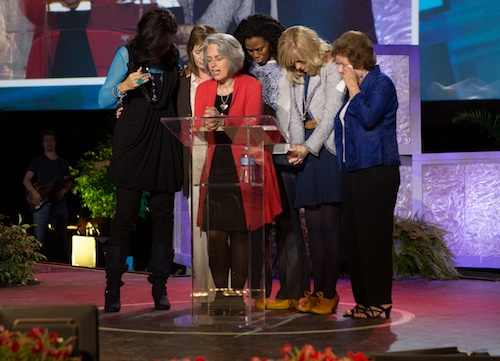
Nancy Leigh DeMoss in 2012 leading other female Bible teachers in a wiccan-originated circle making prayer moment: source FMI

Soul ties are allegedly some kind of tie between people that connect them at a soul level. The connection is usually based on sexual union. It is some kind of intense connection that supposedly entwines one person with another. As this article explains,

In popular usage, a soul tie is a deep emotional or spiritual connection between two individuals. It is believed to bond people on a level that transcends ordinary relationships, often persisting long after a relationship ends. What sets a soul tie apart in popular belief is its intensity, longevity, and impact. … A key point is that a soul tie isn’t always positive or healthy; it can be uplifting or toxic, reflecting the nature of the relationship bond.

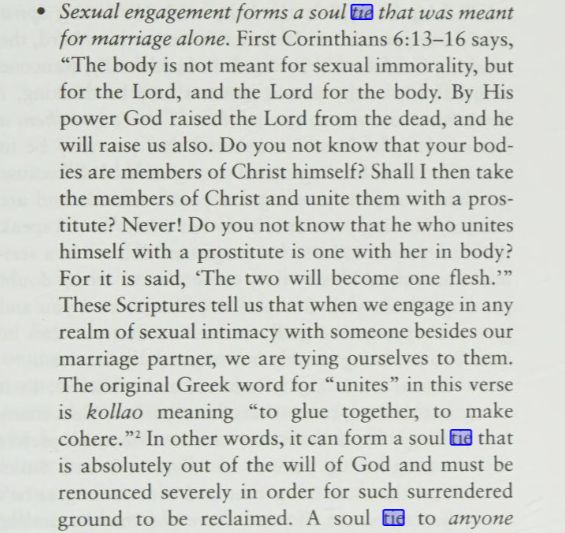
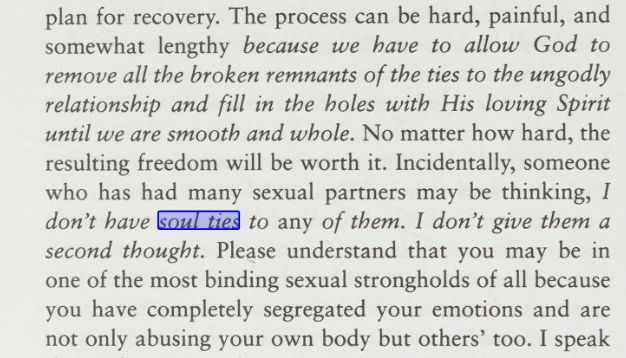
In Beth Moore’s book Praying God’s Word (published 2000) on p. 277-278 Moore is discussing sexual strongholds. She used the term soul ties as one of the reasons people sin sexually. This of course is a Mystical/New Age term and has no business in any Christian book. The only soul we are tied to is Jesus after salvation, as the Holy Spirit comes to indwell us. Even the marital union is one that makes the man and the woman “one flesh,” not ‘one soul’

Here are the screen shots from Moore’s book:

Do you see how an allegedly ‘Christian’ Bible teacher takes a New Age fad and then uses scripture around it to make it a candy coated nugget of garbage? The Corinthians verse is God’s word, but soul ties are Satan’s.

Doreen Virtue was a deeply committed New Ager who blessedly was shown the true faith and she repented. She has renounced all her previous dark teachings and now focuses on the Light of Jesus and His Word. Here on Facebook she mentions ‘soul ties’. I’ll link it but if you don’t have Facebook here is what she said:

The concept of “soul ties” is a new age, not Biblical, belief. Soul ties are NOT in the Bible! Jonathan and David’s friendship and “shall become one flesh” are not about “soul ties.” I should know, because when I was a new age teacher before I was saved, I taught and wrote extensively about soul ties, twin flames, cord connections, etc. I repent and apologize for these false teachings that have now seeped into the church.”

Doreen has a 15 minute video explaining why ‘soul ties’ are not biblical, here.

Soul ties have New Age roots. In the early 1980s many New Age metaphysical books came out. They became influential and propelled ideas from New Age into the mainstream American consciousness. Shirley MacLaine’s Out on a Limb was one of these that became hugely influential, as well as Richard Bach’s metaphysical musings on soul mates in The Bridge Across Forever. From that we morphed into the notion that soul ties are cords of energy linking two people on the planet and even after death linking auras across lifetimes in the cosmos.

GotQuestions has a good essay on soul ties, which they call soul links: What is a soul link?

Fads come and go, but the word of God remains forever.

Phil Johnson, The Flaws of a fad-driven church, part 2: “But that’s how all these fads are crafted. They are deliberately dumbed down, made soft and generic and nonthreatening, so that they don’t rebuke anyone’s sin; they don’t endanger anyone’s shallowness; they don’t threaten anyone’s comfort zone; and they don’t challenge anyone’s worldliness. That’s the way both the publishers and the people want it.“

Friends, when you work in honing your discernment, pray to the Spirit to help you detect if the teacher you are following is properly presenting eternal truths, or teaching passing unbiblical fads wrapped in Christianese talk. They may even (mis)use scripture to do it. Fads are almost always from a different religion. These ideas enter in and try to pollute the faithful, alter the doctrines of God, and sway you from the path of righteousness.

As a result, we are no longer to be children, tossed here and there by waves and carried about by every wind of doctrine, by the trickery of people, by craftiness in deceitful scheming; but speaking the truth in love, we are to grow up in all aspects into Him who is the head, that is, Christ, (Ephesians 4:14-15).

Do not be misled by varied and strange teachings; for it is good for the heart to be strengthened by grace, not by foods, through which those who were so occupied were not benefited. (Hebrews 13:9)

Further Resources

Trying to Understand why Evangelicals quickly chase fads and what actually works

The Flaws of a fad-driven church, part 1

Posted in theology

Jen Wilkin has always been egalitarian, see this from 2015

By Elizabeth Prata

SYNOPSIS: I critique an older essay of Jen Wilkin’s, labeling her a false teacher whose trajectory since 2014 has been downward. I translate her false teacher-speech into what she is really saying, in order to demonstrate that even seemingly soft words and faux-kindness have hidden barbs that destroy. I urge discernment when evaluating their messages.

Continue reading “Jen Wilkin has always been egalitarian, see this from 2015” →
Posted in theology

Born to Be Destroyed: The Stark Language of 2 Peter

By Elizabeth Prata

Something that always surprises me is how tolerant and soft-hearted people are when you mention so-and-so is a false teacher. They look at the person being named as false, and not at Jesus. Certainly they aren’t looking at their Bible. False teachers are of satan. But when you say someone like Joyce Meyer is false, or Beth Moore, they look at Meyer and see a woman who smiles and has a large following and has a Bible in her hand, so they say “But she’s not THAT bad”, or “Have you prayed for her?’ or “Leave her alone- God will sort it out.”

All of those are wrong responses to any named false teacher.

While many people will agree that false teachers exist, when I match the person to the claim, they will balk.

Yet the Bible describes these false ones in the starkest of terms. In just one example, we turn to 2 Peter 2:13-14 which says, ‘they revel in their deceptions’.

suffering wrong as the wages of doing wrong. They count it a pleasure to revel in the daytime. They are stains and blemishes, reveling in their deceptions as they feast with you, 14having eyes full of adultery that never cease from sin, enticing unstable souls, having hearts trained in greed, accursed children;

John MacArthur preached about these false teachers from the 2 Peter 2:13 verse. He said –

“Further describing their action, Peter with obvious disgust says, “They are stains and blemishes.” Boy, those are absolutely vivid words. The word “stains” is the word filth spots, dirt spots. The word “blemish” is the word scab, or the word defect. It is the idea of dirt spots, defects, filth spots, scabs. They pollute. They’re dirty.  They’re foul. They’re diseased. And he says they’re reveling in their deceptions.” Creatures born to be killed.

That means someone like Joyce Meyer is a filth spot. Joel Osteen is a defect. Beth Moore is a scab. THAT is how awful a false teacher is. I’m not saying these things, the Bible is!

Next, do you notice the word revel is used twice in the same verse?! What does revel mean here?

HELPS Word-studies says
tryphḗ (from thryptō, “to break down due to over-indulgence, i.e. living in excessive luxury”) – properly, feebleness brought on by self-indulgence (luxury); (figuratively) moral and spiritual breakdown (“enfeeblement”) from over-indulging in dainty (“delicate”) things, i.e. “dainty living” that deteriorates soul and body.

Their Reveling (2 Peter 2:13–14a), as Warren Wiersbe in The Bible exposition commentary interprets the verse, says-

The words translated “riot” and “sporting” carry the meaning of “sensual reveling.” They also contain the idea of luxury, softness, and extravagance. At the expense of those who support them (2 Peter 2:3), the apostates enjoy luxurious living. In our own society, there are those who plead for funds for their “ministries,” yet live in expensive houses, drive luxury cars, and wear costly clothes. When we remember that Jesus became poor in order to make us rich, their garish lifestyle seems out of step with New Testament Christianity.

Not only do they deceive others, but they even deceive themselves! They can “prove” from the Bible that their lifestyle is right. In ancient times, it was expected that people would revel at night, but these people dared to revel in the daytime, so convinced were they of their practices. A person can become so accustomed to his vices that he sees them as virtues.

These false teachers are born to be killed. Jude 1:4 says certain men were born for condemnation. The 2 Peter verse says they will be destroyed. MacArthur again,

The Greek text actually reads this way, “In their destroying they shall be destroyed.” And that’s…that’s another way to read this, that in the destructive work that they do as they lead people to destruction through their witless, non-reasoning stupidity and living off their passionate instincts, as they consume others in that operation, they will themselves be consumed. They are abandoned to destruction, born for the flesh, born to perish. Sermon- Creatures born to be killed part 1.

It is important to look at the Bible when discerning about false teachers. Because we are sinners, our sin clouds our judgment of others when assessing their output against the Bible. We need the clear word of God to remind us that these teachers whose father is satan, are not just as good as us or just as bad as us. Do not think, “Well, no one is perfect”, or “Well, I sin too.” False teachers are an entirely different beast.

These are springs without water and mists driven by a storm, for whom the black darkness has been reserved. (2 Peter 2:17).

Springs without water are empty, like the promises of false teachers. They are reserved for blackest darkness in the future. Don’t follow them.

Posted in theology

Why should the church always be on guard?

By Elizabeth Prata

The Lord will build His church. It will never fail. That’s not to say that it won’t be under attack. It’s under attack every day. So the Holy Spirit inspired the Bible authors to warn us in many of the books to stay vigilant.

From the John MacArthur Daily Bible, entry on July 18,

Why should the church always be on guard?

“Paul told the Ephesians that he had declared to them “the whole purpose of God” (Ac 20:27). The entire plan and purpose of God for man’s salvation in all its fullness: divine truths of cre ation, election, redemption, justification, adoption, conversion, sanctification, holy living, and glorification. And now that he was leaving, he gives them a warning.”

“False teachers were already plaguing the churches of Galatia (Gal 1:6) and the Corinthian church (2Co 11:4). “Be on guard for yourselves” (v. 28), a warning that proved true by later events at Ephesus (1Ti 1:3-7, 19-20; 6:20-21; Rev 2:2). Paul repeated this call to self-examination to Timothy when his young son in the faith served as pastor of the Ephesian congregation (1Ti 4:16; 2Ti 2:20-21). The “overseers” are the same as elders and pastors. The word stresses the leaders’ responsibility to watch over and protect their congregations- an appropriate usage in the context of a warning against false teachers. Church rule, which minimizes the biblical authority of elders in favor of a cultural, democratic process, is foreign to the New Testament (1Th 5:12, 13; Heb 13:17).”

“He warns of “savage wolves” (v. 29)-a term borrowed from Jesus (Mt 7:15; 10:16). This metaphor stresses the extreme danger false teachers pose to the church. “From among your own selves” (v. 30). Even more deadly than attacks from outside the church are the defections of those (especially leaders) within the church (1Ti 1:20; 2Ti 1:15; 2:17; Jude 3, 4, 10-13). These wolves would speak “perverse things.” The Greek word means “distorted” or “twisted.” False teachers twist God’s Word for their own evil ends (13:10; 2Pe 3:16).”

“And now I commend you to God and to the word of His grace, which is able to build you up” (v. 32). The Scriptures, the record of God’s gracious dealings with mankind, is the source of spiritual growth for all Christians. And since the church is “the pillar and support of the truth” (1Ti 3:15), its leaders must be familiar with that truth.” –end quoted MacArthur Bible entry


Stay vigilant. Be vigilant of our flesh and kill our own sin. Be vigilant over what we absorb from the world, which is at odds with the Lord Jesus. Stay vigilant over enemies and spies who come into the church, either your physical church or the digital Christian world via speeches, books, podcasts and the like. Jesus commended the church at EPhesus for being vigilant-

I know your deeds and your labor and perseverance, and that you cannot tolerate evil people, and you have put those who call themselves apostles to the test, and they are not, and you found them to be false; and you have perseverance and have endured on account of My name, and have not become weary. (Revelation 2:2-3).

How do we remain on guard but not get weary expending that energy? Rely on the Lord. His sustenance is the word, prayer, and fellowship with the saints. These things revive us.

Posted in theology

Recognizing Rebellion Behind the Pulpit

By Elizabeth Prata

SYNOPSIS: This article examines the question of persistent, public disobedience among self-professing Christian women who preach and teach in defiance of biblical commands. It urges discernment, humility, and repentance, arguing that ongoing rebellion against Scripture raises serious concerns about genuine faith.

Continue reading “Recognizing Rebellion Behind the Pulpit” →