By Elizabeth Prata

My “Cut To the Chase” articles are shorter form, bulleted discernment outlines, rather than a longer essay.
@JustinPetersMin wrote, “Experiencing God was one of the most damaging books introduced to the evangelical world in over a hundred years.”
That us a lot of power in a book. False doctrine does not only emerge from the pulpit. In fact, it is more likely to emerge from the tangential ministries in a church, such as the women’s Bible study, the church Library, or brought in as evil seeds from external conferences members attend elsewhere.
Why was “Experiencing God” so damaging? Let’s take a look.
Issue #1: Normalizing hearing from God
5 Solas wrote on X about Blackaby and Experiencing God, “The false teaching that the way God speaks to His people under the New Covenant is audibly or internally by some “still small voice,” and not through His all-sufficient written Word, has done unimaginable harm to the church. The idea that it’s not a personal relationship unless you are hearing voices or getting impressions is damnable. You are essentially saying that God doesn’t speak through His Word.”
This issue relates to the “Sufficiency of Scripture.” We often refer to 2 Timothy 3:16-17 when saying that God’s written word as contained in the 66 books of the Bible is enough for the Christian to learn, absorb, and live by. We do not see and interpret signs or omens, hear whispers, or listen to audible voices directing our steps. The verse says:
All Scripture is inspired by God and beneficial for teaching, for rebuke, for correction, for training in righteousness; so that the man or woman of God may be fully capable, equipped for every good work.
Note the words- All, fully, every. Those words are quantifiers that indicate total, complete, or inclusive quantity. Note what the Bible is good for- all the things a Christian might need to do- teaching (and learning), training, rebuking. Note the benefits of living by the Word only- righteousness, capable, equipped.
How many verses does one need when we have such a perfect description of the Christian life right there in 2 Timothy? But wait, there’s more: Hebrews 4:12, Romans 15:4, Matthew 4:4 and other verses reinforce the sufficiency of God’s word alone.
Issue #2: Believing we can see where God is working
A refrain comes up frequently in the book: “watch to see where God is working and join Him in His work.”
One question: Where ISN’T God working? There is not one molecule not under his jurisdiction, command, and movement. If there is one maverick molecule in the universe (as Sproul famously said) then God is not God, not in control, and not working. It would invalidate His divine sovereignty.
One thought: Do we, being sinners with sin-darkened minds and a finite perspective, have the intelligence to see and know exactly where God is doing a work? The way Providence operates is that it sometimes can be seen but only AFTER the work is done.
One warning: God doesn’t ‘invite’ us to join Him. He commands us to do His will. Working out our salvation with fear and trembling and pursuing holiness is not a cafeteria experience of choosing. ‘I want to join Him there, but not there, that looks uncomfortable…’
Issue #3: That we can come to know God through our own, self-interpreted experiences
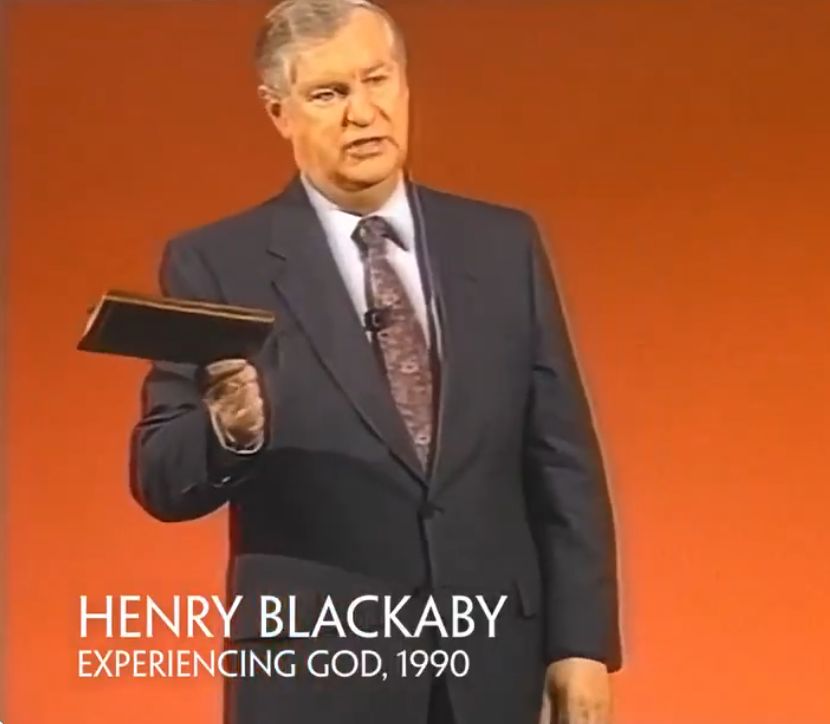
In the book, Blackaby (and co-author Claude King) constantly prioritize personal experience over the commands of God through scripture. From the book blurb at Lifeway: “God is inviting you into an intimate love relationship through which He reveals to you His will, His ways, and His work” but the book teaches that He does this not through scripture, but through our experiences and observations.
We don’t come to know God by looking around and observing. Romans 1 teaches that the danger in doing this is that we begin to worship the creation and not the creator.
Justin Peters said in his teaching linked below that, in “Experiencing God, Henry Blackaby says this: “If you have troubling hearing God speak, you are in trouble at the very heart of your Christian experience.”
That is a dire warning that Blackaby and King issued in their book. ARE we in trouble is we don’t hear God speak? Many conscientious and committed Christians would not want to make a mistake in failing to do something God wants us to do, so they would in all diligence strain to listen. Others who are not as conscientious but are more prideful would seize that claim and puff themselves up as conduits for God. Many professing Christians did just that and claims began popping up like multiplying viruses that various people claimed to hear from God all the time and ‘He said…’
Peters continued, “I would submit to you that the resource, the book that is singularly most responsible for introducing charismatic theology into at least theoretically non-charismatic churches is Experiencing God by Henry Blackaby that came out in 1991. If you go back before 1991, at least in non-charismatic churches, almost everyone would have understood that God speaks to us through the Bible, we speak to Him in prayer. Today hardly anybody understands that; and I believe experiencing God is singularly most responsible for introducing these notions into non-charismatic churches.” –end Justin Peters quote.
The Bible is the most trustworthy source for living life under God’s heaven, for understanding HIs will, and for how to pursue holiness. God gave us His book and that is where He speaks, nowhere else. Avoid “Experiencing God” and experience living by His word from the Bible instead.
“The book that is singularly most responsible for introducing charismatic theology into at least theoretically non-charismatic churches is Experiencing God by Henry Blackaby…” said Justin Peters at the 2019 Truth Matters Conference.
Bob Dewaay at Critical Issues Commentary: Unbiblical Teachings on Prayer and Experiencing God
Book: God Doesn’t Whisper by Jim Osman (Author)

 the-end-time.org
I sure do appreciate your insights. I simply cannot thank you enough. Suzanne
LikeLike
Thank you for posting this. Blackaby’s book was recently recommended as a Sunday school class at my church, but because I had read “God Doesn’t Whisper” by Jim Osman, I knew the issues with it. I brought it to the attention of my pastor and the class didn’t happen. Christians must be more discerning about what they are consuming outside Scripture, whether books, movies, podcasts, music, etc. Not everything labeled as Christian really is.
LikeLike
I’m so glad that your concerns were heard and the class didn’t happen.
LikeLike