

My posts on the resignation of the Pope and the resulting discussion that the Roman Catholic Church is a false church has received more views than any post I’ve ever done, by at least double. Not only is it huge news that the Pope resigned, but it is news to many when someone declares flatly that the RCC is a false church and it promotes doctrines of demons.
(Left, Pope Pius IX, was the longest-reigning elected Pope in the history of the Catholic Church, serving from 16 June 1846 until his death, nearly 32 years. During his pontificate, he convened the First Vatican Council in 1869, which decreed papal infallibility. He also defined the dogma of the Immaculate Conception of the Blessed Virgin Mary, meaning that Mary was conceived without original sin. Previously, those doctrines were not an official part of Catholic dogma.)
Here are the three posts I’ve written about the RCC Pope, and the Prophecy of the Popes:
1. December 2011, Pope Benedict’s health failing, St. Malachy’s prophecy comes up again
2. February 2013, Pope Benedict resigned- will the next pope validate Malachy’s prophecy?
3. February 2013, Catholicism is not a Christian religion
The comments have been respectful for the most part. I have only had to delete a few out of hand for profanity or for not adding anything to the discussion (i.e. ‘You’re all nuts!” kinds of comments get deleted. At least tell us WHY you think we’re nuts…lol). Thank you all for reading and commenting.
In the comment section yesterday, someone had asked about how to witness to Catholics. It was a good question, and I responded. I thought I’d make my response be a post by itself. This is that post.
Any religion besides Christianity, which is to say, every other religion, promotes some form of works toward a person’s salvation. I say again, all other religions in some form or fashion are a works-based religion. How do I know this? Because there is grace, and works. Christianity is a grace based religion. Salvation comes because of the grace bestowed on penitents who believe in the atoning sacrifice of Jesus and His resurrection. He is the only God who can and who does bestow grace, absolve sins, and resurrect the dead. No other religious figure can do that because no other figure has risen from the dead. Therefore in the false religions, lacking the one thing that can actually save a person, the proponents of these false religions add works to their schema to cover the deficit.
In attempting to attain heaven by his own efforts, man forgets how holy God is and how lowly and polluted with sin we are. Attempting offer works to Jesus as an entry validation is like offering Jesus a filthy rag as your best effort. Isaiah 64:6a says-
We have all become like one who is unclean, and all our righteous deeds are like a polluted garment.
Not to get too graphic, but the word for polluted garment is actually Hebrew for used menstrual rag. Believing we can get to heaven on our own works means when you stand before Holy God, and we all will, you will in effect hold out a used and crusty Tampax, and say “Here is a gift for you, Jesus, these are my works. Now I can go into heaven, right?”
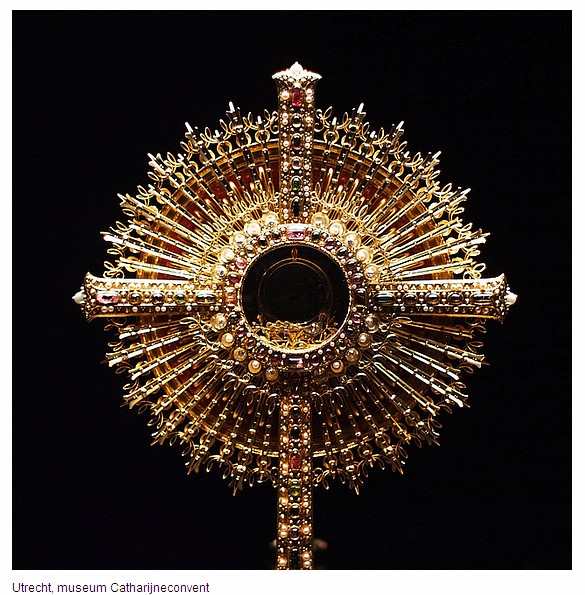
Unappealing, right? God hates sin and cannot even look at sin or the sinner. He is angry over sin. He is personally angry with you by name, over your sin. (Exodus 4:14; 15:7; Leviticus 26:27-33; Numbers 11:1; 12:9; 22:22; 25:3; Deuteronomy 3:17; 29:24-29; Joshua 7:1; Judges 2:14; 2 Samuel 24:1; 1 Kings 14:15; 15:30; 16:2; 25:53; 2 Kings 13:3; 17:11; 23:19; 1 Chronicles 13:10; 2 Chronicles 28:25; Psalm 7:11; 11:4-7; Hebrews 10:27). (Right, Monstrance, a vessel used to show the consecrated Eucharistic host; Utrecht Museum, by Johan)
Get the idea? There is only His grace, and our works. His grace is pure and holy, and our works are a used tampon.
Buddhism, though seemingly altruistic in their promotion of good deeds toward others, is really at root a works based religion because one must work on one’s self before one can attain a state of nirvana. A Buddhist must work on their attitude toward worldly attachments, and once releasing all attachment to any self-desires, can then turn around and help others. Buddhism is an inward works based religion. I know I’m generalizing here, but you get the idea in broad strokes. A Buddhist must work on himself before attaining happiness and being able to help others.
Islam is the same but different. Allah’s grace descends upon the believer but the person must perform good works toward others. The entry into paradise for the Muslim is dependent upon a combination of grace and works. If the Muslim has performed more good works than bad, he’s in. However, the believer never quite knows where he stands…so the tension inside their heart is very heavy. To make matters worse, the Koran states that both good and evil come from Allah, and he is capricious. When you get to Allah’s Paradise gate good deeds may indeed outweigh the bad, but Allah may say “begone with you” anyway. The only sure way to please Allah for sure and make it into an Islamic paradise is to be a suicide martyr. And now you know why they line up for the job…
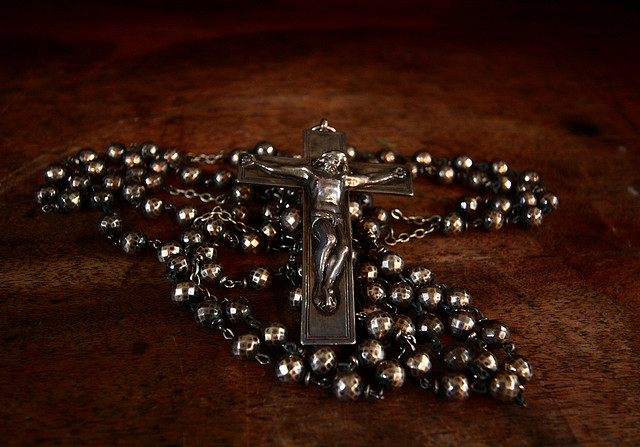
In Catholicism, works also figures in. God’s grace is upon the believer, but that grace is only an enabling function. It enables one to do good works and it is that which they will be judged as worthy or not for heaven.
In Christianity, we receive a free gift when God says, ‘you believe on the Son, therefore I declare you innocent of your sins, justified in My eyes.” (Titus 3:7). In the RCC, justification is denied.
- If any one saith, that by faith alone the impious is justified; in such wise as to mean, that nothing else is required to co-operate in order to the obtaining the grace of Justification, and that it is not in any way necessary, that he be prepared and disposed by the movement of his own will; let him be anathema” (Council of Trent, Canons on Justification, Canon 9)
- “If any one saith, that man is truly absolved from his sins and justified, because he assuredly believed himself absolved and justified; or, that no one is truly justified but he who believes himself justified; and that, by this faith alone, absolution and justification are effected; let him be anathema.” (Canon 14).
Anathema means excommunicated from the body of believers or it means cursed, usually both. The RCC does not come right out and say ‘you must work for salvation’ but that is what they teach. You can read here an essay outlining the key differences between Catholic and Christian doctrines.
One of the biggest burdens in all works-related salvation schemes, Catholicism included, is a secret, nagging fear and burden in the person that they may not be ‘doing enough.’ Mormons are particularly burdened with these secret thoughts, which they rarely verbalize, but are there. Catholics have these interior fears as well, because they are taught that they must maintain their salvation. As any sinner knows, even those who are thoroughly saved and rest on Jesus’s grace alone, we stagger with our conscience in knowing how desperately wicked we are. So any person depending on works in any way for their salvation will always fear they are missing the mark. Catholics are always worried. They have to be, they have no assurance of their salvation!
“If you could lose your salvation, you would.”
As John MacArthur replied once when asked about salvation, “if you could lose your salvation, you would.” That simple truth cuts right to the heart of works-based religions. Imagine the fear and burden of a Catholic wondering if they have recovered from their last sin enough. If they said enough hail Marys. If they will go to purgatory or heaven…
In witnessing to a Catholic, I think that focusing on the simplicity and perfection of grace alone will go a long way toward penetrating a Catholic’s mind and heart, because that is where the anxiety is, in my opinion. Humans simply do not have the perseverance to live a sinless life. Humans are not capable of accumulating enough resources to reach heaven. Only Jesus did that. People in works-based religions are always wondering, “Have I done enough?”
 |
| photo credit: John Steven Fernandez via photopin cc |
In the faith that Jesus delivered to the saints once for all, HE is the one who did enough! We can have assurance of the perfection and completion of His work because God accepted Jesus as the sacrifice, raising Him from the dead. His grace is sufficient for all believers, no more works are needed, because as Jesus said,

John 19:30 records the last words of Jesus in His earthly ministry. It is finished means “As if he had said: “I have executed the great designs of the Almighty – I have satisfied the demands of his justice – I have accomplished all that was written in the prophets, and suffered the utmost malice of my enemies; and now the way to the holy of holies is made manifest through my blood.” An awful, yet a glorious finish. Through this tragical death God is reconciled to man, and the kingdom of heaven opened to every believing soul.” (Clarke’s Commentary on the Bible)
It is awful, as Clarke said, but it is simple. We only need to believe on the work of Jesus through the cross to be saved. It sounds so uncomplicated, doesn’t it? It is. The layers of works and tradition that the RCC has overlaid on this simple and awful-beautiful truth is the monstrous thing. Laying our works on His work is grotesque. Believe on the Son and be saved, beloved. How can one be saved? I will say again, using the words of the Holy Spirit,
cross photo credit: Christopher JL via photopin cc
rosary photo credit: Lawrence OP via photopin cc

 the-end-time.org